The widespread use of smartphones has been a significant technological development of the 21st century. Excessive and incorrect use of smartphones may lead to Musculoskeletal Disorders (MSDs) that can impact the neck, shoulders, arms, hands and wrists [1]. One such condition is De Quervain’s Tenosynovitis (DQT), also known as De Quervain’s Disease (DQD). The increase in smartphone usage has been recognised as a major factor contributing to the rising incidence of DQT [2]. DQT is a painful condition affecting the tendons on the lateral side of the wrist, where patients may experience numbness, tingling, burning and cramping in addition to pain. The condition arises from inflammation of the tendons that control thumb movement, particularly the Abductor Pollicis Longus (APL) and Extensor Pollicis Brevis (EPB) [3]. These tendons pass through a narrow tunnel known as the first extensor compartment of the wrist, which is a fibro-osseous sheath that undergoes constriction and inflammation in cases of DQT [4].
The peak incidence of DQT occurs in individuals in their 40s and 50s and the prevalence is higher in women than in men [5]. Repeated thumb movements and prolonged awkward hand postures related to smartphone use, such as texting and gaming, have been linked to the onset of DQT [6]. Problematic smartphone use is associated with the prevalence of DQT in empirical studies. For instance, a study of college students in Guangxi, China, found that smartphone use-particularly for games and social media-was linked to an increased risk of DQT [6]. Furthermore, research by Benites-Zapata VA et al., found a higher prevalence of DQT symptoms in individuals with problematic smartphone use [7].
Although the studies cited above have established an association between DQT and problematic phone usage, there has been no evaluation of smartphone handling techniques, such as horizontal versus vertical screen orientation and the various usage gestures. The present study aimed to elucidate the correlation between problematic smartphone usage and the gestures associated with using smartphones that are related to the development of DQT, as well as to assess its physical impact on daily activities using the VAS, Patient-rated Wrist/Hand Evaluation (PRWE) and Quick Disabilities of the Arm, Shoulder and Hand (DASH) scores.
Materials and Methods
This was a cross-sectional observational study conducted at the Department of Orthopaedics, SRM Medical College Hospital and Research Centre, SRM Institute of Science and Technology, Chengalpattu, Tamil Nadu, India, from July 2024 to September 2024. Approval from the Institutional Ethics Committee was exempted because it was a cross-sectional observational study.
Inclusion and Exclusion criteria: The present study included participants aged 20-50 years presenting to the Outpatient Department (OPD) with wrist and hand pain, who were willing to share their smartphone usage behaviour. Patients with a history of wrist injury, previous upper limb surgery, inflammatory joint disorders, congenital anomalies, pregnancy, lactation, a family history of DQT, or lateral/medial epicondylitis were excluded.
Sample size calculation: A sample size of 300 patients was classified into two groups based on the results of Finkelstein’s Test. The sample size was calculated with an estimated prevalence of 50% for DQT, with 95% confidence and a 5% margin of error (Ali M et al., [8]).
Study Procedure
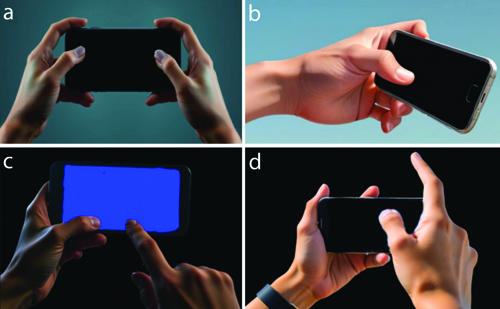
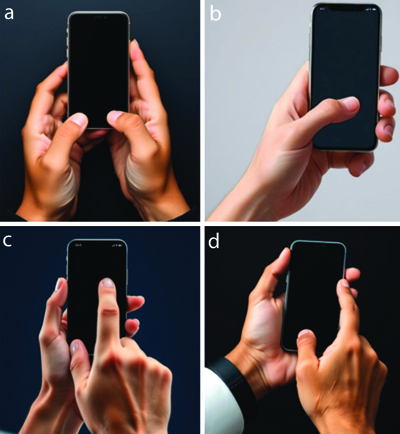
Patients meeting the inclusion criteria were included in the study. Participants were classified into two groups based on the results of Finkelstein’s Test [9]: Group 1 (positive test, indicating DQT) and Group 2 (negative test, no DQT). A self-prepared questionnaire [ANNEXURE-1] was used to assess smartphone usage patterns. This questionnaire included details about daily smartphone usage hours, screen size, most frequently used activities (e.g., texting, gaming, browsing, scrolling) and the most commonly used screen orientation (horizontal or vertical) with gestures while using the smartphone [Table/Fig-1a-d,2a-d]. The collected data evaluated demographic information, usage patterns and gesture distribution. Additionally, patients were classified into unilateral and bilateral DQT based on clinical examination and Finkelstein’s Test results. This comparison will help assess whether problematic smartphone usage patterns contribute differently to unilateral versus bilateral cases.
Graphical image: Horizontal screen orientation commonly used gestures; a) Horizontal screen Both Thumb-Both Hand Grip (HBT-BHG); b) Horizontal screen Unilateral thumb-Isolated Hand Grip (HUT-IHG); c) Horizontal screen Unilateral Index finger-Other Hand Grip (HUI-OHG); d) Horizontal screen Unilateral Thumb-Other Hand Grip (HUT-OHG).
Graphical image: Vertical screen orientation commonly used gestures: a) Vertical screen Both Thumb-Both Hand Grip (VBT-BHG); b) Vertical screen Unilateral thumb-Isolated Hand Grip (VUT-IHG); c) Vertical screen Unilateral Index finger-Other Hand Grip (VUI-OHG); d) Vertical screen Unilateral Thumb-Other Hand Grip (VUT-OHG).
Pain intensity was assessed using the VAS [10]. For the purpose of the present study, scores were categorised as follows: 0 (no pain), 1-2 (mild pain), 3-4 (moderate pain), 5-7 (severe pain) and 8-10 (extreme pain). Functional disability of the upper limb was measured using the Quick DASH questionnaire score [11], which provides a score ranging from 0-100, with higher scores indicating greater disability. For the present study, the scores were divided into five categories: 0-20 (minimal disability); 21-40 (mild disability); 41-60 (moderate disability); 61-80 (severe disability); and 81-100 (extremely severe disability). Similarly, for better interpretation of results, the PRWE questionnaire score [12,13], which also provides a score of 0-100 with higher scores indicating greater disability, was divided into the following sub-scores: 0-24 (minimal pain and minimal disability); 25-49 (mild pain and mild disability); 50-74 (moderate pain and moderate disability); and 75-100 (severe pain and severe disability).
Statistical Analysis
The statistical analysis was performed using IBM Statistical Package for Social Sciences (SPSS) version 23.0. The qualitative variables were expressed as numbers and percentages. The Chi-square test was used to analyse the results, with a p-value of ≤0.05 considered statistically significant. The qualitative variables were described as mean±standard deviation. Analysis of variance was used to analyse qualitative variables.
Results
A total of 300 participants were divided into two groups based on Finkelstein’s Test, Group 1 (n=190) and Group 2 (n=110). Participants in Group 1 were predominantly aged 20-30 years 146 (76.8%), whereas those in Group 2 were primarily aged 31-40 years 37 (33.64%). A significant difference (p-value <0.0001*) was found between the age groups. Females (61.05%) had a greater incidence of DQT than males (p-value=0.0022*). Daily smartphone usage demonstrated a significant association with DQT, as 40% of DQT-positive individuals (n=76) used their phones for over eight hours per day, while the majority of DQT-negative individuals engaged in usage for less than four hours (p-value <0.0001*). Screen size and smartphone activities did not indicate any significant association with DQT. However, horizontal screen orientation was more prevalent among DQT-positive individuals (p-value=0.0168*) [Table/Fig-3].
Demographic characteristics and smartphone usage patterns.
| Demographic characteristics and smartphone usage patterns | Group 1(n=190) | Group 2(n=110) | p-value |
|---|
| Age (in years) | 20-30 | 146 (76.8%) | 37 (33.64%) | <0.0001* |
| 31-40 | 38 (20%) | 63 (57.27%) |
| 41-50 | 6 (3.2%) | 10 (9.09%) |
| Gender (M/F) | Male | 74 (38.95%) | 63 (57.27%) | 0.0022* |
| Female | 116 (61.05%) | 47 (42.73%) |
| Type of DQT | Unilateral | 110 (57.89%) | - | - |
| Bilateral | 80 (42.11%) | - |
| Daily usage (hours) | <4 | 49 (25.79%) | 63 (57.27%) | <0.0001* |
| 4-8 | 65 (34.21%) | 32 (29.09%) |
| >8 | 76 (40%) | 15 (13.64%) |
| Screen size (inches) | ≤5.0 | 19 (10%) | 17 (15.45%) | 0.1810 |
| 5.1-6.0 | 57 (30%) | 38 (34.55%) |
| 6.1-7.0 | 114 (60%) | 55 (50%) |
| Most used activity | Gaming | 86 (45.26%) | 41 (37.27%) | 0.2095 |
| Texting | 53 (27.89%) | 32 (29.09%) |
| Scrolling | 38 (20%) | 22 (20%) |
| Videos | 13 (6.84%) | 15 (13.64%) |
| Screen orientation | Horizontal | 98 (51.58%) | 41 (37.27%) | |
| Vertical | 92 (48.42%) | 69 (62.73%) | 0.0168* |
There were no significant differences between Group 1 and Group 2 in the use of HUT-OHG, HUI-OHG, HUT-IHG and HBT-BHG gestures. However, Group 2 showed that the VUT-OHG gesture was the second most commonly used gesture, indicating a lower incidence of DQT with this gesture. A highly significant difference was observed in the use of the VUI-OHG gesture, with Group 2 demonstrating it as the most commonly used gesture, which was associated with a lower incidence of DQT (p-value=0.0005). No significant differences were found between the two groups in the use of the VUT-IHG and VBT-BHG gestures [Table/Fig-4].
Comparison of common hand gestures usage between Group 1 (Finkelstein Test positive) and Group 2 (Finkelstein Test negative) (N=300).
| Gestures | Group 1(n=190) | Group 2(n=110) | p-value |
|---|
| HUT-OHG | 11 (5.79%) | 3 (2.73%) | 0.2268 |
| HUI-OHG | 13 (6.84%) | 6 (5.45%) | 0.6343 |
| HUT-IHG | 29 (15.26%) | 12 (10.91%) | 0.2913 |
| HBT-BHG | 45 (23.68%) | 20 (18.18%) | 0.2659 |
| VUT-OHG | 11 (5.79%) | 14 (12.73%) | 0.0364* |
| VUI-OHG | 17 (8.95%) | 26 (23.64%) | 0.0005* |
| VUT-IHG | 29 (15.26%) | 14 (12.73%) | 0.5474 |
| VBT-BHG | 35 (18.42%) | 17 (15.45%) | 0.5132 |
HBT-BHG: Horizontal screen both thumb-both hand grip; HUT-IHG: Horizontal screen unilateral thumb-isolated hand grip; HUI-OHG: Horizontal screen unilateral index finger-other hand grip; HUT-OHG: Horizontal screen unilateral thumb-other hand grip; VBT-BHG: Vertical screen both thumb-both hand grip; VUT-IHG: Vertical screen unilateral thumb-isolated hand grip; VUI-OHG: Vertical screen unilateral index finger-other hand grip; VUT-OHG: Vertical screen unilateral thumb-other hand grip
Unilateral DQT was most commonly associated with the HUT-IHG gesture, followed by the VUT-IHG and HUI-OHG gestures, with these differences being statistically significant (p-value <0.05). For bilateral DQT, the most common gesture was HBT-BHG, followed by VBT-BHG, both showing statistically significant differences. No significant differences were found between unilateral and bilateral DQT in the use of the HUT-OHG, VUT-OHG and VUI-OHG gestures [Table/Fig-5].
Comparison of hand gestures between unilateral and bilateral DQT.
| Gestures Finkelstein’s test positive (n=190) | Unilateral DQT(n=110) | Bilateral DQT(n=80) | p-value |
|---|
| HUT-OHG | 8 (7.27%) | 3 (3.75%) | 0.3062 |
| HUI-OHG | 11 (10%) | 2 (2.5%) | 0.0438* |
| HUT-IHG | 26 (23.64%) | 3 (3.75%) | 0.0002* |
| HBT-BHG | 11 (10%) | 34 (42.5%) | <0.0001* |
| VUT-OHG | 6 (5.45%) | 5 (6.25%) | 0.8161 |
| VUI-OHG | 10 (9.09%) | 7 (8.75%) | 0.9356 |
| VUT-IHG | 24 (21.82%) | 5 (6.25%) | 0.0033* |
| VBT-BHG | 14 (12.73%) | 21 (26.25%) | 0.0179* |
HBT-BHG: Horizontal screen both thumb-both hand grip; HUT-IHG: Horizontal screen unilateral thumb-isolated hand grip; HUI-OHG: Horizontal screen unilateral index finger-other hand grip; HUT-OHG: Horizontal screen unilateral thumb-other hand grip; VBT-BHG: Vertical screen both thumb-both hand grip; VUT-IHG: Vertical screen unilateral thumb-isolated hand grip; VUI-OHG: Vertical screen unilateral index finger-other hand grip; VUT-OHG: Vertical screen unilateral thumb-other hand grip
In Group 1, the HUT-OHG gesture was used by 11 participants (5.79%), resulting in mild disability scores. The VUT-IHG gesture was used by 29 participants (15.26%) and the VBT-BHG gesture was used by 35 participants (18.42%), both of which were associated with severe pain and moderate disability scores [Table/Fig-6].
Assessment of VAS, PRWE and Quick-DASH scores in participants with DQT (Group 1).
| Gestures | Group 1 (n=190) | VAS | PRWE | Quick DASH |
|---|
| HUT-OHG | 11 (5.79%) | 4.36±0.67 | 46.64±6.76 | 36.55±7.63 |
| HUI-OHG | 13 (6.84%) | 3.92±0.95 | 40.46±7.22 | 31.38±7.52 |
| HUT-IHG | 29 (15.26%) | 5±0.85 | 50.83±5.64 | 40.93±9.54 |
| HBT-BHG | 45 (23.68%) | 6.98±0.87 | 65.49±5.68 | 55.73±5.82 |
| VUT-OHG | 11 (5.79%) | 4.09±0.83 | 29.64±5.35 | 24.63±3.5 |
| VUI-OHG | 17 (8.95%) | 4.05±0.83 | 26.94±2.61 | 22.94±2.05 |
| VUT-IHG | 29 (15.26%) | 5.22±0.83 | 55.17±10.7 | 45±5.66 |
| VBT-BHG | 35 (18.42%) | 5.97±0.75 | 59.94±8.44 | 50.31±9.44 |
VAS: Visual analogue scale; PRWE: Patient-rated wrist/hand evaluation; Quick DASH: Disabilities of the arm, shoulder and hand; HBT-BHG: Horizontal screen both thumb-both hand grip; HUT-IHG: Horizontal screen unilateral thumb-isolated hand grip; HUI-OHG: Horizontal screen unilateral index finger-other hand grip; HUT-OHG: Horizontal screen unilateral thumb-other hand grip; VBT-BHG: Vertical screen both thumb-both hand grip; VUT-IHG: Vertical screen unilateral thumb-isolated hand grip; VUI-OHG: Vertical screen unilateral index finger-other hand grip; VUT-OHG: Vertical screen unilateral thumb-other hand grip
In Group 2, the HUT-OHG gesture was used by 3 participants (2.73%), resulting in mild pain and minimal disability scores. Similarly, the HUI-OHG gesture was used by 6 participants (5.45%) and exhibited mild pain and minimal disability scores. The VUT-OHG gesture was used by 14 participants (12.73%) and the VUI-OHG gesture was used by 26 participants (23.64%), both displaying mild pain and minimal disability scores [Table/Fig-7].
Assessment of VAS, PRWE and Quick-DASH scores in participants without DQT (Group 2).
| Gestures | Group 2 (n=110) | VAS | PRWE | Quick-DASH |
|---|
| HUT-OHG | 3 (2.73%) | 1.02±0.32 | 14.43±4.24 | 11.67±3.56 |
| HUI-OHG | 6 (5.45%) | 1.09±0.29 | 12.28±3.56 | 10.33±2.88 |
| HUT-IHG | 12 (10.91%) | 2.21±1.41 | 16.06±6.82 | 12.55±3.12 |
| HBT-BHG | 20 (18.18%) | 3.12±1.18 | 22.82±5.66 | 18.62±4.36 |
| VUT-OHG | 14 (12.73%) | 1.13±0.03 | 10.55±4.86 | 9.88±1.98 |
| VUI-OHG | 26 (23.64%) | 1.07±0.12 | 8.37±4.33 | 5.74±1.04 |
| VUT-IHG | 14 (12.73%) | 3.14±1.13 | 18.54±5.34 | 14.48±2.84 |
| VBT-BHG | 17 (15.45%) | 3.18±1.43 | 20.64±6.35 | 16.32±4.6 |
VAS: Visual analogue scale; PRWE: Patient-rated wrist/hand evaluation; Quick DASH: Disabilities of the arm, shoulder and hand; HBT-BHG: Horizontal screen both thumb-both hand grip; HUT-IHG: Horizontal screen unilateral thumb-isolated hand grip; HUI-OHG: Horizontal screen unilateral index finger-other hand grip; HUT-OHG: Horizontal screen unilateral thumb-other hand grip; VBT-BHG: Vertical screen both thumb-both hand grip; VUT-IHG: Vertical screen unilateral thumb-isolated hand grip; VUI-OHG: Vertical screen unilateral index finger-other hand grip; VUT-OHG: Vertical screen unilateral thumb-other hand grip
Group 1 reported a significantly higher mean pain intensity VAS score of 5.43±1.34 (severe pain) compared to Group 2’s score of 2.3±1.02 (mild pain) (p-value <0.0001). The mean PRWE score for Group 1 was 42.67±14.24 (mild disability), which was significantly higher than Group 2’s score of 15.54±8.46 (minimal disability), indicating greater disability in Group 1, which is statistically significant (p-value <0.0001*). Similarly, Group 1 had a Quick DASH score of 38.45±12.52 (mild disability), compared to Group 2’s score of 11.96±6.68 (minimal disability), which is statistically significant (p-value <0.0001*) [Table/Fig-8].
Comparison of VAS, PRWE and Quick-DASH scores between Group 1 and Group 2.
| Physical impact score | Group 1(n=190) | Group 2(n=110) | p-value |
|---|
| VAS score | 5.43±1.34 | 2.3±1.02 | <0.0001* |
| PRWE score | 42.67±14.24 | 15.54±8.46 | <0.0001* |
| Quick-DASH score | 38.45±12.52 | 11.96±6.68 | <0.0001* |
VAS: Visual analogue scale; PRWE: Patient-rated wrist/hand evaluation; Quick DASH: Disabilities of the arm, shoulder and hand;
Discussion
In the present study, it was found that using phones for over eight hours per day and employing a horizontal screen orientation were associated with the development of DQT, resulting in moderate disability scores that affected daily activities. The HBT-BHG gesture was the most commonly used in Group 1 (Finkelstein test-positive), while the VUI-OHG gesture was the most commonly used in Group 2 (Finkelstein test-negative). The HUT-IHG and VUT-IHG gestures were common in Unilateral DQT. The HBT-BHG and VBT-BHG gestures were the most commonly used in Bilateral DQT. Participants in Group 1 (Finkelstein test-positive) experienced higher pain intensity (VAS score) and moderate disability (Quick DASH and PRWE scores), whereas Group 2 reported minimal pain (VAS score) and minimal disability (Quick DASH and PRWE scores).
Benites-Zapata VA et al., found that problematic phone usage increases the risk of DQT in young adults [7]. This aligns with the observation that the majority of participants affected by DQT in the present study were aged between 20 and 30 years. Wolf JM et al., reported that women had a considerably elevated incidence of DQT, with an incidence of 2.8 per 1,000 persons/year, while men had an incidence of 0.6 per 1,000 persons/year [14]. Similarly, the present study revealed a higher proportion of females in the Finkelstein test-positive group (61.05%). They also noted that the incidence of DQT increases with age, particularly in individuals over 40 years old [14].
Morshed MK et al., suggested that extended daily smartphone usage, especially in younger age groups and the use of smaller-screen smartphones may increase the incidence of DQT in young people [15]. The present study revealed that excessive smartphone use (>8 hours daily), particularly involving repetitive thumb movements such as gaming and texting, significantly increases the risk of DQT. In contrast, screen size did not show a significant association with DQT. Ma T et al., also found that mobile gaming frequency, duration and wrist posture increased the DQT risk [16].
Similar to the present study, Blackburn J et al., found that DQT patients experienced greater pain and functional limitations [17]. Participants with DQT in the present study reported a significantly greater physical impact of pain, disability and functional limitations.
When assessing the impact of gestures, it was found that the HUT-IHG and HBT-BHG gestures were associated with higher pain, disability and functional limitations. In contrast, the VUT-OHG and VUI-OHG gestures were associated with lower pain and disability scores. The present study also revealed that prolonged use and frequent horizontal screen orientation may contribute to the development or severity of DQT.
Limitation(s)
The cross-sectional design of the present study makes it difficult to establish a causal relationship between smartphone use and DQT. Additionally, self-reported data may introduce bias or inconsistencies in the reporting of smartphone usage and pain levels.
Conclusion(s)
Based on the findings, it can be concluded that younger individuals (aged 20-30 years) and females had a higher prevalence of DQT. Prolonged smartphone usage (>8 hours/day) and frequent horizontal screen orientation were significantly associated with DQT. Specific hand gestures, such as HBT-BHG, were more commonly observed in individuals with DQT, while the VUI-OHG and VUT-OHG gestures had a lower incidence of DQT. The HBT-BHG gesture was the most common in bilateral DQT, whereas the HUT-IHG gesture was the most frequently used in unilateral DQT. Subjects with DQT exhibited significantly higher pain intensity, with the mean PRWE score indicating moderate disability and the mean Quick DASH score also indicating moderate disability compared to participants without DQT. Thus, in this digital era, problematic phone usage has a strong association with the development of DQT. Further long-term follow-up multicentre studies with larger populations are needed to explore the multifactorial associations of DQT in relation to problematic smartphone usage.
HBT-BHG: Horizontal screen both thumb-both hand grip; HUT-IHG: Horizontal screen unilateral thumb-isolated hand grip; HUI-OHG: Horizontal screen unilateral index finger-other hand grip; HUT-OHG: Horizontal screen unilateral thumb-other hand grip; VBT-BHG: Vertical screen both thumb-both hand grip; VUT-IHG: Vertical screen unilateral thumb-isolated hand grip; VUI-OHG: Vertical screen unilateral index finger-other hand grip; VUT-OHG: Vertical screen unilateral thumb-other hand grip
HBT-BHG: Horizontal screen both thumb-both hand grip; HUT-IHG: Horizontal screen unilateral thumb-isolated hand grip; HUI-OHG: Horizontal screen unilateral index finger-other hand grip; HUT-OHG: Horizontal screen unilateral thumb-other hand grip; VBT-BHG: Vertical screen both thumb-both hand grip; VUT-IHG: Vertical screen unilateral thumb-isolated hand grip; VUI-OHG: Vertical screen unilateral index finger-other hand grip; VUT-OHG: Vertical screen unilateral thumb-other hand grip
VAS: Visual analogue scale; PRWE: Patient-rated wrist/hand evaluation; Quick DASH: Disabilities of the arm, shoulder and hand; HBT-BHG: Horizontal screen both thumb-both hand grip; HUT-IHG: Horizontal screen unilateral thumb-isolated hand grip; HUI-OHG: Horizontal screen unilateral index finger-other hand grip; HUT-OHG: Horizontal screen unilateral thumb-other hand grip; VBT-BHG: Vertical screen both thumb-both hand grip; VUT-IHG: Vertical screen unilateral thumb-isolated hand grip; VUI-OHG: Vertical screen unilateral index finger-other hand grip; VUT-OHG: Vertical screen unilateral thumb-other hand grip
VAS: Visual analogue scale; PRWE: Patient-rated wrist/hand evaluation; Quick DASH: Disabilities of the arm, shoulder and hand; HBT-BHG: Horizontal screen both thumb-both hand grip; HUT-IHG: Horizontal screen unilateral thumb-isolated hand grip; HUI-OHG: Horizontal screen unilateral index finger-other hand grip; HUT-OHG: Horizontal screen unilateral thumb-other hand grip; VBT-BHG: Vertical screen both thumb-both hand grip; VUT-IHG: Vertical screen unilateral thumb-isolated hand grip; VUI-OHG: Vertical screen unilateral index finger-other hand grip; VUT-OHG: Vertical screen unilateral thumb-other hand grip
VAS: Visual analogue scale; PRWE: Patient-rated wrist/hand evaluation; Quick DASH: Disabilities of the arm, shoulder and hand;