The UREs are the leading cause of moderate to severe vision impairment globally and the second most common cause of blindness. According to the findings in the Global Burden of Disease 2010 study [1], 101.2 million cases of Moderate and Severe Visual Impairment (MSVI) and 6.8 million cases of blindness were due to URE. A systematic review by Sheeladevi S et al., estimates a 53% prevalence of at least 0.50 D of SE ametropia (myopia 27.7%, hyperopia 22.9%) in India [2]. URE drastically reduces productivity, educational and job opportunities, and impacts the overall quality of life, leading to social isolation, increased morbidity, and economic distress for individuals and their families. Corrective glasses provide a low-cost and efficient solution in low-resource countries like India. However, there is a lack of data on the magnitude of the problem and suboptimal activity to address the issue, even though URE is part of the blindness control programme [3].
Refractive error is an established and significant public health problem. It is important for primary care physicians, ophthalmologists and policymakers to understand the magnitude and types of UREs among their patients. Targeting refractive error can have a huge impact on people’s lives as well as improve the productivity of the country. In a randomised case-control research trial on 781 tea pickers in Assam, presbyopic correction increased the daily weight of tea picking by 21.7% in the intervention group [4].
Materials and Methods
A cross-sectional study was conducted at Silchar Medical College and Hospital in South Assam, India, between May 2023 and April 2024. The study adhered to the guidelines of the Declaration of Helsinki and was approved by the Silchar Medical College and Hospital Institutional Ethical Committee (IEC# SMC/5675). Informed consent was obtained from each participant before including them in the study.
Inclusion criteria: Patients attending the ophthalmology department, visual acuity worse than 6/6 that improved with a pinhole and patients with age >5 years were included in the study.
Exclusion criteria: Patients with any pathology in the lid, conjunctiva, cornea, anterior chamber, iris, lens, or posterior segment that impaired vision were excluded from the study.
Study Procedure
All patients attending the ophthalmology department at Silchar Medical College and Hospital (SMCH), which primarily serves underprivileged populations in southern Assam, India, were screened for visual acuity, and those aged >5 years with visual acuity worse than 6/6 that improved with a pinhole were selected. Distant visual acuity assessment was conducted using a standard illuminated Snellen visual acuity chart or a C-chart, both with and without a pinhole. Automated refraction followed by subjective refraction was performed on all patients for both distant and near vision. Objective refraction using a streak retinoscope (Beta 200; Heine Optotechnik, Germany) was also performed. Cycloplegic refraction using two drops of cyclopentolate 1% was done for children up to 18 years of age. A detailed examination of the anterior and posterior segments of all patients was performed. A proper proforma containing the information from each patient was maintained.
The refractive error of both eyes was converted to SE, which is the spherical power plus half the cylindrical power. Emmetropia was defined as SE between −0.50 and +0.50 Diopter Sphere (DS), myopia was considered when SE <−0.50 DS, and hyperopia was considered when SE >+0.50 DS. High myopia was defined as SE <−5.0 DS. Astigmatism was measured in negative cylindrical power, with the axis of the cylinder 15 degrees on either side of the horizontal meridian for With The Rule (WTR) astigmatism, and 15 degrees of the vertical meridian for Against The Rule (ATR) astigmatism. Oblique astigmatism was defined as occurring between 15-75° and 105-165° [6,7]. Anisometropia was defined as a difference of >1.0D in SE between the two eyes [7,8].
Visual acuity was measured in both eyes; however, to maintain consistency in methodology and outcome parameters for comparison with previous studies [6-8], statistical analysis was conducted on the right eye only, since the correlation between the SE of both eyes was very high (Pearson correlation 0.883).
Statistical Analysis
Data were collected in an Excel file, and all analyses were conducted using SAS 9.4 (SAS Institute, Inc., Cary, NC, USA). The difference between categorical variables was estimated using the Chi-square test, with p<0.05 considered statistically significant.
Results
Out of the total 11,932 participants attending the Department of Ophthalmology who were screened in the study, refractive errors were identified in 1,434 (12.0%) patients. The age distribution ranged from 5 to 70 years, with a median age of 41 years. The distribution of patients according to various age groups and gender is provided in [Table/Fig-1]. Among the total study subjects, 716 (49.9%) were males, while the remaining 718 (50.1%) were females. The mean age of males was 39.51±18.16 years, and the mean age of females was 38.44±19.12 years. The mean refractive error was -0.58±3.11 DS.
Age and gender distribution.
| Age (in years) | Male, n (%) | Female, n (%) | Total, n (%) |
|---|
| 5-19 | 53 (3.7) | 63 (4.4) | 116 (8.1) |
| 20-29 | 90 (6.3) | 98 (6.8) | 188 (13.1) |
| 30-39 | 230 (16.0) | 235 (16.4) | 465 (32.4) |
| 40-49 | 215 (15.0) | 220 (15.3) | 435 (30.3) |
| 50-59 | 70 (4.9) | 53 (3.7) | 123 (8.6) |
| >60 | 58 (4.0) | 49 (3.4) | 107 (7.5) |
| Total n (%) | 716 (49.9) | 718 (50.1) | 1434 (100) |
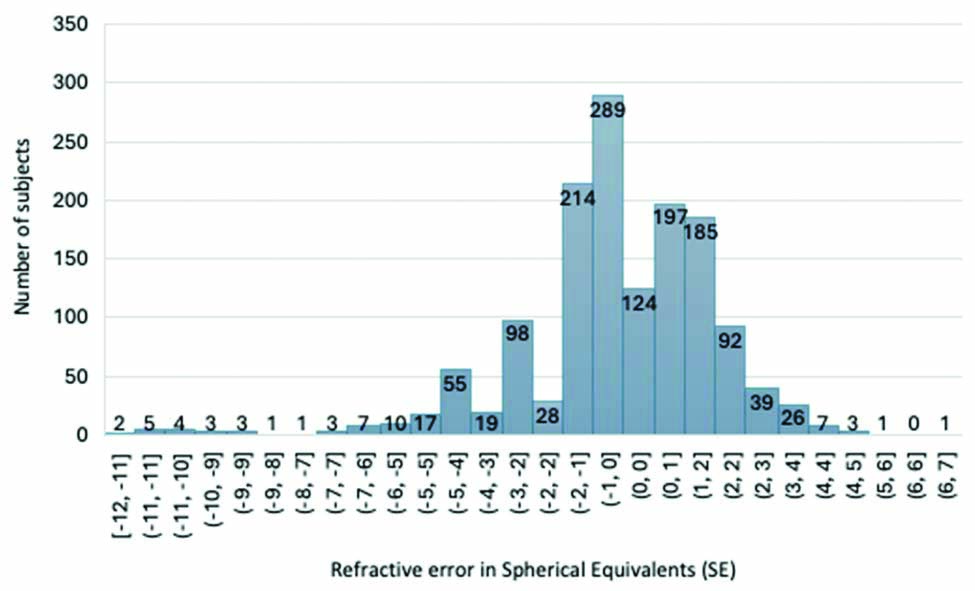
A graphical representation of the distribution of SEs of the right eye of subjects is represented in [Table/Fig-2]. A total of 264 (18.4%) patients had astigmatism >0.5. Of these, 20% had WTR astigmatism, 26% had ATR astigmatism, and the rest had oblique astigmatism. Anisometropia >1.0 was present in 67 (4.7%) patients, more frequently in the younger age group of 20-39 years (49.25% of total anisometropia). The distribution of different types of refractive errors (in SE) is provided in [Table/Fig-3].
Frequency distribution of Spherical Equivalents (SE) of right eye.
Prevalence of refractive errors in various age groups.
| Age (years) | Emmetropia n (%) | Myopia n (%) | High myopia n (%) | Hypermetropia n (%) | Astigmatism n (%) | Anisometropia n (%) |
|---|
| 5-19 | 47 (3.3) | 79 (5.5) | 15 (1.1) | 22 (1.5) | 31 (2.2) | 12 (0.8) |
| 20-29 | 82 (5.7) | 89 (6.2) | 10 (0.7) | 32 (2.2) | 56 (3.9) | 18 (1.3) |
| 30-39 | 99 (6.9) | 125 (8.7) | 5 (0.4) | 106 (7.4) | 76 (5.3) | 15 (1.0) |
| 40-49 | 101 (7.0) | 88 (6.1) | 4 (0.3) | 138 (9.6) | 49 (3.4) | 11 (0.8) |
| 50-59 | 99 (6.9) | 31 (2.2) | 2 (0.1) | 111 (7.7) | 34 (2.4) | 8 (0.6) |
| >60 | 41 (2.9) | 15 (1.1) | 2 (0.1) | 91 (6.4) | 18 (1.3) | 3 (0.2) |
| Total n (%) | 469 (32.7) | 427 (29.8) | 38 (2.7) | 500 (34.9) | 264 (18.4) | 67 (4.7) |
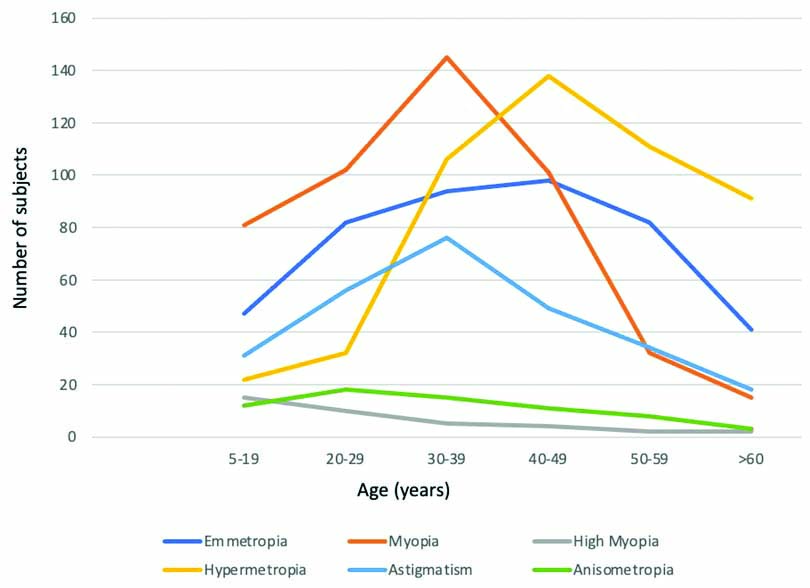
The trend of different types of refractive errors with age is shown in [Table/Fig-4]. The proportion of myopia increased with age, with the highest frequency of presentation between 30-39 years, and then declined thereafter. Hypermetropia had the highest frequency of presentation at 40-49 years of age and decreased with further increases in age.
Progression with the increase in age of different types of refractive errors.
In terms of gender distribution, the proportion of refractive errors was similar in males and females, as shown in [Table/Fig-5]. However, high myopia was more common in males compared to females (63.2% vs 36.8%), although this difference was not statistically significant (p-value=0.09).
Gender distribution of refractive errors.
| Refractive error type | Male n (%) | Female n (%) | Total n (%) | p-value* |
|---|
| Emmetropia | 240 (51.2) | 229 (48.8) | 469 (100) | 0.51 |
| Myopia | 210 (49.2) | 217 (50.8) | 427 (100) | 0.71 |
| High myopia | 24 (63.2) | 14 (36.8) | 38 (100) | 0.09 |
| Hypermetropia | 242 (48.4) | 258 (51.6) | 500 (100) | 0.39 |
| Astigmatism | 133 (50.4) | 131 (49.6) | 264 (100) | 0.87 |
| Anisometropia | 37 (55.2) | 30 (44.8) | 67 (100) | 0.37 |
*Chi-square test was used for the difference in proportion
Discussion
Present study sheds light on the prevalence of refractive errors in the outpatient population of Northeast India, with a prevalence rate of 12%. Emmetropia was present in 32.7% of the participants. Among the refractive errors identified, hypermetropia was the most common (34.9%), followed by myopia (29.8%).
Astigmatism was present in 18.4% of the population, and anisometropia was observed in 4.7%. The pattern of refractive errors varied with age, with myopia being more common among younger individuals (30-39 years), while hypermetropia predominantly affected older adults (40-49 years). Additionally, the proportion of high myopia was 2.7%, an important finding given the associated risks of myopic macular degeneration and retinal detachment. The proportion of refractive errors was similar in males and females.
A summary comparing present study with other similar refractive error studies from various regions of India is provided in [Table/Fig-6] [2,5,6,9-11]. Hypermetropia was the most common refractive error in present study, particularly among the older age group. This aligns with the findings of Hashemi H et al., who noted that hypermetropia was more common in older adults due to the ageing process and loss of accommodative ability [12]. They found a prevalence of hypermetropia of 30.9% in adults, which was close to present finding of 34.9%. The Andhra Pradesh Eye Disease Study [9] reported a prevalence rate of 9.83% for hyperopia in urban Indian populations [Table/Fig-6], which was lower than what was observed in present study [2,5,6,9-11]. Present study prevalence rates were also higher than those reported by Nangia V et al., in Central India [10], who found a prevalence of 18% in their study of the rural population of Central India.
Comparison of present study with other refractive error studies conducted in different parts of India [2,5,6,9-11].
| Author’s name and year (Reference No.) | Place of study | Prevalence of refractive errors (%) | Most common refractive error type | Age group most affected |
|---|
| Dandona R et al., (1999) [9] | Urban population of South India | Not specified | ≤15 years of age: Hyperopia 59.37%>15 years of age: Myopia 19.39% | ≤15 years of age |
| Nangia V et al., (2010) [10] | Rural region in Central India | Myopia 31.3%Hyperopia 18.0% | Myopia 31.3%Hyperopia more common in lower age group | Not specified (Study population: >30 years) |
| Sheeladevi S et al., (2019) [2] | India (Systematic Review) | Prevalence of refractive error -53.1% | Myopia 27.7% | Not specified (Study population: >30 years) |
| Raju P et al., (2004) [11] | Rural South India | Myopia: 26.99%, high myopia: 3.71% Hyperopia: 18.70% | Myopia 26.99% | Not specified (Study population: >39 years) |
| Bhutia KL et al., (2021) [5] | Sikkim, India | 6.7% | Myopia 31.1% | School going children |
| Natung T et al., (2017) [6] | Northeast India | 55.56% | Myopia 27.4% | 20-59 years(study population: >5 years) |
| Thakur NK et al., (2025) | South Assam, India | 12% | Hypermetropia 34.9% | 30-49 years (study population: >5 years) |
The prevalence of myopia in present study (29.8%) was consistent with trends observed in other Asian populations. Wu Q et al., reported a similar prevalence of 29.8% in China, highlighting the growing concern over myopia, especially among younger individuals [13]. Hashemi H et al., found a myopia prevalence of 4.9% in children and 26.5% in adults [12]. Sheeladevi S et al., in a systematic review on refractive errors in India, reported a similar finding of 27.7% prevalence of myopia [2]. Raju P et al., in their study of a rural South Indian population, observed the prevalence of myopia and high myopia to be 26.99% and 3.71%, respectively, which was similar to present study findings [11]. Bhutia KL et al., found a myopia prevalence of 31.1% in their study [5]. Present study finding of high myopia prevalence (2.7%) aligns with Holden BA et al., systematic review, which reported a similar prevalence of 2.7% [14]. They also predicted an increase in the number of cases of high myopia to 9.8% of the world population by 2050, highlighting the importance of addressing the growing population of individuals with high myopia. Studies have also shown an increasing trend in the prevalence of myopia and high myopia in the Asian population [15-17].
The prevalence of astigmatism in present study (18.4%) was slightly higher than the findings of Dandona R et al., in Southern India [9], where 13% of the population had astigmatism, but lower than a population-based cohort study conducted in Bangladesh by Bourne RR et al., which reported a prevalence of 32.4% [7]. In a systematic review by Zhang J et al., the prevalence of astigmatism ranged between 8 to 62% [18]. They also noted that astigmatic patients experienced poor vision quality, increased glare and halos, difficulty with night driving, and a higher risk of falls. Vision-related tasks were performed more slowly by astigmatic patients compared with individuals who had appropriate glasses correction. The higher prevalence of astigmatism in our population highlights the need for early detection to prevent long-term visual impairment and poor productivity in vision-related tasks, especially in children.
Present study also found a lower proportion of anisometropia (4.7%) compared to studies by Bourne RR et al., which reported an anisometropia prevalence of around 8.8%. Another study by Zhou Y et al., found the prevalence of anisometropia to be 25.6%, which was higher than present study findings [7,19]. The lower rates in present study may be due to the hospital-based nature of the sample, which may not capture the full extent of anisometropia in the community. In a study by Hashemi H et al., the most common cause of amblyopia was anisometropia [20]. Hashemi H et al., emphasised the importance of early detection of anisometropia, particularly in younger populations, to prevent amblyopia and other vision-related problems. Yekta A et al., found that anisometropia-related amblyopia was present in 58.1% of their study subjects [21]. The prevalence of anisometropia in their study was 2.31%, which was lower than present study findings. The results of present study support the call for routine eye screenings, especially for children and adolescents, to detect anisometropia early and prevent its progression.
Refractive errors are the most prevalent cause of treatable visual impairment. They can be easily ascertained in everyday clinical practice quickly, easily, and safely. While refractive errors cannot be prevented, studies are still underway to understand how to do so; they can be easily treated with corrective glasses. If corrected in time, they can prevent the development of amblyopia and lifelong visual impairment. It is pertinent that policies are developed to provide good quality and affordable refractive error corrective services and glasses to people belonging to low socio-economic status, especially in areas with limited eye care services. Our hospital caters to a diverse multicultural population, where a significant percentage lives in abject poverty (30-36%) according to a report by the Government of India [22]. As per our knowledge, no data on the prevalence or pattern of refractive errors exist from this area.
Limitation(s)
The study sample for this research was drawn from a hospital’s OPD and not directly from the general population. Since the aim of the study was to focus only on URE, only patients with dimness of vision due to refractive error were included, while those with any pathology affecting the lid, conjunctiva, cornea, anterior chamber, iris, lens, or posterior segment that impaired vision were excluded from the study. However, many patients with temporary eye conditions, such as infective or allergic conjunctivitis, anterior uveitis, ocular foreign bodies, and corneal abrasions, who regularly visit our OPD, were also excluded. Such patients may have refractive errors but were excluded at the time of the study due to the presence of pathology at presentation.
Through this study, authors hope to provide insight into the magnitude and pattern of refractive error in the patient population and the need for correcting refractive errors at an early stage. Authors aim to provide evidence-based data to policymakers and non-governmental organisations so that resources and assistance can be allocated for correcting refractive errors, such as providing prescription glasses free of cost to patients. A substantial number of patients come from very low socio-economic backgrounds and struggle to meet their daily livelihoods, making them unwilling to spend money on corrective glasses.
Conclusion(s)
This study highlights the significant prevalence and distribution of refractive errors, particularly hypermetropia and myopia, in the outpatient population of South Assam in Northeast India. The findings emphasise the growing burden of myopia among younger individuals and the predominance of hypermetropia in older adults, which is consistent with global and regional trends. The notable prevalence of astigmatism and anisometropia further underscores the need for early detection and appropriate interventions to prevent long-term visual impairment. Present study results support the implementation of regular eye screenings, especially in underserved populations, to reduce the burden of UREs. Addressing these visual impairments through affordable corrective lenses and accessible eye care services is crucial for improving the quality of life in this region. Further population-based studies are necessary to provide a broader understanding of refractive error patterns and their public health impact.
*Chi-square test was used for the difference in proportion