The LBP is a significant health concern. Although there have been notable improvements in diagnostic and therapeutic methods, it remains difficult to determine the exact aetiology of LBP [1]. LBP refers to any discomfort that arises in the region between the 12th rib and the inferior gluteal folds, regardless of whether it is accompanied by referred pain [2]. Approximately, 84% of the adult population experiences LBP at some point in their lives [3]. Research has identified prolonged sitting as a possible cause of LBP [4,5]. Due to the growing automation and computerisation of work environments, a significant number of individuals are at risk of adopting sedentary lifestyles and spending a larger percentage of their lives in a seated position. The sitting position is believed to involve the flexion of the lumbar spine and the rotation of the pelvis backward compared to the standing position. This position intensifies the stress on the posterior passive structures of the spine. Extended periods of sitting, such as those experienced in various work environments, are more likely to exacerbate existing LBP [6].
While numerous studies have examined different interventions for chronic LBP, including electromagnetic field therapy [7], joint mobilisation, gym ball exercises, yoga therapy, and more, there is a noticeable gap in research specifically focusing on the impact of diaphragmatic breathing exercises on hamstring length and functional disability in this population [8,9]. Understanding how these exercises can affect hamstring tightness, which often contributes to LBP, and functional disability is crucial for developing more effective treatment strategies. Studies have demonstrated the potential advantages of diaphragmatic breathing exercises in enhancing pain intensity, disability, spinal mobility, postural stability, and overall function in individuals suffering from chronic LBP [10]. However, the direct correlation between these exercises and hamstring length, as well as their specific effects on functional disability, remains largely unexplored. By investigating these relationships, researchers can provide valuable insights into how diaphragmatic breathing exercises can alleviate chronic LBP and improve the overall quality of life for affected individuals.
Although some studies have considered the benefits of diaphragmatic breathing exercises in other conditions, such as shoulder pain, their application to chronic LBP and their effects on hamstring length and functional disability in this specific population have not been thoroughly studied [11,12]. By addressing this gap in the literature, researchers can expand their understanding of how these exercises can serve as a non invasive, cost-effective, and accessible intervention for those dealing with chronic LBP.
The proposed study, which aims to investigate the impact of diaphragmatic breathing exercises on hamstring length and functional disability in individuals with chronic LBP, offers a distinctive and valuable contribution to the existing research. By exploring these relationships, researchers can provide evidence-based insights into the potential benefits of these exercises for improving physical and functional outcomes in individuals with chronic LBP, ultimately enhancing treatment strategies for this prevalent condition.
H0: There is no significant influence of diaphragmatic breathing exercises on hamstring length and functional disability in subjects with chronic LBP.
H1: There is a significant influence of diaphragmatic breathing exercises on hamstring length and functional disability in subjects with chronic LBP.
Materials and Methods
This quasi-experimental design, a single-group pretest to post-test study, was conducted at Padmashree Physiotherapy and Rehabilitation Centre Nagarbhavi, Bengaluru, Karnataka, India from June 2023 to September 2023, after obtaining ethical clearance (letter: PIEC/37/2023 dated 15/06/2023).
Inclusion criteria: Individuals in age group of 18-35 years, both genders. Subjects with LBP for the past three months, subjects with hamstring tightness, pelvic dysfunction were included in the study.
Exclusion criteria: Subjects with restricted spinal mobility, subjects with degenerative diseases of the spine, subjects with lower limb ligament injuries were excluded from the study.
Sample size estimation: The sample size estimation was based on a previous study [13]. The required sample size was estimated to be 66.
Outcome Measures
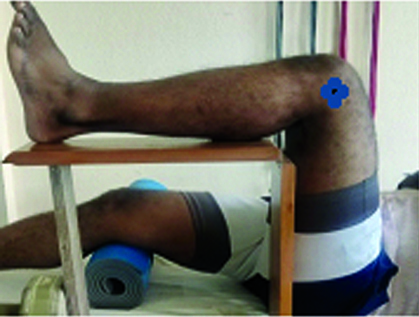
Active Knee Extension (AKE) test to quantity hamstring length [12,14]: The participant was instructed to lie on their back on the plinth, with an adjustable leg rest positioned under the leg that would be inspected. The leg on the opposite side was supported on the platform by a 6-inch foam roller placed under the popliteal fossa, allowing the knee to bend to about 20°. Using the leg rest, each participant was able to hold the leg being tested while it was bent at a 90° angle from the hip to the knee [Table/Fig-1] [12,13].
Initial testing position.
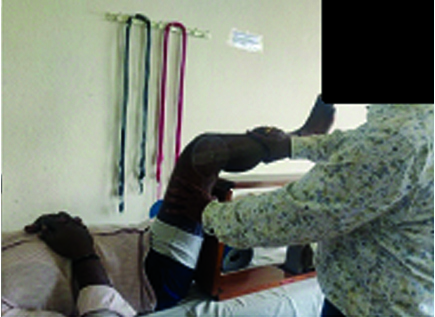
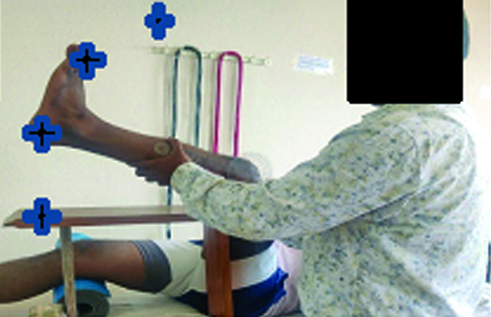
Subsequently, the subject was instructed to fully extend the knee of the lower leg under examination while maintaining a 90° flexion at the hip and a neutral plantar angle at the ankle. The goniometer was placed on the lateral aspect of the testing leg to measure the furthest point of knee extension [Table/Fig-2,3]. The participant was instructed to repeat the test if there were any changes in their hip position, dorsiflexion of their ankle, flexion of their cervical spine, or if they were unable to maintain the final posture for the assessor to take the measurement. A decrease in angle indicates that changes in muscle tightness can lead to compensations in other segments, which may indirectly influence the results.
Measurement of right-side knee extension.
Measurement of left side knee extension.
Oswestry Disability Index (ODI) to measure functional disability [15]: This questionnaire is divided into 10 sections designed to assess limitations in various activities of daily living. Each section is scored on a scale of 0 to 5, with 5 representing the greatest degree of disability [6]. The index is calculated by dividing the summed score by the total possible score, which is then multiplied by 100 and expressed as a percentage. Therefore, for every question that is not answered, the denominator is reduced by five.
Study Procedure
Prior ethical clearance was obtained from the institutional ethical committee, and informed consent was taken from the subjects. Participants were recruited after fulfilling the selection criteria, and their baseline variables were collected. This included baseline scores of the AKE test for both the right and left lower limbs, as well as functional disability scores. After this, the participants were subjected to the intervention procedure, which involved diaphragmatic breathing exercises. The participants were directed to inhale deeply through their nostrils, resulting in noticeable expansion of their abdominal region. They were instructed to sustain this position for a duration of five seconds before exhaling through their mouths. To ensure correct execution of the exercise, participants were asked to place one hand on their chest and the other on their belly. They were encouraged to take deep breaths, with an emphasis on sensing the movement of their abdomen rather than their chest. Each participant performed the assigned exercise, observing a one-minute interval between each session. Specifically, they were instructed to perform three sets of five deep breaths, three days per week, for a total of 12 sessions [16,17]. After the intervention, postintervention values for hamstring length and functional disability were recorded.
Statistical Analysis
The data on baseline characteristics and outcome measures were carefully elicited and recorded. The data were analysed using the statistical software Statistical Package for the Social Sciences (SPSS) version 21.0, with a significance level set at 0.05. A paired t-test was employed to analyse the significant differences between the pre- and post-score assessments. Tables and graphs were generated using MS Word and the SPSS graphical editor.
Results
[Table/Fig-4] presents the demographic characteristics of participants with chronic LBP, comparing 42 males and 24 females. There were no statistically significant differences between males and females across any of the demographic variables.
| Demographic variable | Male (42) | Female (24) | p-value |
|---|
| Range | Mean±SD | Range | Mean±SD |
|---|
| Age (years) | 18-35 | 29.74±4.43 | 18-38 | 27.33±5.64 | 0.060 |
| Height (cm) | 152-180 | 167.02±6.93 | 152-178 | 164.42±7.22 | 0.153 |
| Weight (kg) | 42-79 | 65.62±7.81 | 50-79 | 62.33±6.60 | 0.088 |
| BMI (kg/m2) | 16.51-30.10 | 23.59±3.13 | 18.38-29.37 | 23.08±2.21 | 0.484 |
Unpaired t-test
[Table/Fig-5] presents the pre- and post-test scores for outcome variables in subjects. For AKE Right (AKE RT), the pre-test scores had a mean of 27.85±2.40, which decreased to 24.77±2.26 in the post-test, with p<0.001, indicating a highly significant improvement. Similarly, AKE Left (AKE LT) showed a pretest mean of 27.48±2.52, which reduced to 24.59±2.36 in the post-test (p-value <0.001), also reflecting a significant enhancement. The ODI scores significantly decreased from a pre-test mean of 40.41±12.86 to 36.30±10.08 in the post-test (p-value <0.001).
Pre and post-test scores of outcome variables of subjects with chronic low back ache.
| Outcomevariable | Range | PrescoreMean±SD | Range | PostscoreMean±SD | p-value |
|---|
| AKE RT (°) | 24-32 | 27.85±2.40 | 20-30 | 24.77±2.26 | <0.001 |
| AKE LT (°) | 22-32 | 27.48±2.52 | 19-29 | 24.59±2.36 | <0.001 |
| Oswestry disability index | 15-65 | 40.41±12.86 | 15-58 | 36.30±10.08 | <0.001 |
Paired- t-test; AKE: Active knee extension; RT: Right-side; LT: Left-side
Discussion
The study examined the impact of diaphragmatic breathing exercises on hamstring flexibility and functional disability in individuals with chronic LBP. The results indicated a significant improvement in AKE scores on both sides and a decrease in ODI scores postintervention, indicating an improvement in functional disability. Therefore, the null hypothesis was rejected. O’Sullivan PB and Beales DJ, hypothesised that implementing diaphragmatic breathing exercises would stimulate the core-stabilising muscles and correct the abnormal motor-control strategies observed in individuals with short hamstring length. This, in turn, would lead to enhancements in hamstring flexibility and a reduction in functional disability [18].
In this study, the AKE scores showed a statistically significant improvement (p-value <0.001), indicating a significant enhancement in hamstring length. The improvement in AKE scores is believed to be the result of diaphragmatic breathing exercises. The act of breathing itself can disrupt postural stability due to the anatomical shifts that occur [19-21]. The process of respiration leads to shifts in the position of the center of gravity of the human body in relation to the boundaries of the support base. This necessitates a compensatory response in the trajectory of the Center of Pressure (CoP) to maintain body homeostasis as stably as possible [22]. This type of breathing involves the contraction of the diaphragm, which causes the internal organs to move downward and forward, resulting in the expansion of the abdomen. Abdominal breathing appears to impact postural stability by influencing the activation of the respiratory muscles [23,24], particularly concerning their effect on trunk stability.
The results of this study align with previous findings reported in the literature, which assessed the efficacy of various manual treatment approaches in improving spinal mobility in individuals without any health conditions. The study proposed that the application of a cervical myofascial induction approach enhances cervical range of motion [25]. Furthermore, stretching strategies have been suggested as effective in improving respiratory characteristics such as maximal respiratory pressures, thoracic expansion, and abdominal mobility. Similarly, Kasunich NJ discovered that when the supporting distal components do not function normally, it may cause biomechanical disruptions in the proximal parts [26].
There was a significant improvement in the functional disability of the study participants, as the ODI scores showed a marked reduction, with p-value <0.001. This finding aligns with the study conducted by Cheung YL et al., who investigated the impact of progressive muscle relaxation on reducing anxiety symptoms and enhancing various aspects of quality of life in gastric cancer patients undergoing surgery. The study’s findings revealed positive results [27]. Kwekkeboom KL et al., conducted a study to examine the impact of two simultaneous progressive muscle relaxation techniques and guided imagery on the pain scores of cancer patients. The researchers found that both approaches had favourable benefits [28].
Another study conducted by Larivière C et al., found a significant decrease in the ODI in a sample of 110 participants with persistent LBP who underwent trunk stabilisation exercises collectively. These results indicate that a lumbar stabilisation exercise regimen may have contributed to the improvement in back pain-associated disability (ODI) by enhancing several physical and psychological aspects [29]. Sung PS, discovered a significant decrease in the ODI after implementing spinal stabilisation exercises as a mediation technique over a duration of four and study involved 16 individuals suffering from chronic LBP [30]. Kang JI et al., found that the ODI decreased in a group of patients with persistent LBP who performed spine stabilisation exercises. This improvement was observed after four weeks of intervention. The study concluded that further research is warranted due to the significant variations observed in the ODI [31].
Research supports the effectiveness of diaphragmatic breathing exercises in various conditions. Recent work by Şahin O and Kocamaz D had validated that diaphragmatic breathing can enhance brain function through chemical, mechanical, and cortical-subcortical control mechanisms. Additionally, diaphragmatic mobilisation and breathing exercises have been found to reduce pain and improve the quality of life in individuals with shoulder pain [32]. Moreover, diaphragmatic breathing exercises have been linked to improved pulmonary function, reduced pulmonary complications postsurgery, and enhance respiratory mechanics [33]. These exercises have also benefited individuals with conditions such as chronic stroke and diabetes mellitus, emphasising their positive impact on pulmonary function and quality of life [34]. Research has demonstrated that diaphragmatic breathing can effectively increase peak expiratory flow rate in asthma patients while simultaneously reducing reflux symptoms [35].
Healthcare professionals should consider incorporating diaphragmatic breathing exercises as part of the treatment plan for individuals with chronic LBP to improve hamstring flexibility and functional disability. Collaboration between physiotherapists, pain specialists, and other healthcare providers can optimise the integration of diaphragmatic breathing exercises into holistic treatment regimens for those suffering from chronic LBP.
Limitation(s)
The study’s participants may not have been representative of the larger population due to differences in age, gender, and other demographic characteristics. Additionally, the study could have benefited from a control group to compare the effects of diaphragmatic breathing exercises with those of other techniques or exercises; however, controls were not included.
Conclusion(s)
Diaphragmatic breathing exercises have beneficial effects on functional outcomes in individuals suffering from persistent LBP. The improvements in hamstring length and functional disability observed in the study are consistent with the documented benefits of diaphragmatic breathing across various health conditions, supporting its efficacy as a therapeutic intervention. Subsequent research should include extended follow-up evaluations to investigate the enduring advantages of diaphragmatic breathing exercises on hamstring flexibility and functional impairment in those with chronic LBP. By using objective measures, such as physical assessments, alongside self-reported outcomes, a more comprehensive evaluation of the intervention’s effectiveness can be achieved. A complete treatment plan for persistent LBP could be developed by adopting a multidisciplinary approach that integrates diaphragmatic breathing exercises with other modalities.
Unpaired t-test
Paired- t-test; AKE: Active knee extension; RT: Right-side; LT: Left-side