COVID-19, caused by the novel coronavirus SARS-CoV-2, emerged in Wuhan, China, in December 2019 [1]. It quickly spread worldwide, leading the World Health Organisation (WHO) to declare a pandemic on 11 March 2020 [1]. The pandemic has had long-term effects on physical and mental health [2,3]. Mental health was affected due to social disruption, isolation, job loss, financial crisis, stigma, and the threat to life [4]. The virus can cross the Blood-Brain Barrier (BBB) and, along with infection-induced cytokines, can cause systemic inflammation and direct brain involvement [5,6]. This leads to psychiatric issues such as depression, anxiety, and stress [7-10], psychotic disorders [10], and cognitive impairment, often persisting for a long duration [10-12] and is one of the symptoms of ‘Long COVID syndrome’ [13].
The novelty of the present study lies in the fact that it employed objective neuropsychological tests and face-to-face interviews, avoiding the limitations associated with telephonic, computer-based, or online assessments. By investigating a wide range of socio-demographic variables and including only first-time diagnosed psychiatric patients who developed symptoms after COVID-19 infection, this study provided a more precise understanding of the factors contributing to cognitive decline. Furthermore, it was the first study to utilise data from a specialised post-COVID-19 mental health clinic in India, adding a unique perspective to the global discourse.
This study aimed to bridge the existing research gap by determining the prevalence of cognitive impairment in post-COVID-19 patients and exploring its association with socio-demographic factors, as well as some common post-COVID-19 psychiatric sequelae such as depression, anxiety, and stress. The findings from this research could inform the development of effective strategies, such as early neuropsychological rehabilitation [10,23] and possible pharmacological interventions [24], for those affected by post-COVID-19 cognitive decline.
Materials and Methods
A cross-sectional study was conducted from July 2022 to June 2023 at a ‘Post-COVID Mental Health Clinic’ within a tertiary care medical college in Kolkata, India. Institutional Ethical Committee (IEC) approval was obtained (memo no. IPGME&R/IEC/2022/325) before the beginning of the study.
Inclusion criteria: Both males and females aged 18 to 65 years who had recovered from COVID-19 for more than three months but less than six months (recovery was defined as either completion of 14 days of isolation or clinical recovery, whichever occurred later) and who were experiencing post-COVID-19 psychiatric sequelae (specifically three common post-COVID psychiatric symptoms: depression, anxiety, and stress) were included. Cases diagnosed by Reverse Transcriptase Polymerase Chain Reaction (RT-PCR) and attending our institute’s ‘Post-COVID Mental Health Clinic’ were included only after obtaining proper informed consent.
Exclusion criteria: Patients who required hospitalisation for COVID-19, those exhibiting psychotic features or a history of any psychiatric disorders, individuals who experienced a recent stressful event (excluding COVID-19), those with suicidal intent or a history of suicide attempts, debilitated patients, or those in poor general condition were excluded. Additionally, individuals with severe uncontrolled physical health conditions, a history of alcohol or substance dependence, and/or those currently using any substance of abuse or alcohol (nicotine dependence was not excluded) were also excluded from the study.
Sample size estimation: Sample size calculation was done using the formula for cross-sectional study, Z2 pq/d2=Sample Size=204 (where p=prevalence=85%, q=100-p, Z=1.96 and d (precision)=5% for 95% confidence interval) [25]. Prevalence was taken at 85% as there is a great variation among different studies showing the prevalence of cognitive impairment among COVID-19 survivors from 5% [12] to 86% [11], hence a pilot study was done with 50 subjects in which prevalence came out as 85%. Hence, 204 subjects were recruited by simple random sampling after applying inclusion and exclusion criteria.
Study Procedure
A predesigned semistructured questionnaire was administered, including socio-demographic variables, the MoCA [26,27], and DASS-21 [28,29]. The dependent/outcome variable was cognitive impairment, measured using both categorical (present/absent, with a score of 26 or more) and continuous scales. The independent variables consisted of socio-demographic factors measured on a categorical scale, including age (18 to <35 years, 35 to <50 years, and 50 to 65 years), sex (male/female), education level (below higher secondary, higher secondary, graduate and above), marital status (currently married or currently single), financial constraints (present or absent, according to the patient’s perception), occupation (employed, which includes housewives and students, or unemployed), and residence (urban or rural). Depression, anxiety, and stress were measured on a continuous scale using the DASS-21 score.
The tools used to measure the variables were as follows:
Predesigned semistructured questionnaire: This included the socio-demographic profile.
MoCA: Developed by Nasreddine ZS et al., the MoCA is a 10-minute cognitive screening tool designed to assist first-line physicians in detecting Mild Cognitive Impairment (MCI), a clinical state that often progresses to dementia. The sensitivity and specificity of the MoCA for detecting MCI are 90% and 87%, respectively. The total score is 30, with a score of 26 or above ruling out cognitive impairment, while a score below 26 indicates the presence of cognitive impairment. Higher scores indicate less cognitive impairment. The MoCA tests eight domains [26,30]: visuospatial/executive, naming, memory, attention, language, abstraction, delayed recall, and orientation (scores for each domain are 5, 3, no points, 6, 3, 2, 5, and 6, respectively). The total score is obtained by adding the scores for each domain.
DASS-21: The DASS-21 [28,29] subscales can validly measure the dimensions of depression, anxiety, and stress. It consists of 21 items, each rated on a 4-point Likert scale with scores ranging from 0 to 3. Each of the three subscales-depression, anxiety, and stress-contains seven items. The depression subscale comprises items 3, 5, 10, 13, 16, 17, and 21; the anxiety subscale includes items 2, 4, 7, 9, 15, 19, and 20; and the stress subscale consists of items 1, 6, 8, 11, 12, 14, and 18. The total score for each subscale is 21. Since the DASS-21 is a shorter version of the original 42-item DASS, the score for each subscale must be multiplied by 2 to calculate the final score. The resulting ratings are classified as follows:
- Normal: 0-4 for depression, 0-3 for anxiety, and 0-7 for stress
- Mild: 5-6 for depression, 4-5 for anxiety, and 8-9 for stress
- Moderate: 7-10 for depression, 6-7 for anxiety, and 10-12 for stress
- Severe: 11-13 for depression, 8-9 for anxiety, and 13-14 for stress
- Extremely severe: >14 for depression, >10 for anxiety, and >17 for stress [31].
Statistical Analysis
Data analysis was conducted using IBM Statistical Package for the Social Sciences (SPSS) version 25.0. Socio-demographic characteristics were analysed, and results were presented in tables with frequency and percentage. Chi-square tests of association were performed for each socio-demographic group and cognitive impairment, which were converted into categorical variables, to examine the associations among them. Pearson’s simple correlation was used to assess the relationship between cognitive function/impairment (MoCA score) and depression, anxiety, and stress scores separately. Subsequently, partial correlation analysis was performed to examine the associations between cognitive function/impairment and depression, anxiety, and stress, while controlling for the other two continuous variables (anxiety and stress, stress and depression, and depression and anxiety, respectively). Regression analysis was conducted to explore the relationship between the MoCA score and the depression score from the DASS-21, as cognitive impairment and depression were found to be significantly correlated only after the partial correlation analysis.
Results
The participants’ mean age was 40.79±12.74 years, with 121 males (59.31%) and 83 females (40.69%). Out of 204 subjects, 177 (86.8%) exhibited cognitive impairment.
Among the age groups, 60 out of 69 subjects aged 18 to <35 years (86.96%), 69 out of 79 aged 35 to <50 years (87.34%), and 48 out of 56 aged 50 to <65 years (85.71%) displayed cognitive impairment. Males (88.43%) had a higher prevalence than females (84.34%) [Table/Fig-1]. The mean MoCA score for males was 18.79±5.40, while for females, it was 18.49±5.66.
Socio-demographic profile including Chi-square tests of association of cognitive impairment vs groups.
| Variables | Groups | n (%) | Cognitive impairment absent | Cognitive impairment present | p-value† |
|---|
| n (%) | n (%) |
|---|
| Age (years) | 18 to <35 | 69 (33.82) | 9 (13.04) | 60 (86.96) | 0.96 |
| 35 to <50 | 79 (38.73) | 10 (12.66) | 69 (87.34) |
| 50 to <65 | 56 (27.45) | 8 (14.29) | 48 (85.71) |
| Gender | Male | 121 (59.31) | 14 (11.57) | 107 (88.43) | 0.39 |
| Female | 83 (40.69) | 13 (15.66) | 70 (84.34) |
| Education level | <XII | 72 (35.30) | 5 (6.94) | 67 (93.06) | 0.10 |
| class XII | 58 (28.43) | 8 (13.79) | 50 (86.21) |
| Grad. and > | 74 (36.27) | 14 (18.92) | 60 (81.08) |
| Employment status | Employed | 155 (75.98) | 18 (11.61) | 137 (88.39) | 0.22 |
| Unemployed | 49 (24.02) | 9 (18.37) | 40 (81.63) |
| Marital status | Married | 139 (68.14) | 20 (14.39) | 119 (85.61) | 0.48 |
| Single | 65 (31.86) | 7 (10.77) | 58 (89.23) |
| Financial constraints | Present | 123 (60.29) | 14 (11.38) | 109 (88.62) | 0.34 |
| Absent | 81 (39.71) | 13 (16.05) | 68 (83.95) |
| Residence | Rural | 60 (29.41) | 6 (10) | 54 (90) | 0.38 |
| Urban | 144 (70.59) | 21 (14.58) | 123 (85.42) |
†p-value <0.05 is taken as significant in 95% confidence interval, N=204
Contingency table Chi-square tests of association were performed between cognitive impairment (present/absent) and seven socio-demographic variables: age, gender, education level, employment status, marital status, financial constraints, and residence. None showed a significant association (p>0.05). For age and education level, which each had three subgroups, 2×3 Chi-square tests were performed. To prevent Type I error and to identify which cells in the 2x3 contingency table differed from expected values, a Bonferroni-adjusted p-value of 0.008 (p=0.05/6) was calculated, followed by post hoc tests [32]. After these adjustments, no significant associations (p>0.008) were found between cognitive impairment and age or education level groups.
The mean scores for depression, anxiety, and stress were 22.30±8.59, 22.38±8.08, and 23.08±8.22, respectively. The mean MoCA score was 18.67±5.49.
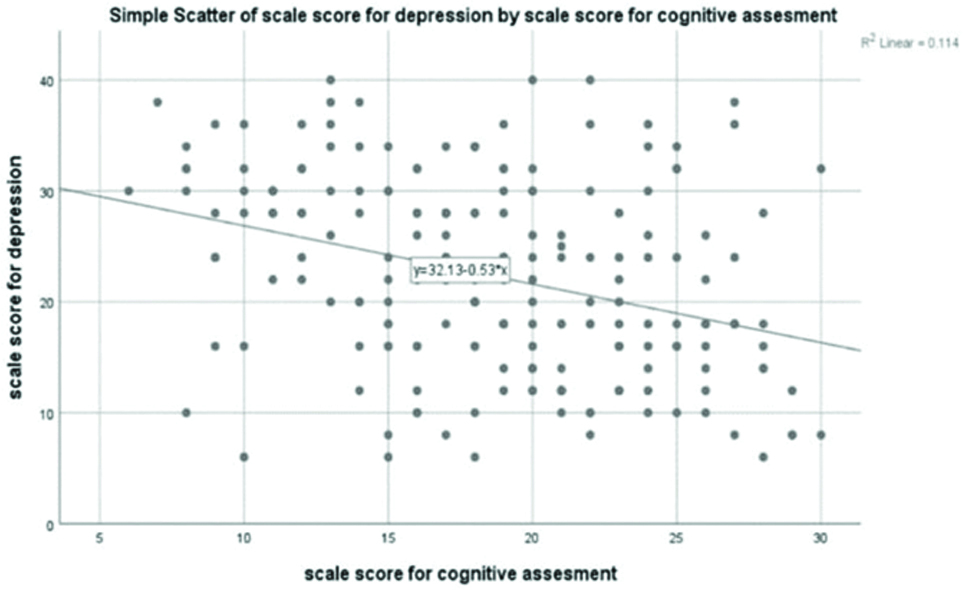
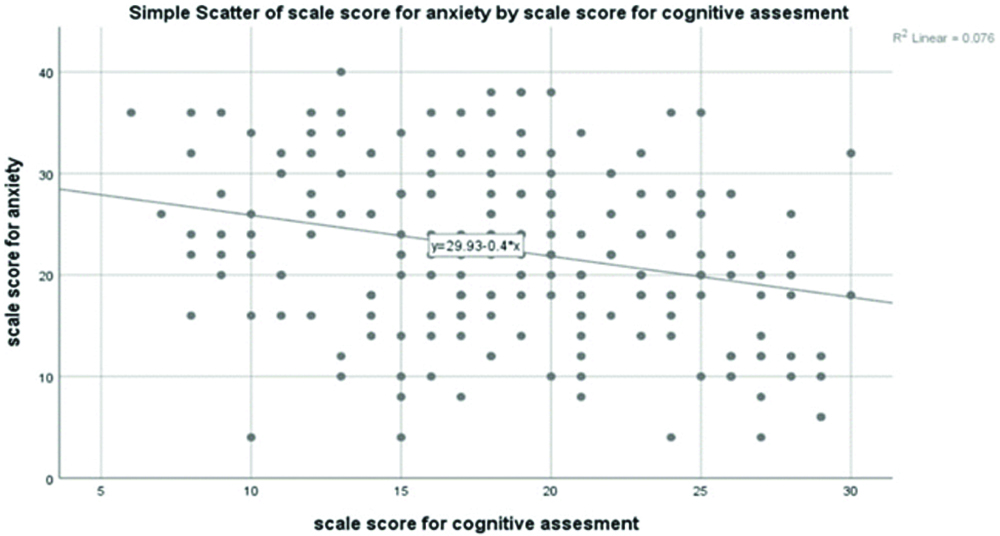
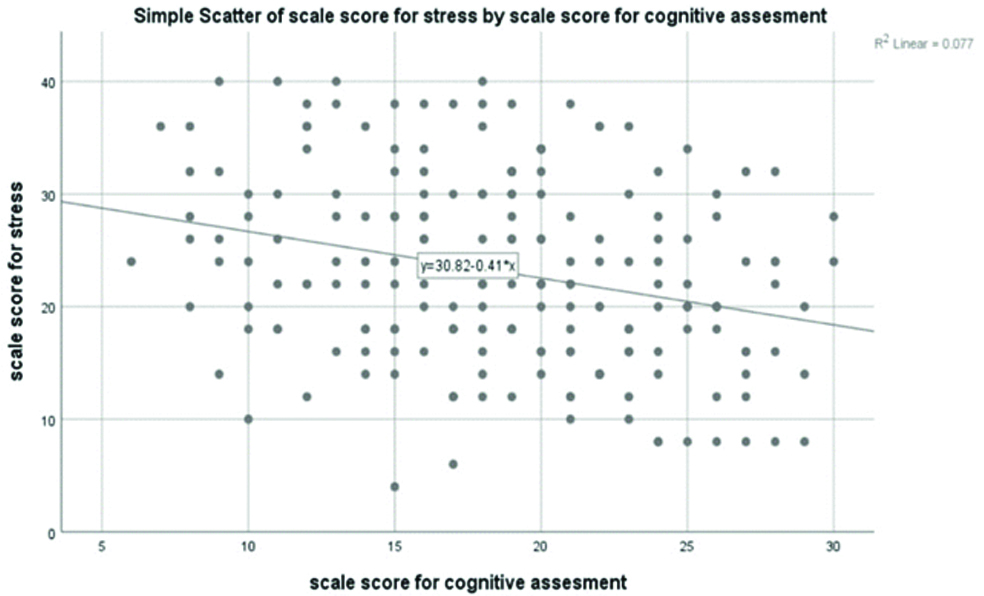
Pearson’s simple correlation analysis revealed weak but significant negative correlations between cognitive function (MoCA score) and the scores for depression, anxiety, and stress obtained from the DASS-21. The correlation between depression severity and cognitive function was {r(202)=-0.337, p-value <0.001} [Table/Fig-2]. Similarly, anxiety severity was correlated with cognitive function at {r(202)=-0.275, p-value <0.001} [Table/Fig-3], and stress severity showed a correlation of {r(202)=-0.277, p-value <0.001} with cognitive function [Table/Fig-4].
Correlation between depression and cognitive function.
Corelation between anxiety and cognitive function.
Corelation between stress and cognitive function.
Partial correlation analyses revealed a weak but significant negative correlation between depression and cognitive function (r-value=-0.221, p-value=0.002) when controlling for anxiety and stress. However, no significant correlation was found between cognitive function and anxiety (r-value=-0.041, p-value=0.563) when controlling for depression and stress, or between cognitive function and stress (r-value=-0.094, p-value=0.182) when controlling for depression and anxiety. These results suggest that while increases in depression, anxiety, and stress are associated with decreased cognitive function, only depression has a significant impact on cognitive function when controlling for the other two variables.
A simple regression analysis was conducted to test if depression significantly predicted cognitive impairment. The R2 value of 0.114 revealed that depression predicted 11.4% of the variance in cognitive function, with {F(1, 202)=25.88, p-value <0.001}. This finding indicated that depression negatively predicted cognitive function, meaning that increased severity of depression significantly predicted cognitive impairment (β=-0.337, p-value <0.001), as shown in [Table/Fig-5].
Regression coefficient of depression and cognitive function.
| Variable | B | β | SE |
|---|
| Constant | 23.47* | | 1.012 |
| Depression | -0.216* | -0.337 | 0.042 |
| R2 | 0.114 | | |
*p<0.001, N=2
Discussion
This study indicated a high prevalence of post-COVID-19 cognitive impairment (86.8%) among individuals suffering from post-COVID-19 mental health problems, which was similar to another study by Davis HE et al., which reported an 86% prevalence [11]. This high prevalence may be attributed to the use of the MoCA tool, which detects Mild Cognitive Impairment (MCI) and is highly sensitive but comparatively low in specificity when a cut-off score of 26 is used [25,33]. Additionally, the validity of this questionnaire has not been tested in the specific population experiencing post-COVID-19 psychiatric sequelae.
Generally, the older population suffers more from cognitive impairment. However, some studies [34-36] have also found that the younger population experiences post-COVID-19 cognitive impairment similarly to older individuals. According to an Indian study by Khanna SK et al., [20], there was no significant difference in cognitive impairment among age groups, indicating that cognitive deficits cannot be solely attributed to ageing. Similarly, the present study did not show significant age-related differences in cognitive impairment.
Studies [20,37] have indicated that there is no significant sex difference in post-COVID-19 cognitive dysfunction, which aligns with the findings of the present study. However, some studies [37,38] have highlighted that women have a higher prevalence of post-COVID-19 cognitive impairment than men. Therefore, it remains unclear whether the onset and severity of cognitive dysfunctions due to COVID-19 are influenced by gender.
Although the present study observed slightly more cognitive impairment in subjects with low educational qualifications, as suggested by other studies [39,40], there was no significant association between educational qualification and post-COVID-19 cognitive dysfunction, consistent with other research [18-20]. This may be because a higher education level is associated with improved baseline cognitive performance but not necessarily with the maintenance of cognitive function [41].
The present study demonstrated post-COVID cognitive impairment irrespective of financial condition, echoing studies with similar results [40,42,43]. Although not widely investigated, depression and memory impairment were more prevalent in post-COVID-19 patients who were unmarried or single [44]. However, this study did not showed any significant association between cognitive impairment and marital status, indicating the need to explore additional factors such as social isolation, lack of family support, stress, and increased cortisol levels, which could make single or unmarried individuals more vulnerable to memory impairment. [Table/Fig-6] shows the findings of present study with other published studies [19,20,34,35,39,42,43,45-50].
| S. No. | Author’s name and year | Place of study | Study design, Number of subjects | Objectives | Parameters assessed | Conclusion |
|---|
| 1. | Amalakanti S et al., 2021 [35] | India | Case-control, 93 cases, 102 controls | To detect mild cognitive impairment in COVID-19 patients | Total MoCA score and each domain compared. Other variables were age and sex | No significant difference in the total MoCA scores between the two groups, but COVID-19 patients had lower scores than controls in the domains of visuoperception, naming, and fluency. Older COVID-19-positive patients scored lower in the MoCA. |
| 2. | Khanna SK et al., 2022 [20] | India | Case-control, 142 cases and 142 control | To detect six months post COVID-19 (RT-PCR positive cases, only mild cases) cognitive impairment | Total MoCA score and domain-wise score with age, sex, and education matched controls | No overall cognitive decline in participants based on MoCA scores, but 40 cases scored low. Significant declines were observed in visuospatial skills/executive function and attention domains. No significant relationship between age, gender, and education with cognitive impairment. |
| 3. | Woo MS et al., 2020 [50] | Germany | Cross-sectional study, 18 cases, 10 controls | Mean 85 days from COVID-19. Neurocognitive deficits in mild COVID-19 young patients | Modified Telephone Interview For Cognitive Status (TICS-M), age and sex-matched controls | COVID-19 patients performed significantly worse than controls in short-term memory, attention, and concentration/language tasks, with no significant link to age or sex. |
| 4. | Lamontagne SJ et al., 2021 [43] | Canada and USA | Observational study, n, 50 cases, 50 controls | Mood and cognitive function who have recovered. (Mean 123.63 days) | Self-reported measures of stress, depression and anhedonia, Attention Network Test and cognitive abilities (Attentional Control Scale) | COVID-19 recovery groups reported increased stress, attention deficits, and impaired executive functioning, but their alertness and orienting remained unaffected. These outcomes were not significantly influenced by demographic factors. |
| 5. | Brown LA et al., 2022 [48] | USA | Observational study, n, 50 cases, 50 controls | Associations between cognitive impairment, self-reported disruptions in memory, depression, anxiety, post-traumatic depression and sleep disorders Mean 22.4 weeks from COVID-19 infection | HADS (Hospital Anxiety and Depression Scale), IES-6 (Impact of Event Scale-6, MoCA -Blind, Self-reported memory disturbance | Depression symptom severity was significantly linked to MoCA total scores, with significant associations also found between depression and MoCA Digit Span-Backward, MoCA Fluency, and MoCA Delayed Recall. |
| 6. | Hampshire A et al., 2021 [42] | UK | Cohort study, 46 patients | To study a possible association between severe COVID-19 and persistent cognitive deficits on average 179 days after COVID-19 onset | Custom Computerised cognitive assessment Battery, GAD-7 (General Anxiety Disrder-7), PHQ-9 (Patient Health Questionnaire-9), PCL-5 (PTSD Checklist for Diagnostic and Statistical Manual of Mental Disorders-5) | Survivors of severe COVID-19 exhibit measurable cognitive deficits that persist for many months, relative to age- and demographic-adjusted norms. Chronic sequelae such as fatigue and mental health issues are prominent, and their severity appears to be somewhat independent of the observed cognitive deficit. |
| 7. | Crivelli L et al., 2022 [45] | Argentina | Prospective cohort study, 45 patients, 45 controls | To investigate the impact of COVID-19 on cognition (patients were evaluated for an average of 142 days after illness) | MoCA, TMT A and B (Trail making test part A and B), Digit Span Forwards, Digit- Symbol Coding, Craft Story, RAVLT (Rey Auditory Verbal Learning Test), Benson Figure, Wisconsin Card Sorting Test, Stroop Test, Phonological Fluency, Clock Drawing Test, Multilingual Naming Test, Semantic Fluency and HADS | No significant differences were found in the screening measures (MoCA p=0.15). Significant differences between groups were found in memory, attention, executive, and language. Self-reported anxiety was associated with the presence of cognitive dysfunction in COVID-19 subjects. |
| 8. | Delgado-Alonso C et al., 2022 [49] | Spain | Cross-sectional study, 50 patients and 450 controls | To characterise cognitive dysfunction in post-COVID-19 patients with cognitive complaints and evaluate its correlation with anxiety, depression, sleep, and olfactory function, 9.12±3.46 months after the onset of the disease | Corsi Block-Tapping Test, SDMT (Symbol Digit Modalities Test) BNT (Boston Naming Test) JLO (Judgment Line Orientation), ROCF (Rey-Osterrieth Complex Figure), FCSRT (Free and Cued Selective Reminding Test), Stroop Colour-Word Interference Test, VOSP (Visual Object and Space Perception Battery), Computerised Neuropsychological Battery Vienna Test System, BSIT (Brief Smell Identification Test), STAI (State- Trait Anxiety Inventory), BDI-II (Beck Depression Inventory -II), PSQI (Pittsburgh Sleep Quality Index), Modified Fatigue Impact Scale (MFIS), 3.0 T MRI38 | Cognitive performance was correlated with olfactory dysfunction, sleep quality, and anxiety to a lesser extent, but not depression. |
| 9. | Zhou H et al., 2020 [46] | China | Prospective cohort study, 29 COVID-19 recovered subjects, 29 healthy controls | To evaluate the impacts of COVID-19 on cognitive functions in recovered patients and its relationship with inflammatory profiles | Trail Making Test (TMT), Sign Coding Test (SCT), Continuous Performance Test (CPT), Digital Span Test (DST), PHQ-9, GAD-7, and tests for inflammatory markers | No significant differences in age, gender, or education levels were found between groups. COVID-19 patients showed potential cognitive dysfunction, with sustained attention correlated to CRP levels. Emotional status and inflammatory markers of healthy controls were not examined. |
| 10. | Ahmed M et al., 2022 [19] | Bangladesh | Cross-sectional study, A total of 401 subjects who were diagnosed COVID-19 positive | To determine the prevalence of memory complaints in post-COVID-19 patients and to find potential contributing factors | Memory Complaint Questionnaire (MAC-Q). Age, Sex, and Living region, COVID-19 severity, oxygen requirement, hospitalisation, treatments taken, co-morbidities, and duration since recovery | One-fifth of the COVID-19 patients develop memory complaints within a year. Region and duration since COVID-19 recovery remained significant factors for post-COVID-19 memory problems. Rural residents were significantly more likely to have post-COVID-19 memory complaints than urban residents, with these complaints becoming more prevalent over time. |
| 11. | Zhao S et al., 2024 [47] | Germany and UK | Multicentre cross-sectional study,194 subjects with Post COVID-19 Conditions (PCC) 63 with no-PCC and 113 with no-COVID | To test if a fundamental deficit-cognitive slowing (here defined as increased time to process information and respond to it)-is present in people with PCC | PCC patients completed web-based cognitive tasks (simple reaction time and Number Vigilance Test) and various questionnaires (PHQ-9, PSQI, HADS, Fatigue Assessment Scale, Brief Fatigue Inventory, Epworth Sleepiness Scale, Post-traumatic stress-scale-14, Mehrfachwahl-Wortschatz-Intelligenztest for Premorbid IQ, and 72 of them completed MoCA. All patients completed PHQ-9, and PSQI | Pronounced cognitive slowing in patients with PCC, which distinguished them from age-matched healthy individuals who previously had symptomatic COVID-19 but did not manifest PCC. Fatigue, depression, anxiety, sleep disturbance, and post-traumatic stress disorder did not account for the extent of cognitive slowing in patients with PCC.72 patients with PCC showed poor global cognition in MoCA, but there was no correlation between the MoCA score and their cognitive slowing. |
| 12. | Cavaco S et al., 2023 [39] | Portugal | Cross-sectional study, 110 subjects, 12 months after infection | To characterise objective cognitive deficits and self-perceived cognitive difficulties, and explore demographic and clinical predictors of both | Brief visuospatial memory test-revised, california verbal learning test, symbol digit modalities test, Broadbent’s Cognitive Failure Questionnaires (CFQ), HADS, MFIS, and Short-Form Health Survey | 18.2% had cognitive dysfunction and 33.3% had cognitive complaints. Cognitive dysfunction was linked to lower education and acute COVID-19 sleep disturbances. Women and those with fewer years of education reported more cognitive complaints, related to anxiety, depression, and fatigue. Sex and psychopathology did not predict cognitive dysfunction. |
| 13. | Abdelghani M et al., 2022 [34] | Egypt | Comparative cross-sectional study, a total of 85 post-COVID-19 patients and 85 controls | To identify and compare the Cognitive Impairment (CI) and its correlates among COVID-19 survivors and control subjects | A semistructured demographic questionnaire, MoCA, HADS | Cognitive impairment was prevalent among more than half of the COVID-19 survivors. The visuospatial-executive functions, attention, language, and delayed recall were the most affected domains. Older age and lower educational level predicted CI in COVID-19 survivors. |
| Present study, 2024 | India | Cross-sectional study with 204 post-COVID-19 patients (>3 months but <6 months after clinical Recovery/RT-PCR for COVID-19 negative/14 days of home isolation completed, whichever is earlier) | To investigate the prevalence of long-term cognitive impairment and its association, with socio-demographic factors, depression, anxiety, and stress | A semistructured socio-demographic questionnaire (including age, gender, education level, employment status, marital status, financial constraints, residence), MoCA, and DASS-21 | Cognitive Impairment is unrelated to socio-demographic factors, post-COVID-19 anxiety, or stress; except for post-COVID-19 depression, which is a significant predictor of cognitive dysfunction in some patients. |
This study found no association between post-COVID cognitive impairment and employment status. Interestingly, cognitive performance was better among those who were unemployed, which is a unique finding, as it is generally expected that employed individuals perform better in cognitive tasks than unemployed individuals [51]. This discrepancy may be due to the smaller number of unemployed subjects compared to the number of employed subjects, as present study included students and housewives in the employed group, which may have created a bias.
According to a 2023 study by Sobrino-Relaño S et al., [18], the rural population experienced more cognitive impairment, particularly among the elderly [52,53]. In this study, it was also found that the rural population was more affected than their urban counterparts, although the association was not significant.
Researchers [54,55] have found an association between depression, anxiety, and stress with cognitive impairment in general. These findings were consistent with the present study, where post-COVID-19 cognitive impairment was correlated with anxiety, depression, and stress. However, further evaluation revealed that only post-COVID-19 depression appeared to predict post-COVID-19 cognitive impairment, consistent with other studies [43,53,54] that found stress and anxiety were not significant predictors of post-COVID-19 cognitive impairment, unlike depression.
The present study indicated that only a small number of patients’ cognitive dysfunction could be attributed to depressive symptoms, while the majority exhibited cognitive dysfunction that could not be predicted by depression. This aligns with a study conducted by Woo MS et al., which suggested that post-COVID-19 cognitive impairment was unrelated to any neuropsychiatric sequelae or their severity, indicating it may be due to the direct effect of the COVID-19 virus on the brain [50].
Limitation(s)
As this was a cross-sectional study, a key limitation was the lack of patient follow-up. The high prevalence of cognitive impairment observed may partly be attributed to the use of the MoCA score, which is highly sensitive and capable of detecting even Mild Cognitive Impairment (MCI). Additionally, it may have limited validity in patients with post-COVID-19 psychiatric sequelae.
The study did not assess specific cognitive domains, relying instead on total MoCA scores, which limits the analysis of domain-specific impairments. Several important factors, such as disease severity, number of hospitalisations, physical sequelae, recovery time, duration since the last COVID-19 infection, number of previous infections, viral load, and vaccination status, were not included in the study, further limiting its findings.
Moreover, the study focused on only three common post-COVID psychiatric symptoms-depression, anxiety, and stress-while neglecting other relevant conditions such as obsessive-compulsive symptoms, insomnia, and PTSD. Lastly, the inclusion of patients with stable co-morbid conditions like diabetes, hypertension, and thyroid disorders, without excluding them, may have confounded the cognitive and psychiatric outcomes.
CONCLUSION(S)
COVID-19 can lead to persistent cognitive impairment even after recovery from the illness. Post-COVID cognitive dysfunction is not significantly influenced by socio-demographic factors or by post-COVID anxiety and stress. However, post-COVID depression is a notable risk factor for cognitive impairment. The infection itself remains a primary risk factor for most cognitive issues observed after COVID-19. Further research is essential to identify additional causes and risk factors for cognitive impairment following COVID-19 in order to improve preventive and treatment strategies to decrease the long-term burden of cognitive decline in future pandemics.
†p-value <0.05 is taken as significant in 95% confidence interval, N=204
*p<0.001, N=2