Introduction
The state of Goa has the highest prevalence of diabetes and prediabetes in India. Pain because of abnormalities in the somatosensory system due to diabetes is referred to as Painful Diabetic Peripheral Neuropathy (PDPN). A common complication associated with PDPN is poor Quality of Life (QoL), which can lead to lifelong disability.
Aim
To estimate the prevalence of PDPN and its impact on QoL in patients in Goa, India.
Materials and Methods
In this cross-sectional observational study, 320 participants were screened at Goa Medical College, Bambolim, Goa, India, from August 2021 to August 2022, and 288 were diagnosed with Diabetic Peripheral Neuropathy (DPN). Among those 288 individuals, 91 reported experiencing PDPN, as assessed using the Douleur Neuropathique 4 (DN-4) questionnaire. The investigator interviewed participants aged 18 to 75 years, of all genders, who were diagnosed with either Type 1 or Type 2 diabetes. Baseline characteristics, including age, weight, height, Body Mass Index (BMI), duration of diabetes, and results from the lateralisation test using the graded motor imagery app, were recorded. Participants were assessed using the Neuropathy Symptom Score, and only those who scored at least 1 were included, indicating the presence of DPN. These participants then completed the DN-4 questionnaire; those scoring 3 or more were diagnosed with PDPN. Subsequently, QoL was assessed using the RAND QoL questionnaire {RAND Short Form Survey (SF-36)}. Demographic and clinical characteristics were presented as mean±Standard Deviation (SD). Comparisons between patients with PDPN and those without PDPN were made using an Independent t-test. The normality of continuous variables was tested using the Kolmogorov-Smirnov test. All analyses were carried out using IBM Statistical Package for the Social Sciences (SPSS) (version 28.0).
Results
The prevalence of PDPN was found to be 31.6%, with significant impairments in the physical functioning, social functioning, and pain domains (p-value <0.001).
Conclusion
The prevalence of PDPN was found to be 31.6%. Significant impairments in various QoL domains were noted in participants with PDPN.
Introduction
Diabetes is a major global public health concern that affects 77 million individuals in India [1]. By 2045, this number is expected to nearly double, reaching 134 million [1-3]. The rising prevalence of diabetes has resulted in an increased frequency of chronic diabetic complications [4]. DPN is the most common chronic complication associated with diabetes, affecting both sensory and motor peripheral nerves in individuals with type 1 and type 2 diabetes [5,6]. The lifetime prevalence of DPN is estimated to be over 50%, with 15-25% of diabetic patients experiencing neuropathic pain, known as PDPN [7,8]. PDPN is defined as pain arising as a direct consequence of a lesion or disease affecting the somatosensory system [9]. It presents with sensory symptoms that begin symmetrically in the toes and slowly advance up to the calves before beginning in the fingers and subsequently in the arms [10]. Symptoms encompass numbness and tingling, and in some patients, pain that may be described as burning, stinging, shooting, or deep aching [9,10].
The risk factors associated with PDPN include physical inactivity, obesity, cigarette smoking, poor glycaemic control, hyperlipidaemia, lower education level, longer duration of diabetes, lower Low Density Lipoprotein (LDL) levels, increased uric acid, severe vitamin D deficiency, and a decreased estimated glomerular filtration rate [11-13]. PDPN is linked to impaired daily functioning, depression, sleep disturbances, financial instability, and a marked negative impact on QoL [14-16]. The DN-4 questionnaire is the validated and most commonly used as a screening tool for the assessment of PDPN [17,18]. PDPN significantly affects patients’ QoL and is often underdiagnosed, leading to a delays in management [19]. Patients often do not realise that their pain is related to diabetes and therefore do not report it to their clinician. While neuropathic pain in diabetes has not been identified as a significant cause of mortality, severe chronic pain has been associated with an increased risk of mortality [20]. However, mortality related to pain can often be traced to analgesic overdoses and suicides resulting from co-morbid depression [20].
Despite the disabling symptoms caused by PDPN, there is still a lack of literature on the prevalence of PDPN in Goa, India. Therefore, understanding the prevalence of PDPN and its impact on QoL will allow for more diligent screening and management of the diabetic population. Raising awareness about PDPN and its impact on QoL will not only help reduce complications but also help reduce the healthcare burden associated with the disease. This study is a part of a bigger clinical trial. Estimating the prevalence of PDPN in the study population will provide new insights into the formation and implementation of preventive strategies and new treatment approaches. Hence, the present study aimed to estimate the prevalence of PDPN and its impact on QoL.
Materials and Methods
The present study was a cross-sectional observational study conducted at the Outpatient Department (OPD) and Inpatient Department (IPD) of a tertiary care hospital in Goa, India, from August 2021 to August 2022. Ethical clearance was obtained from the Institutional Ethics Committee (IEC) of Goa Medical College and Hospital, with IEC number IEC-GMC/July/2021-56.
Inclusion criteria: A physical therapist screened potential participants according to the following criteria: participants of all genders aged 18-75 years, diagnosed with Type I or Type II Diabetes Mellitus, having peripheral neuropathy confirmed by a Diabetic Neuropathy Symptom Score of 1 to 4, presenting with pain in the feet, and those willing to sign the informed consent. Only those who scored at least 1 were included, indicating the presence of DPN [21]. These participants then completed the DN-4 questionnaire; those scoring 4 or more were diagnosed with PDPN [22].
Exclusion criteria: Participants presenting with severe osteoarthritis, knee or ankle ligament sprains, and fractures of the lower limb within the last six months; any other neurological disease aside from PDN; any other disease that may cause pain in the feet and/or damage to the peripheral nervous system (e.g., ulcers, amputation, vascular insufficiency); presence of severe cardiovascular and respiratory diseases; and participants who had been on chemotherapeutic drugs or radiation in the last 10 years were excluded from the study.
Sample size estimation: The expected proportion was set at 0.163, corresponding to a 16.3% prevalence of diabetic neuropathy [23]. The precision (margin of error) was set at 5%, and the desired confidence level was 95%. The sample size (n) was calculated using the formula n=Z2pd/d2, resulting in n=208.
- Z=Z value for alpha level=1.96 at 5% alpha error or 95% confidence interval
- p=prevalence of diabetic neuropathy=16.3%
- q=100-p=100-16.3=83.7%
- d=margin of error=4%
Study Procedure
Baseline characteristics such as age, gender, height, weight, BMI, duration of diabetes, and results from the lateralisation test using the Graded Motor Imagery app were recorded. QoL was assessed using the RAND SF-36 questionnaire. The RAND SF-36 is the most widely used Health-Related Quality of Life (HR-QoL) survey instrument in the world. It comprises 36 items that assess eight health concepts: physical functioning, role limitations caused by physical health problems, role limitations caused by emotional problems, social functioning, emotional wellbeing, energy/fatigue, pain, and general health perceptions, as well as one question on health change. It is a reliable and valid scale [24].
Statistical Analysis
The demographic and clinical characteristics were presented as mean±SD. Comparisons between patients with PDPN and those without PDPN were made using an Independent t-test. The normality of continuous variables was tested using the Kolmogorov-Smirnov test. All analyses were carried out using IBM SPSS (version 28.0). A p-value of <0.05 was considered statistically significant.
Results
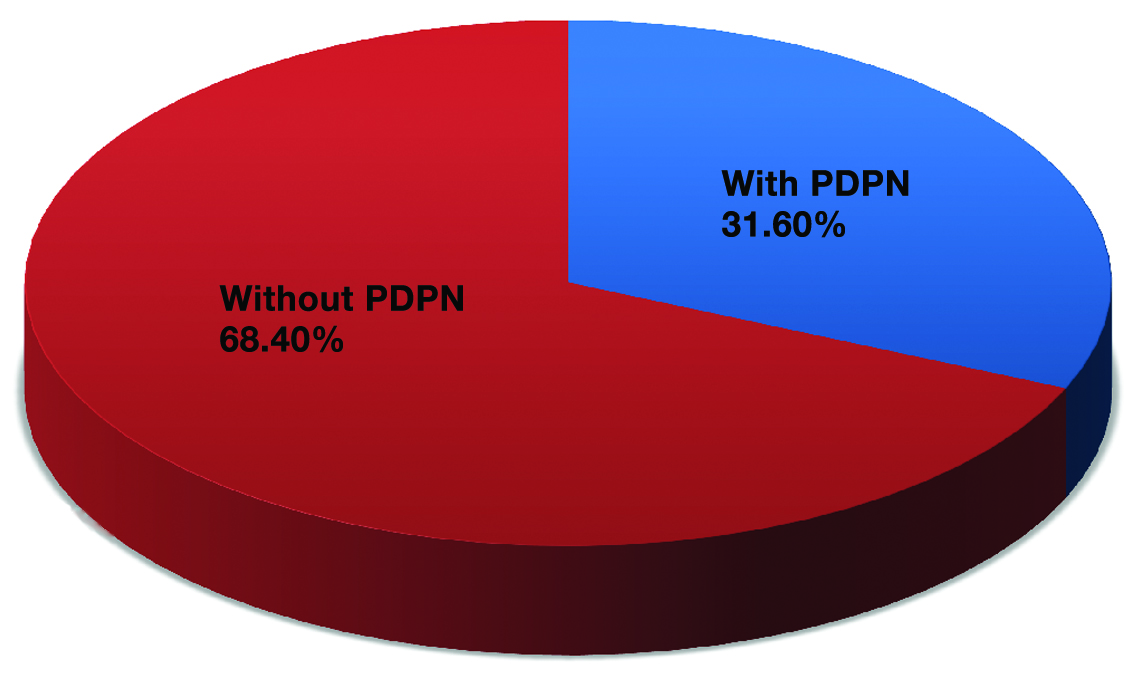
In the study, 320 participants were screened, and 288 were diagnosed with DPN. Among those 288 individuals, 91 reported experiencing PDPN, as assessed using the DN4 questionnaire. The prevalence was determined to be 31.6%, as shown in [Table/Fig-1].
The mean age of participants with DPN without pain was 58.6±9 years, while the mean age of participants with PDPN was 59.8±10 years. The ability to lateralisation for time and accuracy in both groups was similar. On the other hand, the duration of diabetes (in years) was more in the PDPN participants with a mean value of 13±8, compared to 9.1±8 in the group without PDPN. This result suggests that both groups were not well matched at baseline, with a p-value of 0.0003 [Table/Fig-2].
Demographic and clinical characteristics.
| CharacteristicsMean±SD | Without pain DPNn=197 | PDPN n=91 | t-value | p-value |
|---|
| Age (years) | 58.6±9 | 59.8±10 | -0.9261 | 0.3552 |
| Weight (kg) | 65.5±11 | 65.8±9 | -0.2242 | 0.8227 |
| Height (mts) | 3.3±16 | 3.3±16 | -0.0377 | 0.97 |
| BMI (kg/m2) | 25.2±4 | 25.5±4 | -0.5534 | 0.5804 |
| Duration of diabetes (years) | 9.1±8 | 13±8 | -3.6824 | 0.0003* |
| Lateralisation, Mean±SD |
| Time left (sec) | 2.2±1.3 | 2.2±1.2 | -0.1242 | 0.9013 |
| Time right (sec) | 2.3±1.4 | 2.3±1.3 | 0.1773 | 0.8594 |
| Accuracy, left (%) | 66.1±24 | 68±25 | -0.7656 | 0.4445 |
| Accuracy, right (%) | 69±23 | 69±24 | -0.0539 | 0.9571 |
*p<0.05, statistically significant
The study results indicate a statistically significant difference (p-value <0.05) in various domains of the RAND-SF 36 between the two groups. The differences were as follows: physical functioning (69±25 for the non pain group and 57.8±27 for the PDPN group, p=0.0005), role limitations due to physical health (68±42 and 45±45, p=0.0001), role limitations due to emotional problems (79±38 and 63±46, p=0.00029), social functioning (80±22 and 70±25, p=0.0004), pain (73±21 and 63±21, p=0.0002), and health change (52±23 and 45±22, p=0.0217). These results suggest that individuals experiencing PDPN are more adversely affected than those without pain associated with DPN. However, the domains of energy/fatigue, emotional wellbeing, and general health did not show statistically significant differences between both the groups [Table/Fig-3].
| Domains | Without pain DPNn=197 | PDPN n=91 | t-value | p-value |
|---|
| Physical functioning | 69±25 | 57.8±27 | 3.5021 | 0.0005* |
| Role limitation due to physical health | 68±42 | 45±45 | 4.208 | 0.0001* |
| Role limitation due to emotional problems | 79±38 | 63±46 | 2.999 | 0.00029* |
| Energy/fatigue | 53±16 | 50±17 | 1.281 | 0.2010 |
| Emotional wellbeing | 62±18 | 60±17 | 0.489 | 0.6252 |
| Social functioning | 80±22 | 70±25 | 3.552 | 0.0004* |
| Pain | 73±21 | 63±21 | 3.723 | 0.0002* |
| General health | 50±17 | 46±17 | 1.642 | 0.1017 |
| Health change | 52±23 | 45±22 | 2.307 | 0.0217* |
*p<0.05, statistically significant
Discussion
The present study aimed to estimate the prevalence of PDPN and its impact on QoL in patients in Goa, India. The prevalence of PDPN was estimated to be 31.6% using the DN-4 questionnaire. A study conducted by Baxi H et al., reported the prevalence of PDPN to be 28.85% in New Delhi, India [25]. In contrast, a study by Li C et al., in China noted that 57.2% of diabetic neuropathy patients experienced painful neuropathy [13]. In Hong Kong, Taiwan, and Thailand, the estimated prevalence of PDPN ranged from 12% to 18%, while the prevalence in Malaysia was 29%, and in the Philippines, it was 33% [26].
The mean age of patients with PDPN in this study was estimated to be 59.8±10 years. Diabetic patients over the age of 60 years were found to be 1.7 times more likely to develop diabetic neuropathy compared to those <60 years old [27]. Numerous studies have also indicated that the risk of diabetic neuropathy rises with age [28-30].
In the present study, the mean BMI of patients with PDPN was 25.5±4 kg/m2. A study conducted by Zhang Y et al., reported a mean BMI of 24.99±7.51 kg/m2 [30]. Contradictory results were noted in another study conducted in the USA by Petersen EA et al., which reported a higher mean BMI of 33.7 kg/m2 [31]. This discrepancy may be attributed to the higher prevalence of obesity in the USA. In both types of diabetes, obesity is linked to endothelial dysfunction and systemic inflammation, which can contribute to peripheral neuropathy [32].
The present study reported an average duration of diabetes of 13±8 years for PDPN. Similar findings were observed in the study conducted by Shillo P et al., which reported an average duration of 15 years [33]. Various structural and metabolic changes in neurons associated with a longer duration of diabetes have been implicated in the development of diabetic neuropathy [34,35].
The left and right-sides of the brain are specialised to attend to different types of information, process sensory inputs in different ways, and control different types of motor behaviour. This phenomenon is referred to as hemispheric specialisation or simply brain lateralisation [36]. In the present study, participants took longer to complete the lateralisation test and had lower accuracy compared to normal values. This can be attributed to the neurocognitive changes observed in diabetic patients, which have been linked to alterations in both white and grey matter volumes [36-38]. The study conducted by Segerdahl AR et al., suggested that dysfunction in the ventrolateral periaqueductal grey-mediated descending pain modulatory system represents a brain-based mechanism of pain facilitation that contributes to painful diabetic polyneuropathy [39].
In the present study, PDPN has also been shown to impact physical functioning, role limitations due to physical health, emotional role problems, social functioning, pain, and health changes, ultimately resulting in a low QoL. Pain and other symptoms significantly impact the QoL and functionality of patients with PDPN, disrupting daily activities and leading to increased anxiety, depression, and a loss of self-efficacy [40]. Mobility impairments, such as reduced walking speeds and difficulty securely navigating the physical environment, can influence an individual’s socio-economic and mental wellbeing, thereby affecting physical functioning [41]. In conclusion, symptoms like pain, anxiety, and sleep disturbances significantly decrease the QoL in individuals with PDPN [42].
Limitation(s)
Nerve conduction studies were not used as an objective measure because they were not readily available.
Conclusion(s)
The prevalence of PDPN was determined to be 31.6%. Participants with PDPN exhibited a longer duration of diabetes and experienced notable impairments in various domains of QoL, like physical functioning, social functioning, and pain. This study reinforces the need for targeted interventions and comprehensive management strategies to address the complex challenges faced by patients with PDPN. Interventions that target the biopsychosocial aspects, like physiotherapy, could offer solutions for managing pain, thus maintaining QoL.
*p<0.05, statistically significant
*p<0.05, statistically significant
[1]. Harreiter J, Roden M, Diabetes mellitus- Definition, Klassifikation, Diagnose, Screening und Prävention (Update 2023) [Diabetes mellitus: Definition, classification, diagnosis, screening and prevention (Update 2023)]Wien Klin Wochenschr 2023 135(Suppl 1):07-17.German. Epub 2023 Apr 20. PMCID: PMC1013303610.1007/s00508-022-02122-y37101021 [Google Scholar] [CrossRef] [PubMed]
[2]. Pradeepa R, Mohan V, Epidemiology of type 2 diabetes in IndiaIndian J Ophthalmol 2021 69(11):2932-38.PMCID: PMC872510910.4103/ijo.IJO_1627_2134708726 [Google Scholar] [CrossRef] [PubMed]
[3]. Luhar S, Kondal D, Jones R, Anjana RM, Patel SA, Kinra S, Lifetime risk of diabetes in metropolitan cities in IndiaDiabetologia 2021 64(3):521-29.Epub 2020 Nov 23. PMCID: PMC786481810.1007/s00125-020-05330-133225415 [Google Scholar] [CrossRef] [PubMed]
[4]. Chang MC, Yang S, Diabetic peripheral neuropathy essentials: A narrative reviewAnn Palliat Med 2023 12(2):390-98.Epub 2023 Feb 810.21037/apm-22-69336786097 [Google Scholar] [CrossRef] [PubMed]
[5]. Jensen TS, Karlsson P, Gylfadottir SS, Andersen ST, Bennett DL, Tankisi H, Painful and non-painful diabetic neuropathy, diagnostic challenges and implications for future managementBrain 2021 144(6):1632-45.PMCID: PMC832026910.1093/brain/awab07933711103 [Google Scholar] [CrossRef] [PubMed]
[6]. Ahmad I, Verma S, Noohu MM, Shareef MY, Hussain ME, Sensorimotor and gait training improves proprioception, nerve function, and muscular activation in patients with diabetic peripheral neuropathy: A randomized control trialJ Musculoskelet Neuronal Interact 2020 20(2):234-48.PMCID: PMC728838232481239 [Google Scholar] [PubMed]
[7]. Jang HN, Oh TJ, Pharmacological and nonpharmacological treatments for painful diabetic peripheral neuropathyDiabetes Metab J 2023 47(6):743-56.Epub 2023 Sep 6. PMCID: PMC1069572310.4093/dmj.2023.001837670573 [Google Scholar] [CrossRef] [PubMed]
[8]. Hicks CW, Selvin E, Epidemiology of peripheral neuropathy and lower extremity disease in diabetesCurr Diab Rep 2019 19(10):86Published 2019 Aug 2710.1007/s11892-019-1212-8 [Google Scholar] [CrossRef]
[9]. Abdissa D, Prevalence and associated factors of painful diabetic peripheral neuropathy among diabetic patients on follow up at Jimma University Medical CenterJ Diabetes Metab Disord 2020 19(2):1407-13.PMCID: PMC784370810.1007/s40200-020-00661-733520843 [Google Scholar] [CrossRef] [PubMed]
[10]. Preston FG, Riley DR, Azmi S, Alam U, Painful diabetic peripheral neuropathy: Practical guidance and challenges for clinical managementDiabetes Metab Syndr Obes 2023 16:1595-612.PMCID: PMC1024334710.2147/DMSO.S37005037288250 [Google Scholar] [CrossRef] [PubMed]
[11]. Elafros MA, Andersen H, Bennett DL, Savelieff MG, Viswanathan V, Callaghan BC, Towards prevention of diabetic peripheral neuropathy: Clinical presentation, pathogenesis, and new treatmentsLancet Neurol 2022 21(10):922-36.PMCID: PMC1011283610.1016/S1474-4422(22)00188-036115364 [Google Scholar] [CrossRef] [PubMed]
[12]. Ponirakis G, Elhadd T, Al Ozairi E, Brema I, Chinnaiyan S, Taghadom E, Prevalence and risk factors for diabetic peripheral neuropathy, neuropathic pain and foot ulceration in the Arabian Gulf regionJ Diabetes Investig 2022 13(9):1551-59.Epub 2022 May 5. PMCID: PMC943458210.1111/jdi.1381535445568 [Google Scholar] [CrossRef] [PubMed]
[13]. Li C, Wang W, Ji Q, Ran X, Kuang H, Yu X, Prevalence of painful diabetic peripheral neuropathy in type 2 diabetes mellitus and diabetic peripheral neuropathy: A nationwide cross-sectional study in mainland ChinaDiabetes Res Clin Pract 2023 198:110602Epub 2023 Mar 410.1016/j.diabres.2023.11060236871876 [Google Scholar] [CrossRef] [PubMed]
[14]. Xiaohua G, Dongdong L, Xiaoting N, Shuoping C, Feixia S, Huajun Y, Severe vitamin D deficiency is associated with increased expression of inflammatory cytokines in painful diabetic peripheral neuropathyFront Nutr 2021 8:612068PMCID: PMC798780710.3389/fnut.2021.61206833777989 [Google Scholar] [CrossRef] [PubMed]
[15]. Selvarajah D, Kar D, Khunti K, Davies MJ, Scott AR, Walker J, Diabetic peripheral neuropathy: Advances in diagnosis and strategies for screening and early interventionLancet Diabetes Endocrinol 2019 7(12):938-48.Epub 2019 Oct 1410.1016/S2213-8587(19)30081-631624024 [Google Scholar] [CrossRef] [PubMed]
[16]. Taylor RS, Health-related quality of life and spinal cord stimulation in painful diabetic neuropathyDiabetes Res Clin Pract 2023 206(Suppl 1):11082610.1016/j.diabres.2023.11082638245322 [Google Scholar] [CrossRef] [PubMed]
[17]. Ponirakis G, Elhadd T, Chinnaiyan S, Hamza AH, Sheik S, Kalathingal MA, Prevalence and risk factors for diabetic neuropathy and painful diabetic neuropathy in primary and secondary healthcare in QatarJ Diabetes Investig 2021 12(4):592-600.Epub 2020 Sep 14. PMCID: PMC801583310.1111/jdi.1338832799429 [Google Scholar] [CrossRef] [PubMed]
[18]. Tesfaye S, Brill S, Eerdekens M, Labrador MM, Petersen G, de Rooij Peek A, Diagnosis, management and impact of painful diabetic peripheral neuropathy: A patient survey in four European countriesJ Diabetes Complications 2023 37(4):108417Available from: https://doi.org/10.1016/j.jdiacomp.2023.108417 [Google Scholar]
[19]. Abd-Elsayed AA, Marcondes LP, Loris ZB, Reilly D, Painful diabetic peripheral neuropathy- A survey of patient experiencesJ Pain Res 2023 16:2269-85.Available from: https://doi.org/10.2147/JPR.S409876 [Google Scholar]
[20]. Jamal A, Ahmad I, Ahamed N, Azharuddin M, Alam F, Hussain ME, Whole body vibration showed beneficial effect on pain, balance measures and quality of life in painful diabetic peripheral neuropathy: A randomized controlled trialJ Diabetes Metab Disord 2019 19(1):61-69.PMCID: PMC727039510.1007/s40200-019-00476-132550157 [Google Scholar] [CrossRef] [PubMed]
[21]. Yang Z, Chen R, Zhang Y, Huang Y, Hong T, Sun F, Scoring systems to screen for diabetic peripheral neuropathyCochrane Database Syst Rev 2018 2018(7):CD010974PMCID: PMC651366710.1002/14651858.CD010974.pub2 [Google Scholar] [CrossRef]
[22]. Ríos-León M, Taylor J, Segura-Fragoso A, Barriga-Martín A, Usefulness of the DN4, S-LANSS, and pain DETECT screening questionnaires to detect the neuropathic pain components in people with acute whiplash-associated disorders: A cross-sectional studyPain Med 2024 25(5):344-51.PMCID: PMC1106374810.1093/pm/pnad16538150190 [Google Scholar] [CrossRef] [PubMed]
[23]. Ankush Dias A, Gomes E, Dessai A, Complications in advanced diabetics in a tertiary care centre: A retrospective registry-based studyJ Clin Diagn Res 2016 10(4):OC15-OC19.Epub 2016 Apr 1. PMCID: PMC486615910.7860/JCDR/2016/15268.758327190861 [Google Scholar] [CrossRef] [PubMed]
[24]. RAND HEALTH CARE36-Item Short Form Survey (SF-36) Scoring Instructions (Version 1.0) [Internet] 1992 Santa Monica, California[cited 2024 Aug]. Available from: https://www.rand.org/health/surveys_tools/mos/mos_core_36item_scoring.html [Google Scholar]
[25]. Baxi H, Habib A, Hussain MS, Hussain S, Dubey K, Prevalence of peripheral neuropathy and associated pain in patients with diabetes mellitus: Evidence from a cross-sectional studyJ Diabetes Metab Disord 2020 19(2):1011-17.PMCID: PMC784366010.1007/s40200-020-00597-y33520819 [Google Scholar] [CrossRef] [PubMed]
[26]. Malik RA, Aldinc E, Chan SP, Deerochanawong C, Hwu CM, Rosales RL, Perceptions of painful diabetic peripheral neuropathy in South-East Asia: Results from patient and physician surveysAdv Ther 2017 34(6):1426-37.Epub 2017 May 13. PMCID: PMC548788110.1007/s12325-017-0536-528502036 [Google Scholar] [CrossRef] [PubMed]
[27]. Kamalarathnam SR, Varadarajan S, Diabetic peripheral neuropathy in diabetic patients attending an urban health and training centreJ Family Med Prim Care 2022 11(1):113-17.Epub 2022 Jan 31. PMCID: PMC893017210.4103/jfmpc.jfmpc_470_2135309653 [Google Scholar] [CrossRef] [PubMed]
[28]. Zhu J, Hu Z, Luo Y, Liu Y, Luo W, Du X, Diabetic peripheral neuropathy: Pathogenetic mechanisms and treatmentFront Endocrinol (Lausanne) 2024 14:1265372PMCID: PMC1080388310.3389/fendo.2023.126537238264279 [Google Scholar] [CrossRef] [PubMed]
[29]. Carmichael J, Fadavi H, Ishibashi F, Shore AC, Tavakoli M, Advances in screening, early diagnosis and accurate staging of diabetic neuropathyFront Endocrinol (Lausanne) 2021 12:671257PMCID: PMC818898410.3389/fendo.2021.67125734122344 [Google Scholar] [CrossRef] [PubMed]
[30]. Zhang Y, Zhang S, Pan L, Wang B, Sun Y, Gao L, Painful Diabetic Peripheral Neuropathy Study of Chinese Outpatients (PDNSCOPE): A multicentre cross-sectional registry study of clinical characteristics and treatment in Mainland ChinaPain Ther 2021 10(2):1355-73.Epub 2021 Aug 7. PMCID: PMC858627710.1007/s40122-021-00281-w34363598 [Google Scholar] [CrossRef] [PubMed]
[31]. Petersen EA, Stauss TG, Scowcroft JA, Brooks ES, White JL, Sills SM, Effect of High-frequency (10-kHz) spinal cord stimulation in patients with painful diabetic neuropathy: A randomized clinical trialJAMA Neurol 2021 78(6):687-98.PMCID: PMC802226810.1001/jamaneurol.2021.053833818600 [Google Scholar] [CrossRef] [PubMed]
[32]. Lim JZM, Burgess J, Ooi CG, Ponirakis G, Malik RA, Wilding JPH, The peripheral neuropathy prevalence and characteristics are comparable in people with obesity and long-duration type 1 diabetesAdv Ther 2022 39(9):4218-29.Epub 2022 Jul 22. PMCID: PMC940274110.1007/s12325-022-02208-z35867275 [Google Scholar] [CrossRef] [PubMed]
[33]. Shillo P, Selvarajah D, Greig M, Gandhi R, Rao G, Wilkinson ID, Reduced vitamin D levels in painful diabetic peripheral neuropathyDiabet Med 2019 36(1):44-51.Epub 2018 Sep 2010.1111/dme.1379830102801 [Google Scholar] [CrossRef] [PubMed]
[34]. Maiga Y, Diallo S, Konipo FDN, Sangho O, Sangaré M, Diallo SH, Diabetic polyneuropathy with/out neuropathic pain in Mali: A cross-sectional study in two reference diabetes treatment centers in Bamako (Mali), Western AfricaPLoS One 2020 15(11):e0241387PMCID: PMC765232410.1371/journal.pone.024138733166296 [Google Scholar] [CrossRef] [PubMed]
[35]. Rogers LJ, Brain lateralization and cognitive capacityAnimals (Basel) 2021 11(7):1996PMCID: PMC830023110.3390/ani1107199634359124 [Google Scholar] [CrossRef] [PubMed]
[36]. Luna R, Talanki Manjunatha R, Bollu B, Jhaveri S, Avanthika C, Reddy N, A comprehensive review of neuronal changes in diabeticsCureus 2021 13(10):e19142PMCID: PMC862835810.7759/cureus.1914234868777 [Google Scholar] [CrossRef] [PubMed]
[37]. Sebastian MJ, Khan SK, Pappachan JM, Jeeyavudeen MS, Diabetes and cognitive function: An evidence-based current perspectiveWorld J Diabetes 2023 14(2):92-109.PMCID: PMC1001189910.4239/wjd.v14.i2.9236926658 [Google Scholar] [CrossRef] [PubMed]
[38]. Aderinto N, Olatunji G, Abdulbasit M, Ashinze P, Faturoti O, Ajagbe A, The impact of diabetes in cognitive impairment: A review of current evidence and prospects for future investigationsMedicine (Baltimore) 2023 102(43):e35557PMCID: PMC1061547810.1097/MD.000000000003555737904406 [Google Scholar] [CrossRef] [PubMed]
[39]. Segerdahl AR, Themistocleous AC, Fido D, Bennett DL, Tracey I, A brain-based pain facilitation mechanism contributes to painful diabetic polyneuropathyBrain 2018 141(2):357-64.PMCID: PMC583762810.1093/brain/awx33729346515 [Google Scholar] [CrossRef] [PubMed]
[40]. Anastasi JK, Capili B, Detecting peripheral neuropathy in patients with diabetes, prediabetes and other high-risk conditions: An advanced practice nurse’s perspectiveJ Med Clin Nurs 2022 3(2):143Epub 2022 Mar 21. PMCID: PMC901785710.47363/jmcn/2022(3)14335445219 [Google Scholar] [CrossRef] [PubMed]
[41]. Alghamdi M, Owolabi LF, Adamu B, Taura MG, Jibo A, Almansour M, Disease-specific quality of life in patients with diabetic neuropathySaudi Med J 2022 43(4):408-17.PMCID: PMC999804910.15537/smj.2022.43.4.2021086135414620 [Google Scholar] [CrossRef] [PubMed]
[42]. Davoudi M, Rezaei P, Rajaeiramsheh F, Ahmadi SM, Taheri AA, Predicting the quality of life based on pain dimensions and psychiatric symptoms in patients with Painful diabetic neuropathy: A cross-sectional prevalence study in Iranian patientsHealth Qual Life Outcomes 2021 19(1):49Erratum in: Health Qual Life Outcomes. 2022;20(1):32. Doi: 10.1186/s12955-022-01939-5. PMCID: PMC787153410.1186/s12955-021-01697-w33563291 [Google Scholar] [CrossRef] [PubMed]