The initial dental visit is crucial for shaping a child’s attitude towards dental care and can foster positive behaviour in the dental office if conducted appropriately [1]. Ensuring a child’s cooperation during treatment is essential for providing quality dental care [2]. DFA in children present significant challenges for paediatric dentists [3]. These fears often result in delays or avoidance of regular dental care, leading to an increase in untreated dental issues and associated morbidity, which adversely affects a child’s oral health and, consequently, their quality of life [4].
Various factors contribute to the development of DFA, including physical, physiological, psychological, psychosocial, environmental, and cultural influences [5]. Additionally, factors specific to the child, such as age, cultural background, parental transmission of fear, cognition, and previous dental experiences, also play a role [6]. The prevalence of dental anxiety and fear in children ranges from 5% to 20%, with an average prevalence of 11% [7]. This inability to manage threatening dental stimuli often leads to behaviour management challenges.
By evaluating a child’s fear, paediatric dentists can intervene to disrupt the cycle of dental anxiety, promoting a more positive attitude toward dental care and ensuring good oral health [8]. Both pharmacological and non-pharmacological behaviour modification techniques are employed to manage a child’s anxiety in a dental setting, with a preference for non-pharmacological approaches due to their numerous advantages [9]. Common non-pharmacological techniques include Tell-Show-Do (TSD), parental presence and reassurance, distraction, eye movement distraction, systematic desensitisation, relaxation, audio analgesia, modelling, the use of audiovisual aids, and thaumaturgy [10,11].
The American Academy of Paediatric Dentistry has emphasised the importance of non-pharmacological behaviour interventions. The TSD method, a cornerstone of behaviour management introduced by Addelston in 1959, is based on principles of learning theory [12]. It involves telling the child what will happen, showing them a simulation, and then performing the procedure. The TPSD technique, a recent modification of TSD, includes explaining the procedure in a child-friendly manner, using euphemisms, and allowing the child to role-play as a dentist with dental imitation toys before the actual procedure [13]. This hands-on approach helps children in the preoperational stage of cognitive development better understand dental procedures through play [14].
Recently, smartphone dental game apps have been explored as tools to reduce DFA. These apps provide children with a virtual experience of dental procedures, enabling them to perform tasks such as oral prophylaxis, fillings, and extractions [15]. The use of video games as a behaviour management tool leverages principles of cognitive-behavioural therapy and neurofeedback mechanisms, making it particularly effective for children already accustomed to digital environments [16].
Materials and Methods
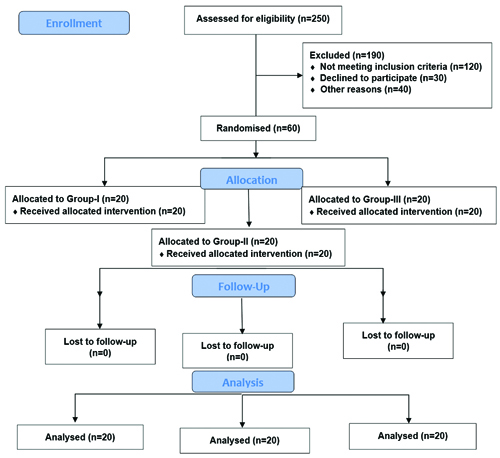
This in-vivo double-blind randomised clinical study was conducted in the Department of Paediatric and Preventive Dentistry at Dr. D. Y. Patil Dental College and Hospital, Pimpri, Pune, from June 2023 to September 2023. Ethical clearance was obtained from the Institutional Ethical Committee (DYPDCH/DPU/EC/391/14/2022), in adherence to the Helsinki Declaration of 1975, as revised in 2013. The trial was registered with the Clinical Trials Registry India (CTRI/2023/04/051874). This clinical trial conforms to the CONSORT guidelines [Table/Fig-1].
CONSORT 2010 flow diagram.
Participants were enrolled based on specific criteria. The inclusion criteria included children aged 4-8 years who were visiting the Department of Paediatric and Preventive Dentistry, had not received previous dental treatment, required Class I restoration (ICDAS Code 2 or Code 3) on any upper or lower molars, and had parental consent. The exclusion criteria included children experiencing pain, those with medical conditions, or those who were unaccompanied by a parent during the visit.
The sample size was calculated by the formula:
n=N*X/(X+N-1),
where, X=Zα/22 *p*(1-p)/MOE2
Where, N=population size; e=Margin of error (percentage in decimal form); Zα/2=critical value of the normal distribution at α/2 (for a confidence level of 95%, α=0.05 and the critical value=1.96), MOE=margin of error, p=sample proportion, and N=population size.
For this calculation, the values considered were p=0.5 (assuming maximum variability), N=1000 (hypothetical population size), and MOE=0.05 (margin of error). Using Open Epi Software, Version 3.01, with a 95% confidence interval and 80% power, the minimum sample size required was estimated to be 10 in each group. Since there were three groups, the total sample size required was 30. Therefore, after applying eligibility criteria and accounting for potential observer and instrumentation errors, the sample size was increased to 20 for each group.
A total of 60 children aged 4-8 years, attending their first dental visit and requiring Class I Glass Ionomer Cement restorations (ICDAS Code 2 and Code 3) in either the maxillary or mandibular molars, were randomly assigned to three groups of 20 each.
Group-I: TSD Technique (n=20)
Group-II: TSPD Technique (n=20)
Group-III: Smartphone Dental Game App (n=20)
Randomisation was performed using computer-generated numbers (Randomiser.com). Written informed consent, which outlined the purpose, procedure in brief, and confidentiality, was obtained. Parents were provided with written informed consent after the study’s purpose and procedures were thoroughly explained to them.
A single operator performed the restorations for both groups, while another assessor recorded the scales for all the patients. The result analysis was conducted by a statistician who was blinded to the study.
The CFSS-DS questionnaire, a validated tool for assessing DFA, was administered to parents to categorise their children into those with high DFA. It includes 15 items covering different aspects of dental treatment, with each item rated on a 5-point Likert scale. Children with a CFSS-DS score above 38, indicating high anxiety, were included in the study [17]. The children were randomly assigned to three groups, and their anxiety levels were assessed before and after the behaviour modification interventions using the MCDAS-f [18]. The assessment involved asking the child to choose a face that best represented their current feelings. The scale features five behaviourally defined categories ranging from 0 to 5, with higher scores indicating increased anxiety or reduced cooperation. The Visual Analogue Scale for Anxiety (VAS-A) was also used to score the patients’ anxiety levels. Patients’ anxiety scores before and after treatment were analysed to indicate the severity of anxiety levels: scores of 1-3 represent mild anxiety, scores of 4-6 indicate moderate anxiety, and scores of 7-10 reflect severe anxiety [19].
Children’s anxiety levels before and after the Class I GIC (ICDAS Code 2 and Code 3) restorative treatment procedure were also assessed by recording their heart rates before and after the procedure. Additionally, SpO2 levels during the procedure were recorded as a physiological measurement using a portable finger pulse oximeter device.
Group I: TSD children were conditioned using the conventional TSD technique. This involved explaining the procedure, demonstrating it on a cast model, and allowing the child to handle dental instruments. Child-friendly language and euphemisms, along with verbal and nonverbal communication, were used to make the process understandable and less intimidating.
Group II: TPSD - In this group, children were provided with a customised dental instrument toy set called the “Play-Doh Doctor Drill ’N Fill Retro Pack,” manufactured by Hasbro Limited and procured through Amazon India. Play-Doh, a reusable clay-based modelling compound, is often used by children for art projects. The operator explained the customised dental objects using terms and procedures appropriate to the child’s cognitive level. The child was then given the opportunity to hold and use dental instruments, including an airotor that replicates the drilling effect and sound of a real airotor, to simulate performing a dental procedure. This hands-on approach aimed to familiarise children with the dental set-up through play.
Group III: Smartphone Dental Game App - Children in this group used the “Baby Shark - Dentist Game” app developed by Andre Scheidemantel, available on the Apple App Store. This app simulates various dental procedures and equipment through animated visuals and sound effects. The game showcased the use of standard dental tools such as airotors, ultrasonic scalers, and suction tips through animated images combined with visual and sound effects, providing children with a simulated experience of their operation, associated noises, and clinical outcomes. Subsequently, each child in this group was encouraged to role-play as a dentist and conduct virtual dental procedures using the app. A group of paediatric dentists verified the app’s content. The app allowed children to virtually perform dental procedures, providing a first-hand experience of the dental environment. The content of the app was verbally translated into the local vernacular language to include explanations and instructions to ensure comprehension and engagement by the children. This adaptation aimed to make the app more accessible and relatable to the participants, who primarily spoke the local language.
Statistical Analysis
Statistical software: SPSS version 27.0 (IBM; Chicago, IL) was used to analyse the data. Demographic variables were analysed using frequency (N) and percentage (%). To assess statistical significance, a Chi-square test was applied [Table/Fig-2]. Oxygen saturation levels (SpO2) were described using descriptive statistics [Table/Fig-3]. For the analysis before and after treatment, pulse rate was evaluated using a paired t-test [Table/Fig-4], while the MCDAS-f scale and VAS scale were assessed using the Wilcoxon signed-rank test. For the comparison of the three groups, the VAS scale was analysed using the Kruskal-Wallis test, followed by multiple group comparisons using the Bonferroni post-hoc test, as it showed statistical significance with the Kruskal-Wallis test [Table/Fig-4,5 and 6]. The MCDAS-f scale, pulse rate, and SpO2 were compared using one-way Analysis of Variance (ANOVA). A p-value of <0.05 was considered statistically significant, adhering to all the assumptions of the statistical tests. The data analysis is presented in both table and graph formats. Graphical representation of the data was created using MS Excel.
Demographic details of the study participants.
| Demographic variables | Group-I | Group-II | Group-III | Total | Sig. |
|---|
| Age (in years) | 4 | 0 (0.0%) | 4 (20.0%) | 4 (20.0%) | 8 (13.3%) | χ2=12.14df=10p=0.276 (NS) |
| 4.5 | 1 (5.0%) | 4 (20.0%) | 2 (10.0%) | 7 (11.7%) |
| 5 | 5 (25.0%) | 6 (30.0%) | 6 (30.0%) | 17 (28.3%) |
| 6 | 7 (35.0%) | 4 (20.0%) | 6 (30.0%) | 17 (28.3%) |
| 7 | 6 (30.0%) | 2 (10.0%) | 2 (10.0%) | 10 (16.7%) |
| 8 | 1 (5.0%) | 0 (0.0%) | 0 (0.0%) | 1 (1.7%) |
| Gender | Female | 7 (35.0%) | 9 (45.0%) | 7 (35.0%) | 23 (38.3%) | χ2=0.56df=02p=0.75 (NS) |
| Male | 13 (65.0%) | 11 (55.0%) | 13 (65.0%) | 37 (61.7%) |
| Dentition type | Primary | 8 (40.0%) | 13 (65.0%) | 19 (95.0%) | 40 (66.7%) | χ2=13.65df=02p=0.001 (S) |
| Permanent | 12 (60.0%) | 7 (35.0%) | 1 (5.0%) | 20 (33.3%) |
| No. of teeth treated | Single | 19 (95.0%) | 17 (85.0%) | 20 (100.0%) | 56 (93.3%) | χ2=3.75df=02p=0.15 (NS) |
| >1 | 1 (5.0%) | 3 (15.0%) | 0 (0.0%) | 4 (6.7%) |
| If siblings are undergoing treatment | Not applicable | 2 (10.0%) | 1 (5.0%) | 3 (15.0%) | 6 (10.0%) | χ2=3.41df=04p=0.49 (NS) |
| No | 9 (45.0%) | 14 (70.0%) | 11 (55.0%) | 34 (56.7%) |
| Yes | 9 (45.0%) | 5 (25.0%) | 6 (30.0%) | 20 (33.3%) |
Descriptive statistics of the outcome measure SpO2 levels in all the three groups.
| Min | Max | Mean | SD | SE | Median | IQR | 95% CI |
|---|
| LB | UB |
|---|
| Group-I | 95 | 99 | 96.80 | 1.00 | 0.22 | 97.00 | 1 | 96.33 | 97.27 |
| Group-II | 95 | 99 | 96.55 | 1.14 | 0.25 | 96.50 | 1 | 96.01 | 97.50 |
| Group-III | 95 | 99 | 97.55 | 1.09 | 0.24 | 98.00 | 1 | 97.04 | 98.06 |
Comparison of pulse rate and MCDAS-f scale for anxiety before and after the dental treatment in each individual group using paired t-test.
| Outcome measure | Groups | Time | Mean (SD) | SEM | Mean difference | 95% CI | t-value | df | Sig. |
|---|
| L | U |
|---|
| Pulse rate | 1 | Pre | 84.55 (6.18) | 1.38 | 2.10 | -0.97 | 5.17 | 1.43 | 19 | 0.169 (NS) |
| Post | 82.45 (4.81) | 1.07 |
| 2 | Pre | 83.50 (5.18) | 1.16 | 3.40 | 0.76 | 6.03 | 2.70 | 19 | 0.014 (S) |
| Post | 80.10 (6.50) | 1.45 |
| 3 | Pre | 82.25 (4.81) | 1.07 | 0.25 | -2.45 | 2.95 | 0.19 | 19 | 0.84 (NS) |
| Post | 82.00 (4.20) | 0.94 |
| MCDAS-f | 1 | Pre | 33.20 (5.12) | 1.14 | 7.40 | 5.09 | 9.70 | 6.72 | 19 | <0.001 (S) |
| Post | 25.80 (2.37) | 0.53 |
| 2 | Pre | 38.70 (3.13) | 0.70 | 19.25 | 16.84 | 21.65 | 16.75 | 19 | <0.001 (S) |
| Post | 19.45 (3.94) | 0.88 |
| 3 | Pre | 35.60 (4.52) | 1.01 | 14.25 | 11.79 | 16.70 | 12.13 | 19 | <0.001 (S) |
| Post | 21.35 (3.89) | 0.87 |
S: Significant at p-value <0.05; NS: Not significant
Group-wise comparison of MCDAS-f scale for anxiety before and after the dental treatment using One-way Analysis of Variance test followed by multiple group comparison using Bonferrori post-hoc test.
| Outcome measure | | Sum of squares | df | Mean square | F-value | Sig. | Post-hoc |
|---|
| Groups | Sig. |
|---|
| MCDAS-f scale | Pre treatment | Between groups | 139.03 | 2 | 69.51 | 3.19 | 0.048 (S) | Group-I vs. Group-II | 0.98 (NS) |
| Within groups | 1239.30 | 57 | 21.74 | Group-I vs. Group-III | 0.39 (NS) |
| Group-II vs. Group-III | 0.045 (S) |
| Post treatment | Between groups | 171.30 | 2 | 85.65 | 5.17 | 0.009 (S) | Group-I vs. Group-II | 1.00 (NS) |
| Within groups | 944.30 | 57 | 16.56 | Group-I vs. Group-III | 0.01 (S) |
| Group-II vs. Group-III | 0.05 (S) |
| Pulse rate | Pre treatment | Between groups | 0.63 | 2 | 0.31 | 0.10 | 0.99 (NS) | - | |
| Within groups | 1730.10 | 57 | 30.35 | | |
| Post treatment | Between groups | 1.63 | 2 | 0.81 | 0.28 | 0.97 (NS) | - | |
| Within groups | 1641.35 | 57 | 28.79 | | |
| SpO2 | Between groups | 10.83 | 2 | 5.41 | 4.60 | 0.014 (S) | Group-I vs. Group-II | 1.00 (NS) |
| Within groups | 67.10 | 57 | 1.17 | Group-I vs. Group-III | 0.09 (NS) |
| Group-II vs. Group-III | 0.015 (S) |
S: Significant at p-value <0.05; NS: Not significant
Group-wise comparison of VAS scale for anxiety before and after the dental treatment using Kruskal Wallis test followed by multiple group comparison using Bonferrori post-hoc test.
| Median | IQR | Kruskal-Wallis test | Post-hoc |
|---|
| Mean rank | Sig. | Groups | Mean rank | Sig. |
|---|
| Pre treatment | Group-I | 3 | 4, 3 | 0.41 | 0.81 (NS) | - |
| Group-II | 3 | 4, 3 |
| Group-III | 3 | 4, 3 |
| Post treatment | Group-I | 2 | 3, 2 | 36.85 | <0.001 (S) | Group-I vs. Group-II | 31.975 | <0.001 (S) |
| Group-II | 0 | 0, 0 | Group-I vs. Group-III | 18.350 | 0.002 (S) |
| Group-III | 1 | 2, 0.25 | Group-II vs. Group-III | -13.625 | 0.030 (S) |
S: Significant at p-value <0.05; NS: Not significant
Results
A total of 60 children aged 4-8 years were randomly assigned to three groups of 20 each: TSD technique (n=20), TSPD technique (n=20), and smartphone dental game (n=20). The demographic characteristics, including mean age, gender, number of teeth treated, and whether siblings were undergoing treatment, were comparable across all groups. Oral screening, oral prophylaxis, and Class I Glass Ionomer restorative treatment were completed for each group. Statistical analysis revealed that dentition status (primary or permanent teeth present) had a significant impact on DFA (χ2=13.65; df=2; p=0.001), whereas other demographic variables were not significant [Table/Fig-2]. Additionally, no significant differences were found in the Parent’s CFSS-DS scores (p=0.529) [Table/Fig-7].
Showing intergroup comparison between three groups for the parents’ CFSSDS score.
| Outcome measured | Groups | Mean | Std. Deviation | p-value |
|---|
| Parents’ CFSSDS score more than 38 | 1. Tell-Show-Do (TSD) | 59.10 | 6.59 | 0.529 (NS) |
| 2. Tell-Show-Play-Do (TSPD) | 57.04 | 7.39 |
| 3. Smartphone dental game app | 56.70 | 7.68 |
The mean SpO2 level was lowest in the Group II TSPD group (96.55) [Table/Fig-3]. Analysis of pulse rate and MCDAS-f scale for anxiety using a paired t-test showed that the pulse rate did not change significantly before and after treatment in the TSD and smartphone dental game groups. However, in the TSPD group, the mean pulse rate decreased significantly post-treatment (p=0.014). MCDAS-f scores indicated a significant reduction in anxiety across all groups (p<0.001), with the highest mean difference observed in the TSPD group, suggesting that it was the most effective method for reducing anxiety [Table/Fig-4].
When comparing the MCDAS-f scale for anxiety before and after treatment using one-way ANOVA with Bonferroni post-hoc test [Table/Fig-5], significant differences were found between the TSPD and smartphone dental game groups before treatment (p=0.045). Post-treatment results were highly significant (p=0.009), showing a substantial reduction in dental anxiety following all interventions. The TSPD group showed a more significant reduction in anxiety compared to the TSD (p=0.01) and smartphone dental game groups (p=0.05). Pulse rate analysis showed no significant reduction before and after the intervention across all groups, while SpO2 levels displayed significant differences only between the TSPD and smartphone dental game groups.
Further analysis of the VAS-A Scale using the Wilcoxon signed-rank test [Table/Fig-8] demonstrated that DFA significantly decreased in all groups after the intervention (p<0.001), with the TSPD group showing the most substantial impact, where 16.7% of children were no longer anxious post-intervention. Group wise comparison of the VAS scale for anxiety was conducted with the Kruskal-Wallis test followed by Bonferroni post-hoc test [Table/Fig-6], which revealed no significant differences pre-treatment. However, post-treatment comparisons showed significant differences (p<0.001) among all groups, with the highest significance between the TSD and TSPD groups (p<0.001), followed by the TSD and smartphone dental game app groups (p=0.002), and then between the TSPD and smartphone dental game app groups (p=0.03).
Comparison of VAS scale for anxiety before and after the dental treatment in each group using the Wilcoxon sign-rank test.
| VAS | Not anxious | Mild anxiety scores (1-3) | Moderate anxiety (4-6) | Severe anxiety (7-10) | Total | SE | Test statistics | Sig. |
|---|
| 1 | Pre | 0 (0%) | 12 (20.0%) | 8 (13.3%) | 0 (0%) | 20 (33.3%) | 18.83 | -3.61 | <0.001 (S) |
| Post | 7 (11.7%) | 13 (21.7%) | 0 (0%) | 0 (0%) | 20 (33.3%) |
| 2 | Pre | 0 (0%) | 13 (21.7%) | 7 (11.7%) | 0 (0%) | 20 (33.3%) | 25.87 | -4.05 | <0.001 (S) |
| Post | 10 (16.7%) | 10 (16.7%) | 0 (0%) | 0 (0%) | 20 (33.3%) |
| 3 | Pre | 0 (0%) | 11 (18.3%) | 9 (15.0%) | 0 (0%) | 20 (33.3%) | 26.41 | -3.97 | <0.001 (S) |
| Post | 4 (6.7%) | 16 (26.7%) | 0 (0%) | 0 (0%) | 20 (33.3%) |
S: Significant at p-value <0.05; NS: Not significant
Thus, all three techniques were effective in alleviating DFA in children, with the TSPD technique demonstrating superior effectiveness across multiple parameters.
Discussion
The outcomes of the study significantly highlight the effectiveness of the TSPD technique in reducing DFA among highly anxious children. The success of this method is attributed to its comprehensive approach, which incorporates elements of familiarity, engagement, and distraction through play, thereby creating a more relaxed and positive dental experience. The notable reduction in MCDAS-f and VAS scores, along with the significant decrease in pulse rate post-treatment (p=0.014), indicated that combining instructional techniques with playful interactions significantly alleviates anxiety. Additionally, the physiological impact observed with lower mean SpO2 levels (96.55) in the TSPD group suggested a calming effect, possibly due to reduced stress and improved cooperation during dental procedures. The absence of significant differences in demographic variables, except for dentition type, reinforces the notion that the intervention’s efficacy is independent of these factors.
These findings aligned with previous studies that have investigated various behaviour management strategies for children with DFA.
Managing children’s behaviour in a dental setting is crucial in paediatric dentistry [1]. Dentists use behaviour modification techniques to enhance communication, reduce fear and anxiety, ensure quality dental care, build trust with the child and parent, and foster a positive attitude towards dental care, helping children cope and be willing to undergo treatment [16].
Paediatric dentists must comprehend the stages of children’s cognitive development. According to Piaget’s stages, children aged 4-7 are in the pre-operational phase. Their growing vocabulary, attention, and concentration during this period indicate their readiness for social interaction, making this age group suitable for testing behaviour modification techniques and their positive effects on children [1].
Dental fear is common among children, with uncertainty causing anxiety in dental settings. This fear is a major reason why children avoid dental treatment [2]. A child’s behaviour during dental visits is influenced by factors such as medical and dental history, age, parental anxiety about dental treatments, and their behaviour. Managing children’s behaviour is essential in paediatric dentistry, with the first visit playing a crucial role in fostering a positive dental attitude. Encouraging the child’s cooperation during dental treatment is vital for delivering high-quality care [16]. Behaviour management techniques aim to boost cooperation, improve communication, reduce fear and anxiety, and ensure effective dental care [16,20].
Techniques such as TSD and TPSD, which are grounded in learning theory and cognitive development principles, can significantly reduce DFA [18]. The TPSD technique, which incorporates play into the learning process, appears to be particularly effective for younger children in the preoperational stage of cognitive development [10].
The effectiveness of the TPSD technique may be attributed to its incorporation of play into the learning process. By allowing children to interact with dental instruments in a playful manner, TPSD creates a positive and engaging experience that helps alleviate anxiety and promote cooperation during dental procedures. The data showed a significant decrease in anxiety scores among children in the TPSD group, suggesting that this hands-on approach may be particularly well-suited for younger children in the preoperational stage of cognitive development.
The use of smartphone dental game apps also shows promise as a modern behaviour management tool [12]. These apps offer a contemporary approach to behaviour management by utilising children’s familiarity with digital technology. Previous studies have highlighted the effectiveness of both TPSD and digital interventions in improving children’s behaviour and reducing anxiety during dental visits [5].
Moreover, smartphone dental game apps provide a modern approach to behaviour management by leveraging children’s familiarity with digital technology. Our study found that children who used the “Baby Shark - Dentist Game” app experienced a significant reduction in anxiety levels. This finding aligns with prior research showing the effectiveness of digital interventions in reducing DFA [5].
Vishwakarma A et al., compared TPSD and live modelling techniques, finding TPSD to be more effective in promoting cooperative behaviour, as evidenced by significantly lower heart rates during dental visits. They suggested TPSD as an alternative to traditional sedation and live modelling techniques [21]. Patil VH et al., studied 60 children using the mobile dental app “My Little Dentist” and noted significant reductions in anxiety levels, with 86.67% of children showing improved behaviour according to Frankl’s behaviour rating, indicating the app’s potential as an adjunct to traditional behaviour modification techniques [15]. Sharma A and Tyagi R assessed children’s behaviour with live modelling and TSD techniques, finding both effective in modifying behaviour and emphasising the importance of proper assessment for appropriate behaviour management [22]. Paryab M and Arab Z compared filmed modelling with TSD among four- to six-year-olds, reporting significant improvements in behaviour and heart rates, suggesting filmed modelling as a viable alternative to TSD [16].
While this study provides valuable insights into the effectiveness of these behaviour management techniques, additional research is needed to elucidate the underlying mechanisms. One potential mechanism may involve distraction and desensitisation. Both TPSD and smartphone dental game apps distract children from the dental procedure itself, redirecting their attention to engaging activities. Additionally, repeated exposure to dental stimuli in a non-threatening context may help desensitise children to the sights, sounds, and sensations associated with dental treatment.
Another possible mechanism is the establishment of positive associations with dental care. By providing children with enjoyable and positive experiences in the dental setting, both TPSD and smartphone dental game apps may help counteract negative perceptions and fears surrounding dental visits. Over time, these positive associations may contribute to a more favourable attitude towards dental care and reduced anxiety during future visits.
Incorporating effective techniques such as the TSPD approach is of significant importance for paediatric dentists. In this study, the findings emphasise that children in the TSPD group exhibited higher levels of relaxation, comfort, and anxiety alleviation compared to those in the TSD group, who reported mild discomfort. By actively involving children and leveraging their cognitive abilities through hands-on participation, this method promotes adaptive behaviours and effectively reduces DFA. Such tailored approaches not only enhance the dental experience during childhood but also lay the groundwork for a positive attitude towards oral health throughout life. Paediatric dentists play a pivotal role in fostering these positive experiences early on, thereby nurturing a lifelong commitment to optimal oral health and overall well-being among their young patients.
Limitation(s)
However, despite the robust methodology and comprehensive assessment approach, the study has certain limitations. Firstly, the small sample size may affect the applicability of the findings to broader populations. Additionally, the study was conducted at a single centre, which could introduce potential biases related to patient demographics and institutional practices. Moreover, the use of subjective scales to measure anxiety may be influenced by individual differences in perception and interpretation, highlighting the need for more objective measures in future research.
Overall, while objective scales may offer certain advantages in terms of precision and objectivity, subjective scales like the MCDAS-f and VAS-A are well-suited for assessing anxiety in young children in a dental setting, taking into account factors such as age appropriateness, practicality, comprehensive assessment, and validation.
Despite certain limitations, this study provides significant insights into the effectiveness of behaviour modification techniques for managing DFA in children, providing a foundation for future research. Generation Alpha’s extensive exposure to digitalisation, including interactive apps and virtual reality, enables paediatric dentists to effectively use video aids and games to educate, comfort, and engage young patients, thereby enhancing their overall dental experience.
Conclusion(s)
Within the scope of this study, the TSPD technique proved to be the most effective behaviour management strategy, followed by the use of a smartphone dental game app. Paediatric dentists should prioritise child-friendly, stress-free, distractive, and engaging methods to achieve better compliance and improve treatment outcomes in children with high levels of fear and anxiety. Additional studies involving larger and more diverse populations are necessary to validate these findings and to investigate other behaviour management techniques.
S: Significant at p-value <0.05; NS: Not significant
S: Significant at p-value <0.05; NS: Not significant
S: Significant at p-value <0.05; NS: Not significant
S: Significant at p-value <0.05; NS: Not significant