Unforeseen Intrauterine Foetal Demise in Dichorionic Diamniotic Twin Pregnancy during the Second Trimester: A Case Report
Aishwarya Uday Beedkar1, Neema S Acharya2, Megha Karnik3, Shivani Singh4
1 Resident, Department of Obstetrics and Gynaecology, Datta Meghe Institute of Higher Education and Research, Wardha, Maharashtra, India.
2 Professor and Head, Department of Obstetrics and Gynaecology, Datta Meghe Institute of Higher Education and Research, Wardha, Maharashtra, India.
3 Assistant Professor, Department of Obstetrics and Gynaecology, Datta Meghe Institute of Higher Education and Research, Wardha, Maharashtra, India.
4 Junior Resident, Department of Obstetrics and Gynaecology, Datta Meghe Institute of Higher Education and Research, Wardha, Maharashtra, India.
NAME, ADDRESS, E-MAIL ID OF THE CORRESPONDING AUTHOR: Dr. Aishwarya Uday Beedkar, Sawangi, Wardha, Maharashtra, India.
E-mail: aishwaryabeedkrwi@gmail.com
The health of both mother and child during delivery is the cornerstone of a thriving nation; however, rare cases of unexpected Intrauterine Foetal Demise (IUFD) pose significant challenges to healthcare. This case report presents an unexpected IUFD in a dichorionic diamniotic twin pregnancy involving a primigravida female who conceived through In-vitro Fertilisation (IVF). At 18 weeks and two days of gestation, one twin was diagnosed with IUFD through an ultrasound examination, with an unknown aetiology. The patient underwent cervical cerclage to support the continued pregnancy. Ultimately, at 35 weeks, a caesarean section was performed to deliver one live female baby and one mummified foetus of unknown gender. This case underscores the challenges and management of IUFD in multiple pregnancies and highlights the importance of close monitoring and timely interventions.
Intrauterine foetal loss, Maternal outcomes, Obstetric challenges
Case Report
A 24-year-old primigravida female with a history of infertility conceived through IVF. There was no history of twin pregnancies in her family. The pregnancy was dichorionic diamniotic, and the patient had been receiving routine prenatal care. At 18 weeks of gestation, a routine ultrasound examination revealed the presence of a live foetus (foetus A, weight 222 g) and an IUFD of the other twin (foetus B, weight 158 g).
The aetiology of the IUFD was not immediately evident based on the ultrasound findings. The first foetus had a normal amniotic fluid volume, measuring 5.71 cm from 18 weeks of gestation until delivery, and its measurements were appropriate. In contrast, for the second foetus, biometry revealed much lower dimensions and low amniotic fluid volume. There were no signs of foetal anomalies.
The Doppler scan of the umbilical artery showed pulsatility for Foetus A (live) (PI: 0.7, RI: 1.0), whereas for Foetus B (deceased), it displayed sinusoidal patterns of venous umbilical flow [Table/Fig-1]. Foetus A and Foetus B had an anterior low placenta.
a) Ultrasonography scan performed at 18 weeks and two days of gestation with adequate liquor and growth in fetus A. b) Absent cardiac activity in fetus B suggestive of intrauterine foetal demise. (Red arrow shows live fetus and yellow shows the deceased one).
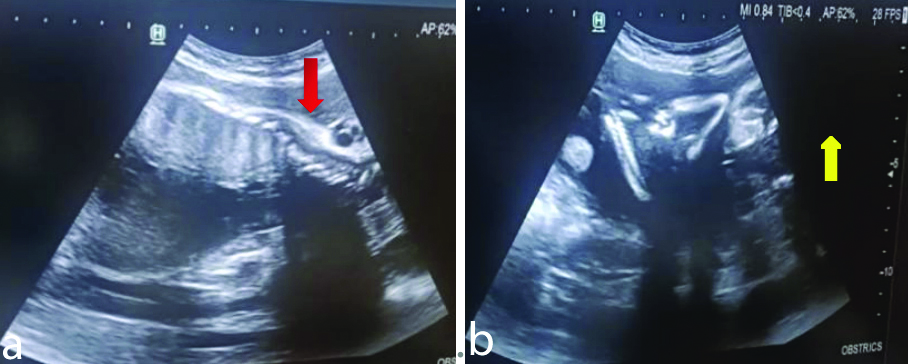
Given the desire to continue the pregnancy with the surviving foetus, the patient underwent cervical cerclage to reduce the risk of preterm birth and miscarriage. Subsequent prenatal care involved close monitoring, including serial ultrasounds and foetal heart rate checks.
At 35 weeks of gestation, due to concerns about foetal wellbeing and the safety of the surviving twin, a decision was made to proceed with a caesarean section under spinal anaesthesia. The procedure was performed, resulting in the delivery of one live female baby weighing 1.63 kg and one mummified foetus of unknown gender, confirming the previous IUFD [Table/Fig-2,3].
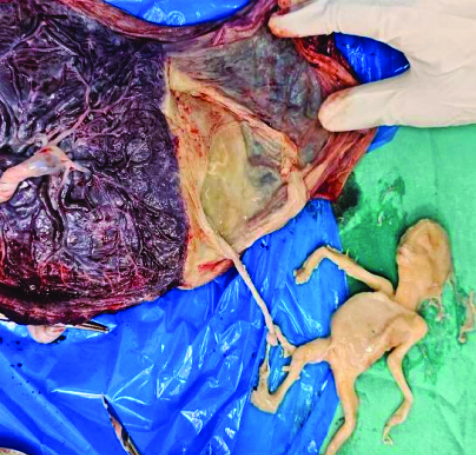
Female 1.63 kg- the surviving co-twin.
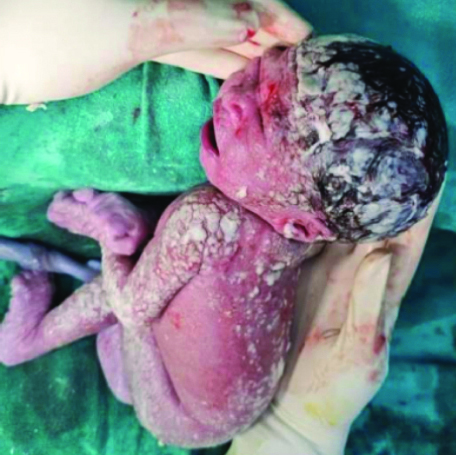
The APGAR score was 8 at one minute and 9 at five minutes for the live baby, while it was zero for the mummified one.
No complications were observed during the postpartum period. On the sixth postoperative day, the mother and baby were discharged.
Discussion
Intrauterine single foetal demise in a dichorionic diamniotic twin pregnancy is a rare and complex obstetric scenario that presents considerable management challenges [1,2]. Any gestational age can be affected by intrauterine single foetal death [3,4]. Enbom estimates that 0.5% to 6.8% of twin pregnancies end in a single foetal death [4], with the incidence of death of one foetus in twin gestation in utero being 2.7% in the second trimester and 6.7% in the third trimester [5]. The occurrence of intrauterine death in one foetus of a twin gestation can be attributed to various aetiologies, including twin-to-twin transfusion syndrome, intrauterine growth restriction, placental abnormalities, chromosomal anomalies, and congenital disorders. Pregnant women who experience this event during the first trimester of pregnancy are likely to have a surviving twin with no further complications. In contrast, preterm labour, Intrauterine Growth Restriction (IUGR), preeclampsia, and perinatal mortality are associated with foetal death after mid-gestation (17 weeks) [3].
Foetal complications are more pronounced with monozygotic twins [5-8]. However, the effects of a dead foetus on the surviving twin are unlikely in dichorionic gestation [6]. As the present case involves a dichorionic diamniotic pregnancy, it is probable that no abnormalities were detected in the surviving foetus. Similar findings were noted in a study conducted by Yaman Tunç S et al., [4]. This study encompassed 29 cases of single intrauterine demise between January 2008 and December 2013, with a mean age of 29.9±6.5 years for the cohort. Among these cases, 13 (44.8%) were classified as monochorionic, while the remaining 16 (55.2%) were identified as dichorionic. Intrauterine foetal death manifested during the first trimester in six patients and in the second or third trimester in 23 patients. Notably, 20 (69%) of the patients underwent caesarean section, while the remaining 9 (31%) experienced spontaneous vaginal deliveries [4].
Based on previous medical literature and a comprehensive analysis of the current case, it is well established that intrauterine single foetal demise presents a notable management challenge for obstetricians, as highlighted by prior studies [1,4,6]. The decision to pursue conservative management necessitates a meticulous evaluation of the associated risks, which should be carefully balanced against the potential risk of preterm birth. In cases where conservative management is opted for, rigorous monitoring of both maternal and foetal status becomes a crucial imperative. Literature discussing the outcomes of twin pregnancies with single foetal demise is shown in [Table/Fig-4] [1,6,9-12].
A review of observations and outcomes in twin pregnancy with single foetal demise; obtained from last 10 years medical literature [1,6,9-12].
| Authors | Maternal age | Gravida | IUFD observation | Mode of delivery | Gestational week at delivery | Child’s weight of live baby | Anomalies observed |
|---|
| Babah OA (2014) [6] | 33 years | First | 32 weeks | Vaginal delivery | 37 weeks | 2.45 kg | A foetus papyraceous was noted within the placenta, which appeared |
| Swarankar ML et al., (2017) [9] | 28 years | G2A1 | 25 weeks | Cesarean section | 34 weeks | 2.2 kg | No |
| Haque R et al., (2018) [1] | 24 years | First | 23 weeks | Cesarean section | 34 weeks | 2.4 kg | No |
| 26 years | Para 1+0 | 28 weeks | Cesarean section | 35 weeks | 2.6 kg | No |
| Stefanescu BI et al., (2021) [10] | 24 years | First | 25 weeks and 4 days | Cesarean section | 35 weeks and 5 days | 3.1 kg | No |
| Nkwelle EE et al., (2022) [11] | 23-year-old | NA | 22 weeks | Vaginal delivery | 37 weeks | 2.8 kg | No |
| Patvekar M et al., (2022) [12] | 23 year | First | 16 weeks | Cesarean section | 39 weeks | 2.6 kg | No |
Conclusion(s)
In twin pregnancies, the occurrence of IUFD presents a considerable obstetric challenge. The effective management of such complex cases necessitates rigorous antenatal surveillance and a multidisciplinary approach, emphasising the significance of comprehensive care for expectant mothers experiencing multiple pregnancies. Profound counselling and meticulously executed management strategies can lead to successful outcomes. However, further research is imperative to enhance our understanding of the underlying causes and to develop preventive measures for IUFD in twin pregnancies.
Author Declaration:
Financial or Other Competing Interests: None
Was informed consent obtained from the subjects involved in the study? Yes
For any images presented appropriate consent has been obtained from the subjects. Yes
Plagiarism Checking Methods: [Jain H et al.]
Plagiarism X-checker: Nov 17, 2023
Manual Googling: Jan 09, 2024
iThenticate Software: Feb 20, 2024 (12%)
[1]. Haque R, Rahman MM, Akhter K, Intrauterine single fetal demise in twin pregnancyDelta Medical College Journal 2018 6(1):53-57. [Google Scholar]
[2]. Maslovich MM, Burke LM, Intrauterine Fetal Demise. 2022In: StatPearls [Internet] 2023 Treasure Island (FL)StatPearls Publishing32491465 [Google Scholar] [PubMed]
[3]. Mackie FL, Rigby A, Morris RK, Kilby MD, Prognosis of the co-twin following spontaneous single intrauterine fetal death in twin pregnancies: A systematic review and meta-analysisBJOG Int J Obs Gynaecol 2019 126(5):569-78.10.1111/1471-0528.15530 [Google Scholar] [CrossRef]
[4]. Yaman Tunç S, Ağaçayak E, Yaman Görük N, Içen MS, Fındık FM, Evsen MS, Single intrauterine demise in twin pregnancies: Analysis of 29 casesTurk J Obstet Gynecol 2015 12(4):226-29.Epub 2015. PMCID: PMC558847610.4274/tjod.3549328913074 [Google Scholar] [CrossRef] [PubMed]
[5]. Kunaal S, Bangal VB, Sai B, Rashmi S, Intrauterine fetal demise of co-twin in multifetal pregnancyInt J Biomedic Res 2012 3(1):52-55. [Google Scholar]
[6]. Babah OA, Olamijulo A, Ayanbode OS, Sanusi MM, Conservative management of single fetal death in twin pregnancy at a tertiary health institution in southern Nigeria: A case reportIOSR J Dent Med Sci 2014 13:79-83. [Google Scholar]
[7]. Szpera-Gozdziewicz A, Dera AN, Breborowicz GH, Twin pregnancy complicated by intrauterine death of one fetusArch Perinat Medic 2012 18(4):210-13. [Google Scholar]
[8]. Jain D, Purohit RC, Review of twin pregnancies with single fetal death: Management, maternal and fetal outcomeJ Obstet Gynaecol India 2014 64(3):180-83. [Google Scholar]
[9]. Swarankar ML, Shekhawat U, Choudhary M, Choudhary V, Maternal and neonatal outcome of surviving twin after single fetal demise at 25 weeks: A rare case reportFertility Science and Research 2017 4(1):30-34. [Google Scholar]
[10]. Stefanescu BI, Adam AM, Constantin GB, Trus C, Single fetal demise in twin pregnancy- A great concern but still a favorable outcomeDiseases 2021 9(2):33 [Google Scholar]
[11]. Nkwelle EE, Armel DNK, Nkwetta AE, Pierre W, Single intrauterine foetal death at the second trimester in a twin pregnancy: Case reportJ Clin Images Med Case Rep 2022 3(1):1566 [Google Scholar]
[12]. Patvekar M, Suryarao P, Khumujam PP, Laxmi KD, Sree KD, Twin pregnancy with intrauterine fetal demiseDY Patil Journal of Health Sciences 2022 10(1):36-39. [Google Scholar]