Case Report
A 36-year-old female patient presented at the Kayachikitsa Outpatient Department with complaints of whitish discharge, erythematous skin lesions on the left foot, and accompanying itching over the past year. The patient had no significant past medical history. She had previously sought help at a local hospital and underwent a prolonged four-month course of medication, but did not experience satisfactory relief.
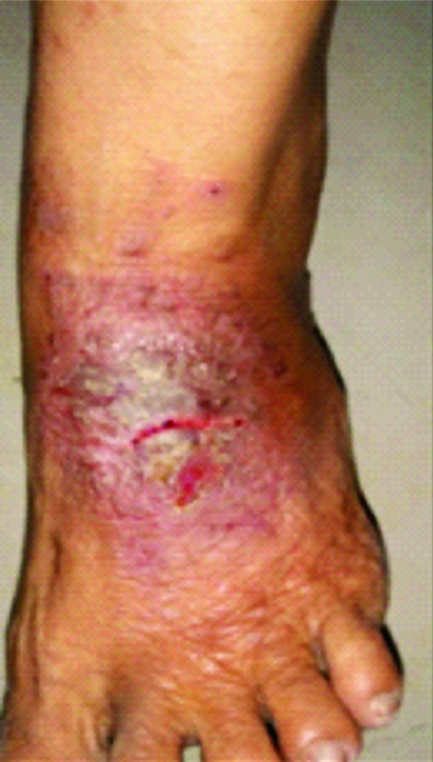
During the local examination, a wound measuring 8×7 cm with mild serous discharge and swelling was observed on the left foot, along with superficial ulcerations. These findings indicated occupational exposure that may have contributed to the skin manifestations, as shown in [Table/Fig-1].
Image of Vicharchika on left foot.
The patient reported engaging in daily farming for 5-6 hours and having a history of tea addiction. There was no history of trauma, major illnesses (such as diabetes, hypertension, and asthma), or relevant surgical procedures. The patient’s dietary routine included consuming non vegetarian meals twice a week and regularly indulging in spicy foods.
Recognising various factors that contribute to the condition is crucial for creating an effective treatment plan. Factors such as irregular sleep patterns (Diwaswap) and frequent feelings of stress or anger are important considerations for treatment planning.
Clinical assessments, including Ashtavidha pariksha and Dashavidh pareeksha, revealed normal findings, as detailed in [Table/Fig-2]. The patient’s vital signs and systemic examinations were within normal limits. She was described as moderately built and nourished, with a normal appetite, bowel habits, and bladder habits. The patient reported disturbed sleep due to itching. Dosha assessment revealed a predominance of Pitta-kapha. Further examination of excretory functions indicated normalcy, with clear and regular bowel movements (Mala) and urine (Mutra). The tongue (Jivha) appeared normal, and speech (Shabda) was clear. The sense of touch (Sparsha) was reported to have normal and moderate temperature perception (Anushnasheeta). Visual examination (Druk) showed clear and proper vision, while the physical form (Akriti) was described as moderate, as shown in [Table/Fig-2].
Ashtavidha pariksha and Dashvidha pariksha of patient.
| Parameters | Findings |
|---|
| Nadi | 76/min, pitta-kaphaj |
| Mala | Niram |
| Mutra | Niram |
| Jivha | Niram |
| Shabda | Spashta |
| Sparsha | Anushnasheeta |
| Druk | Samyak |
| Akriti | Madhyam |
| Dashvidha pariksha of the patient (examination) |
| Prakruti | Pitta vata |
| Vikruti | Kapha vata |
| Satva | Madhyam |
| Satmya | Madhura, amla, katu |
| Ahara shakti | Madhyam |
| Vyayam shakti | Madhyam |
| Saara | Madhyam |
| Samhanan | Madhyam |
| Agnishakti | Madhyam |
| Vaya | Madhyam |
Samprapti ghatak: In the present case, an imbalance of Tridosha is identified as the trigger for a pathogenic cascade, indicating a disturbance in the fundamental energies that govern the body. This imbalance negatively impacts various tissues, including the skin (Twak), blood (Rakta), muscles (Mansa), and the lymphatic system (Lasika), ultimately leading to the development of a skin disorder. The disruption extends to the circulation channels (Strotas), particularly Rasavaha and Raktavaha, resulting in a complex interplay that significantly contributes to the pathophysiology and progression of the condition [1]. Recognising these intricate dynamics is essential for developing a comprehensive treatment strategy aimed at restoring Doshas’ equilibrium and promoting the harmonious functioning of affected bodily elements.
Diagnosis: The manifestation predominantly occurs in the lower limbs with the presence of vesicles (Pidika), accompanied by itching (Kandu) and a burning sensation (Daha), characterising the dermatological disorder known as Vicharchika or Kushta.
Treatment plan: The plan is designed not only to address the existing symptoms but also to prevent the recurrence of the condition through lifestyle modifications and dietary adjustments. The two-month treatment plan included Shaman Chikitsa with internal medications for symptom alleviation and dosha balance, Bahir Parimarjana Chikitsa incorporating external applications for wound healing, and lifestyle recommendations addressing occupational exposure and addictive habits [Table/Fig-3]. Through regular follow-up appointments, the patient exhibited gradual improvement. Watery discharge, itching, and swelling diminished, and superficial ulcerations displayed signs of healing. The patient reported an overall enhancement in well-being.
Showing Shaman Chikitsa and Bahirparimarjanchikitsa.
| Formulation | Ingredients | Dose | Route | Anupana |
|---|
| Gandhak Rasayan | Purified Sulphur powder, Guduchi(Tinospora cordifolia), Bhringraj (Ecliptida alba), Haritaki (Terminalia chebula), Bibitaki (Termanaliabelerica), Amlaki (Phyllanthus emblica) | 500 mg twice a day, after meal | Oral | Lukewarm water |
| Skin powder with Gomutra Arka | Amlaki (Phyllanthus emblica), Haridra (Curcuma longa), Behada (Terminalibellirica), Nagarmotha (Cyperus rotundus), Suddha Gandhak (purified sulphur) and Manjistha (Rubia cordifolia) | QS | Local application | - |
| Padachira ointment | Ghruta (clarified butter), Rai (mustard seed, shudhasuvarnagairik (silicate of aluminia), Kapur (camphor, KaduNimboil (Azadirachta indica), Kokamoil (garcinia indica) | QS | Local application | - |
| Panchatiktaghrita | Neem (AzadirachtaIndica), patola (luffaacutangula) Trichosanthes Dioica (Gourd), SolanumXanthocarpum (Branched Shrub), Guduchi (TinofporaCordifolia) and Adulsa (Adhatoda Vasica) triphala | 1 Tsf twice a day after meal | Oral | Lukewarm water |
QS: Quantum satis (quantity sufficient); Tsf: Teaspoonful
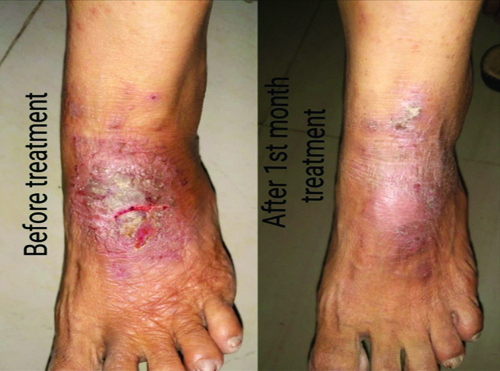
The pretreatment and post-treatment assessment of Vicharchika (eczema) was performed using the grading of the signs and symptoms of Vicharchika [2]. After two months of treatment, the patient experienced complete alleviation from the signs and symptoms of Vicharchika [Table/Fig-4,5].
Symptoms before and after treatment.
| Symptoms | Before treatment | After treatment | Percentage |
|---|
| Lesion | Score 3Spreads over extremities | Score 0No eruption | 100% |
| Itching (kandu) | Score 3Moderate itching | Score 0No itching | 100% |
| Oozing | Score 2Oozing discharge | Score 0No any discharge | 100% |
| Colour | Score 3Slight black | Score 1Near to normal | 95% |
| Pain (Vedana) | Score 3More pain at site | Score 0No pain | 100% |
Improvement after one month of treatment.
Discussion
The skin, the body’s largest and heaviest organ at an average of 20 square feet, serves beyond protecting internal organs, encompassing various functions [3]. Allergic contact dermatitis, an immune response to skin-contacting allergens, affects around 245 million people globally (3.34% of the world population). Skin disorders, with eczema being prominent, make up 10-20% of general practice cases [4]. Two studies from North India reported a prevalence of Atopic Dermatitis (AD) of 9.2%, while another study reported a prevalence of 0.98% across all age groups. A hospital-based study reported a point prevalence of 6.75% amongst outpatient attendees on a single day in one medical college in each of the four zones of India [5]. It manifests as inflamed skin, itching (pruritus), and adversely affects both patient and caregiver sleep and Quality of Life (QoL) [6]. According to Ayurveda, Vicharchika (eczema) is a disorder due to the vitiation of blood (Rakta Pradoshaj Vikar) being involved in three doshas (three bio-energies) with the dominance of kapha [7].
In Ayurveda, all skin diseases are categorised as ‘Kushtha,’ further divided into two types: Mahakushtha (major skin disorders) and Kshudra Kushtha (minor skin disorders) [8]. Although it is classified as a minor skin disease (Kshudra Kushtha), Vicharchika runs a chronic course and tends to exacerbate. Acharya Charaka described Vicharchika as characterised by itching (Kandu), lesions (Pidika), and discharge (Srava). According to Charak Acharya, Vicharchika is a Kapha Pradhana Vyadhi [9]. Meanwhile, Acharya Sushrut mentioned features such as dryness of the skin (Rukshatha), intense itching (Kandu), and marked lining (Raji) [10]. Yogaratnakar described symptoms as blackish lesions (Shyava VarniyaPidika) with itching (Kandu) [11]. The prevalence of Vicharchika in adults is approximately 2-10%, with a male to female ratio of 1:1.4. It is often co-associated with eczema, a form of dermatitis or inflammation of the upper skin layer. Eczema, a term broadly applied to various chronic or recurring skin rashes, is characterised by redness, skin swelling, itching, and potential crusting, flaking, blistering, oozing, or bleeding. Vicharchika can be caused by factors such as excessive consumption of dry, stale, cold, salty, spicy, sour, fermented, or fried foods, late-night work schedules, delayed dinners, intense physical, mental, and social activities, and stress. Additionally, excessive intake of tea, coffee, alcoholic beverages, and issues like acidity or flatulence may contribute to Vicharchika. In modern medicine, the treatment for eczema involves the use of topical and systemic antifungal medications, along with corticosteroids. Ayurvedic approaches such as Shodhan, Shaman, and Bahirparimarjan (topical) Chikitsa are also employed in this case study, incorporating a combination of therapeutic techniques [12].
Eczema or Vicharchika is precipitated by faulty diet and lifestyle, which results in impaired digestion and aggravation of Kapha [13]. The vitiated three doshas- Vata, Pitta, and Kapha along with impaired Tvaka, Rakta, Mamsa, and Ambu collectively represent seven essential entities that play a role in the pathogenesis of skin disorders, with Kapha being the foremost dosha involved in Vicharchika [14]. In the present case study, Bahirparimarjan and Shaman Chikitsa are selected for the treatment of Vicharchika, focusing on Bahirparimarjan Chikitsa.
1. Mechanism of action of S-Skin powder: S-Skin powder with Gomutra Arka.
Ingredients: S-Skin powder contains Amla (Phyllanthus emblica), Haridra (Curcuma longa), Behada (Terminalia bellirica), Nagarmotha (Cyperus rotundus), Suddha Gandhak (purified sulphur), and Manjistha (Rubia cordifolia).
Action: The ingredients of this formulation possess antibacterial, antifungal, and antimicrobial characteristics, along with properties such as Raktashodhaka (blood purification) and Vranaropak (wound healing). To enhance its absorption property during application, it is recommended to mix Gomutra with this powder [15].
2. Mechanism of action of Padachira ointment:
Ingredients:Padachira ointment contains Ghruta (clarified butter), Rai (mustard seed), Shudha suvarnagairik (silicate of aluminia), Kapur (camphor), Kadu Nimb oil (Azadirachta indica), and Kokam oil (Garcinia indica).
Action: Padchira ointment is a versatile Ayurvedic preparation made with pure desi ghee and various herbal drugs. Its rich fat content imparts a soothing effect, protecting the skin from drying. With its antifungal, antiseptic, antibacterial, and anti-inflammatory properties, Padchira ointment serves as a multipurpose solution. It is effective in addressing dry feet, dry skin, acting as an antiseptic and burn ointment, and proving beneficial in conditions such as eczema, psoriasis, and contact dermatitis, often used in conjunction with topical steroids. In Shaman Chikitsa, Gandhak Rasayan and Panchatikta Ghrita are used [16].
3. Gandhak Rasayan’s mechanism of action:
Ingredients:Gandhak Rasayan is a herbomineral formulation having ingredients like Shudhagandhak, Guduchi (Tinospora cordifolia), Bhringraj (Eclipta alba), Haritaki (Terminalia chebula), Bibitaki (Terminalia belerica), Amlaki (Phyllanthus emblica) with the Bhavana of different Kwathswarasa, etc., [17].
Action: It is the superior medicine in kushtha with the main ingredient ‘Gandhak’ which is Kushthaghna, Kandughna, Dahaprashaman, Raktashodhak, Vranaropak, Twachya, and Krumighna. It possesses properties like antiviral and antibacterial [18]. It has a major contributing action on Rakta and Twacha and is useful in conditions such as inflammation, itching, and infection.
4. Mechanism of action of Panchatikta ghrita: The ingredients of Panchatikta ghrita are Tikta rasa, Ruksha, and Laghu guna. It mainly acts on Kled, Meda, Lasika, rakta, pitta, and kapha, which helps normalise or balance dosha and dhatu, which are vitiated. It has properties like Deepan, Pachan, Strotoshodhak, Raktashodhak,Raktaprasadak, Kushtaghna, Kandughna, and Varnya [19].
Vicharchika is identified as having Pitta-Kapha dominance by Acharya Charak and Vagbhata, and as Kaphapradhan according to Acharya Sushruta. The involvement of both Rasa and Rakta is highlighted in the samprapti (pathogenesis) of this condition. Treatment in the Samhita involves repeated Shodhana (purification) and Shamana (pacification) therapies using medications with Kushtaghna, Krumighna, and Kandughna characteristics. Additionally, the application of medications externally through BahiparimarjanaChikitsa, in the form of lepa (paste) and oil, is recommended for enhanced results [20].
Following the weekly evaluation, a progressive enhancement in all assessed symptoms of Vicharchika, such as itching (Kandu), papular eruption (Pidika), discolouration (Vaivarnyata), burning sensation (Daha), pain (Vedana), and dryness (Rukshata), was observed up to the 4th week of the study period. Subsequently, there was consistent relief in the case of burning sensation (Daha) and pain (Vedana), while improvement in itching (Kandu), discoloration (Vaivarnyata), and dryness (Rukshata) exhibited a delayed pattern. A decrease in relief for papular eruption (Pidika) was noted in the 5th week. After two months of treatment, the patient experienced complete alleviation from the signs and symptoms of Vicharchika. The present case underscores the importance of considering occupational factors in dermatological conditions and demonstrates the effectiveness of an integrative Ayurvedic approach for comprehensive patient care. Ongoing studies in this realm can further refine tailored interventions for improved outcomes.
Conclusion(s)
The chief complaints of the patients such as discharge, erythematous skin lesions with intense itching, after undergoing treatment of Bahirparimarjana as well as ShamanChikitsa show marked improvement. The present study shows that the combination of Ayurvedic modalities gives significant results in the Lakshanas of Vicharchika. To prevent infections, wash your hands often and properly, clean any scrapes, cuts, or insect bites immediately, avoid sharing personal items like towels and razors, and steer clear of skin-to-skin contact with anyone who has a skin infection.
QS: Quantum satis (quantity sufficient); Tsf: Teaspoonful
[1]. Lawrence DT, Anand J, Girish J, Tripaty TB, Ayurvedic management of Vicharchika (Eczema)- A case reportJ Ayurveda Integr Med Sci 2023 06:240-44. [Google Scholar]
[2]. Patel VK, Acharya R, Management of Vicharchika (Eczema) with Rakta Karavira Taila: An open-label clinical studyJ Res Ayurvedic Sci 2020 4(2):65-71.10.5005/jras-10064-0109 [Google Scholar] [CrossRef]
[3]. Karim N, Phinney BS, Salemi M, Wu PW, Naeem M, Rice RH, Human stratum corneum proteomics reveals cross-linking of a broad spectrum of proteins in cornified envelopesExp Dermatol 2019 28(5):618-22. [Google Scholar]
[4]. Berth-Jones J, Eczema, Lichenification, Prurigo and Erythroderma. In Burns T et al., edsRook’s textbook of Dermatology 2010 8th editionUKBlackwell Publishing LtdAvailable from: http://dx.doi.org/10.1002/9781444317633. Ch2321812829 [Google Scholar] [PubMed]
[5]. De A, Karekar S, Adhav C, Current burden of atopic dermatitis in India: A systematic literature reviewIndian J Dermatol 2023 68(4):487PMCID: PMC1056421510.4103/ijd.ijd_181_2337822382 [Google Scholar] [CrossRef] [PubMed]
[6]. Schneider L, Tilles S, Lio P, Boguniewicz M, Beck L, LeBovidge J, Atopic dermatitis: A practice parameter update 2012J Allergy Clin Immunol 2013 131:295-99.:el-27. [Google Scholar]
[7]. Agnivesha, Charak, Charak Samhita, Sutrasthan, Chapter 7, shloka 30, Acharya Shukula and Ravi Dutta Tripathi - editors 2006 VaranasiChowkhamba Sanskrit Pratishthan:253 [Google Scholar]
[8]. Sharma PV, Charaka Samhita of Agnivesha with English Translation 2008 21st Edition Reprint edVaranasiChaukhambha Orientalia:183 [Google Scholar]
[9]. Sharma RK, Dash Bhagwan, English translation on Cakrapani Datta’s Ayurveda Dipika on Agnivesa’s Caraka Samhita, Chikitsasthana, Kushta chikista: Chapter 7, Verse 26 2014 VaranasiChowkhamba Sanskrit series office:325 [Google Scholar]
[10]. Shastri Ambikadatta, Sushrutsamhita 2004 VaranasiChaukhambha Prakashan [Google Scholar]
[11]. Tripathi D, Tripathi I, Yogaratnakar 2007 VaranasiChaukhambha Prakashan [Google Scholar]
[12]. Singh S, Beena PM, Profile of dermatophyte infections in BarodaIndian J Dermatol Venereol Leprol 2003 69(4):281-83. [Google Scholar]
[13]. Acharya TJ, Charak A, Dridhabala Charak Samhita, Chikitsasthana, Kushthachikitsa Adhyaya 2001 7/305th edVaranasiChaukhambha Sanskrit Sansthana:185 [Google Scholar]
[14]. Sawant PM, Bande UK, A case report on ayurvedic management of Vicharchika (Eczema)International Journal of Ayurveda and Pharma Research 2020 8(3):59-65. [Google Scholar]
[15]. Rajput SH, Dhangarmali VD, Bhavsar D, Phatak AA, Choudhari PD, Use of Karanj Oil (Pongamia glabra) in topical formulationRes J Pharm, Biol Chem Sci 2014 5(3):546-51. [Google Scholar]
[16]. Deshmukh S, Thakre T, Approach towards Kushta (Psoriasis) with Ayurveda - A case studyInt J Res Pharm Sci 2020 11(4):5546-54.10.26452/ijrps.v11i4.3189 [Google Scholar] [CrossRef]
[17]. Prasanna KT, Vijaya KGS, Devi YD, In-vitro antifungal activity of Gandhak RasayanInternational Journal of Ayurvedic Medicine 2010 1(2):93-99.Available from: https://doi.org/10.47552/ijam.v1i2.23 [Google Scholar]
[18]. Haritha MM, Jadar PG, A review on probable mode of action of Gandhaka Rasayana - An Ayurvedic Herbo-Mineral formulation with multifaceted actionInternational Journal of Ayurveda and Pharma Research 2024 12(2):173-79.Available from: https://doi.org/10.47070/ijapr.v12i2.3120 [Google Scholar]
[19]. Mishra Bramhashankar, Bhaishajya Ratnavali 2006 Vol-IIIedition 1stNew DelhiChaukhamba Sanskrit Bhavan:54;257-260.:82 [Google Scholar]
[20]. Munshi R, Patil T, Garuda C, Kothari D, An experimental study to evaluate the antiosteoporotic effect of Panchatikta Ghrita in a steroid-induced osteoporosis rat modelIndian J Pharmacol 2016 48(3):298-303.PMCID: PMC490000410.4103/0253-7613.18288127298501 [Google Scholar] [CrossRef] [PubMed]