Introduction
Medicinal plants and their substances are used as adjunctive therapies for a range of acute and chronic inflammatory diseases. Syzygium aromaticum and Persea americana, in particular, have demonstrated beneficial effects, including anti-inflammatory and antioxidant properties, in the management of inflammation. Although the extracts from these plants have been assessed in research, the possibility of combining them to synthesise a mouthwash and evaluate its effectiveness has not yet been investigated.
Aim
To evaluate the combined anti-inflammatory and antioxidant properties of a mouthwash formulation based on the extensively nutritious avocado fruit (Persea americana) and clove (Syzygium aromaticum).
Materials and Methods
This in-vitro investigation was carried out in the Oral Pathology and Microbiology Department at Saveetha Dental College and Hospitals, Saveetha Institute of Medical and Technical Sciences, Saveetha University, Chennai, Tamil Nadu, India, between December 2021 and July 2022. A mouthwash was formulated with extracts from clove and avocado fruit, and its anti-inflammatory and antioxidant properties were evaluated using Bovine Serum Albumin (BSA) denaturation and 2,2-diphenyl-1-picrylhydrazyl (DPPH) assays, respectively. Microsoft Excel was utilised for data collection, and Statistical Package for the Social Sciences (SPSS) version 23.0 with independent t-tests was used for statistical analysis. A p-value of 0.05 was considered statistically significant.
Results
The anti-inflammatory activity of the prepared mouthwash based on P. americana and Syzygium aromaticum at a concentration of 50 μL (86.62% inhibition) was comparable to that of the standard drug (diclofenac sodium) (84.82% inhibition); however, its antioxidant properties were significantly lower.
Conclusion
The mouthwash synthesised from the edible part of P. americana in conjunction with Syzygium aromaticum exhibited superior anti-inflammatory properties, with the highest activity observed at a concentration of 50 μL. Therefore, the prepared formulation could be used for managing minor inflammatory conditions.
Introduction
Inflammation is one of the complex biological responses of the body to injury or infection [1]. It can be initiated by several stimuli, such as pathogens, chemical irritants, nutritional imbalances, and various cell injuries, and is thus considered an important defense mechanism vital to health [2,3]. Typically, the body responds with acute inflammation, which can become chronic if not controlled, potentially contributing to several inflammatory diseases [4]. The inflammation may then progress through a host-mediated pathway, resulting in tissue damage, where the formation of Reactive Oxygen Species (ROS) significantly affects the tissue [5,6].
Drugs to control and suppress these inflammatory crises have been developed, including corticosteroids, Non Steroidal Anti-Inflammatory Drugs (NSAIDs), and immunosuppressants, most of which are associated with adverse effects. Therefore, it has always been a primary concern to select drugs at the least effective dosage, maximising efficacy while minimising adverse effects [7]. Common inflammatory disorders of the oral cavity, such as stomatitis, ulcerations and glossitis, require medications that are sufficiently less toxic to effectively relieve symptoms. It has been proven that diets enriched with fruits and vegetables are inversely associated with inflammatory stress [8]. This emphasises the importance of investigating and developing new natural drugs with anti-inflammatory and antioxidant properties. For instance, phytochemical studies have reported high anti-inflammatory properties of curcumin in-vitro and in animal models [9,10]. One such natural and richly nutritive product presented in this study is avocado.
Persea americana, commonly known as avocado or alligator pear, is rich in fat content, primarily consisting of oleic acid and unsaturated fatty acids, with approximately 60% in the oil, 7% in the skin, and around 2% in the seed. The bioactive molecules of avocado have been used in medicine worldwide and are appreciated for their numerous biological properties, such as anti-inflammatory, anticancer, antifungal, analgesic, antiviral, antihaemolytic, antimalarial, antioxidant, and wound healing effects [11,12]. Research has found that the main lipid component of avocado fruit extract is oleic acid, along with fibres, proteins, carotenoids, and minerals. Its properties have been confirmed in Lipophilic Oxygen Radical Absorbance Capacity (L-ORAC), DPPH, Fluorescence Recovery After Photobleaching (FRAP), 2,2′-azinobis-(3-ethylbenzothiazoline-6 sulfonic acid) (ABTS), and ORAC assays, suggesting that it is a potential source of antioxidant compounds. However, the phytochemical characteristics of only the extracts obtained from the avocado pulp have been explored [13].
Clove (Syzygium aromaticum) has been reported to have a wide range of beneficial effects in the oral cavity, particularly in the form of toothpaste and mouthwashes. It is recognised for its antibacterial, antifungal, insecticidal, and antioxidant properties [14,15]. The main components of cloves, which are linked to several health benefits, include eugenol (70-90%), tannins (13%), and fixed oil (10%) [16]. Furthermore, a formulation of clove and ginger enriched with Zinc Oxide (ZNO) nanoparticles demonstrated a significantly better anti-inflammatory effect than the standard diclofenac sodium [17]. Thus, cloves can be a valuable addition to commercially available mouthwashes.
Since avocado pulp has not previously been utilised for synthesising mouthwashes, the present study employs it as the primary component for the formulation. Clove, a common herbal ingredient in commercial mouthwashes, was added to enhance the fruit’s buttery taste. Therefore, the present study aimed to combine clove and avocado pulp to synthesise a mouthwash and evaluate their synergistic anti-inflammatory and antioxidant properties.
Materials and Methods
This in-vitro study was conducted at Saveetha Dental College and Hospitals in the Department of Oral Pathology and Microbiology, Saveetha Institute of Medical and Technical Sciences, Saveetha University, Chennai, Tamil Nadu, India from December 2021 to July 2022. Ethical clearance and informed consent were not required, as the study did not involve human subjects.
Preparation of Fruit and Plant Extract
Ripened avocados were purchased from a grocery store and stored at 4 degrees Celsius. A 10 g sample of the edible part of the avocado was added to 200 mL of distilled water and stirred well for 15 minutes using a glass rod. The mixture was then filtered using a double filter. With a heat mantle, the mixture was boiled for five minutes at 60 degrees Celsius. It was filtered again after 24 hours and stored at a low temperature for later use.
A total of 10 cloves were powdered, and 2 g of the powdered cloves were precisely weighed. To this, 100 mL of distilled water was added, and the mixture was boiled for about 10 minutes at 60 degrees Celsius. This process activates the phytochemicals present in the cloves. Using Whatman filter paper No. 1, the mixture was filtered and stored at a low temperature for further use.
Preparation of the Mouthwash
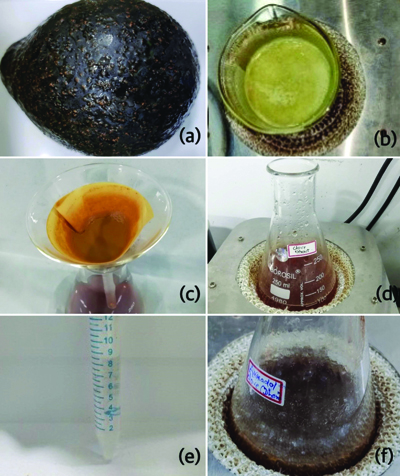
A 1 mL sample of the prepared fruit extract and 1 mL of the prepared clove extract were mixed with 9 mL of distilled water. To this mixture, 0.01 g of sodium lauryl sulfate, 0.3 g of sucrose, and 0.001 g of sodium benzoate were added. The resulting mixture was then stored at a low temperature [Table/Fig-1a-f].
a) Photograph showing ripened avocado fruit; b) The extract of the ripened fruit; c) Extraction of clove extraction; d) Prepared extract of cloves; e) Mixture of sodium lauryl sulfate, sucrose and sodium benzoate; and f) Prepared Persea americana and Syzygium aromaticum-based mouthwash.
Assessment of anti-inflammatory activity using bovine serum albumin denaturation assay: The albumin denaturation assay was used to test the anti-inflammatory activity of the mouthwash in the present study. The mouthwash was assessed according to the method described by Mizushima Y and Kobayashi M [18,19]. A total of 0.45 mL of bovine serum albumin (1% aqueous solution) was added to 0.05 mL of the prepared mouthwash at various concentrations (10 μL, 20 μL, 30 μL, 40 μL, 50 μL). The pH of the mixture was adjusted to 6.3 using 1N hydrochloric acid. The samples were incubated at room temperature for about 20 minutes and then boiled in a water bath at 55°C for approximately 30 minutes before being cooled. Spectrophotometric analysis was used to estimate the absorbance at 660 nm, and Diclofenac Sodium was employed as a control.
The following equation was used to calculate the percentage of protein denaturation [18,19]:
% Inhibition=(Absorbance of control-Absorbance of sample)/Absorbance of control×100
Assessment of antioxidant activity using DPPH (2,2-Diphenyl-1-picrylhydrazyl) assay: The antioxidant properties of the formulated mouthwash using P. americana and clove extract were evaluated using the DPPH assay. The mouthwash was diluted to five different concentrations (10 μL, 20 μL, 30 μL, 40 μL, 50 μL). To this, 1 mL of 0.1 mM DPPH in methanol and 450 μL of 50 mM Tris HCl buffer (pH 7.4) were added, and the mixture was then incubated for about 30 minutes. The amount of DPPH free radicals reduced, which depended on the absorbance, was assessed at 517 nm. Butylated Hydroxytoluene (BHT) was used as the standard [20]. The absorbance of the mixture at 517 nm was measured using an Ultraviolet-visible (UV-Vis) spectrophotometer. The formula for calculating the percentage of scavenging activity is:
(Absorbance of control-Absorbance of the test)/Absorbance of control×100.
Statistical Analysis
The data was managed using Microsoft Excel, and statistical analysis was conducted with SPSS software, version 23.0. Independent t-tests were employed to compare the outcomes between the groups, with a p-value of 0.05 considered statistically significant.
Results
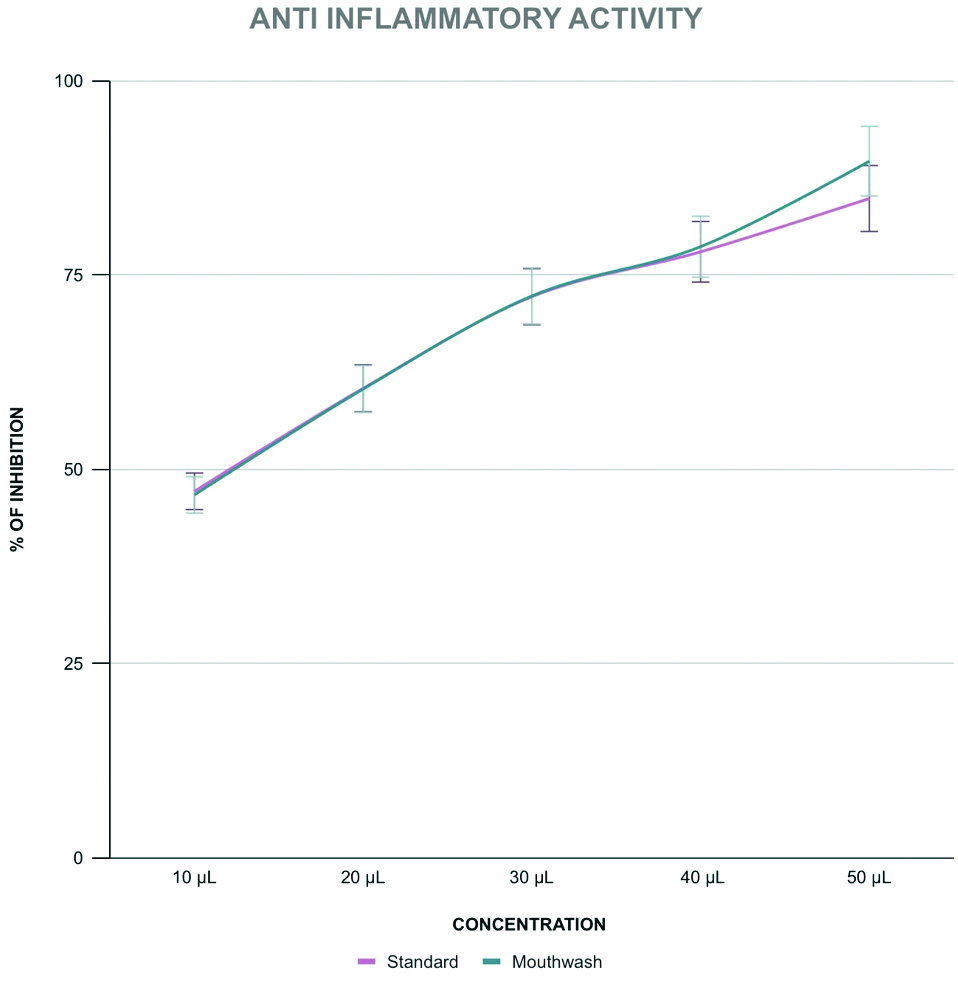
Anti-inflammatory activity: The anti-inflammatory activity of the synthesised mouthwash at 10 μL, 20 μL, 30 μL, 40 μL, and 50 μL was measured as 46.68, 60.3, 72.28, 78.62, and 89.62, respectively. In comparison, the activity of the standard diclofenac sodium at the same volumes was 47.14, 60.4, 72.18, 77.96, and 84.82, respectively. The present study demonstrated superior anti-inflammatory activity of the prepared P. americana-based mouthwash at the 50 μL concentration (p-value <0.001) when compared to that of the standard diclofenac sodium [Table/Fig-2,3].
Comparative anti-inflammatory activity of prepared mouthwash and control group.
| Concentration (μL) | Diclofenac sodium (control) % of inhibition(Mean) | Standard Deviation (SD) | Standard error (Mean) | P. americana-based mouthwash % of inhibition(Mean) | Standard Deviation (SD) | Standard error (Mean) | p-value |
|---|
| 10 | 47.14 | 1.17 | 0.52 | 46.68 | 1.23 | 0.55 | 0.562 |
| 20 | 60.4 | 0.73 | 0.33 | 60.3 | 0.85 | 0.38 | 0.847 |
| 30 | 72.18 | 0.68 | 0.31 | 72.28 | 0.77 | 0.34 | 0.833 |
| 40 | 77.96 | 0.44 | 0.2 | 78.62 | 0.53 | 0.24 | 0.065 |
| 50 | 84.82 | 0.88 | 0.39 | 89.62 | 0.54 | 0.24 | <0.001* |
*statistically significant; #not statistically significant; Test applied: Independent t-test, statistical significance set as p<0.05
Comparison of the anti-inflammatory activity of the standard mouthwash and the synthesised mouthwash using BSA assay.
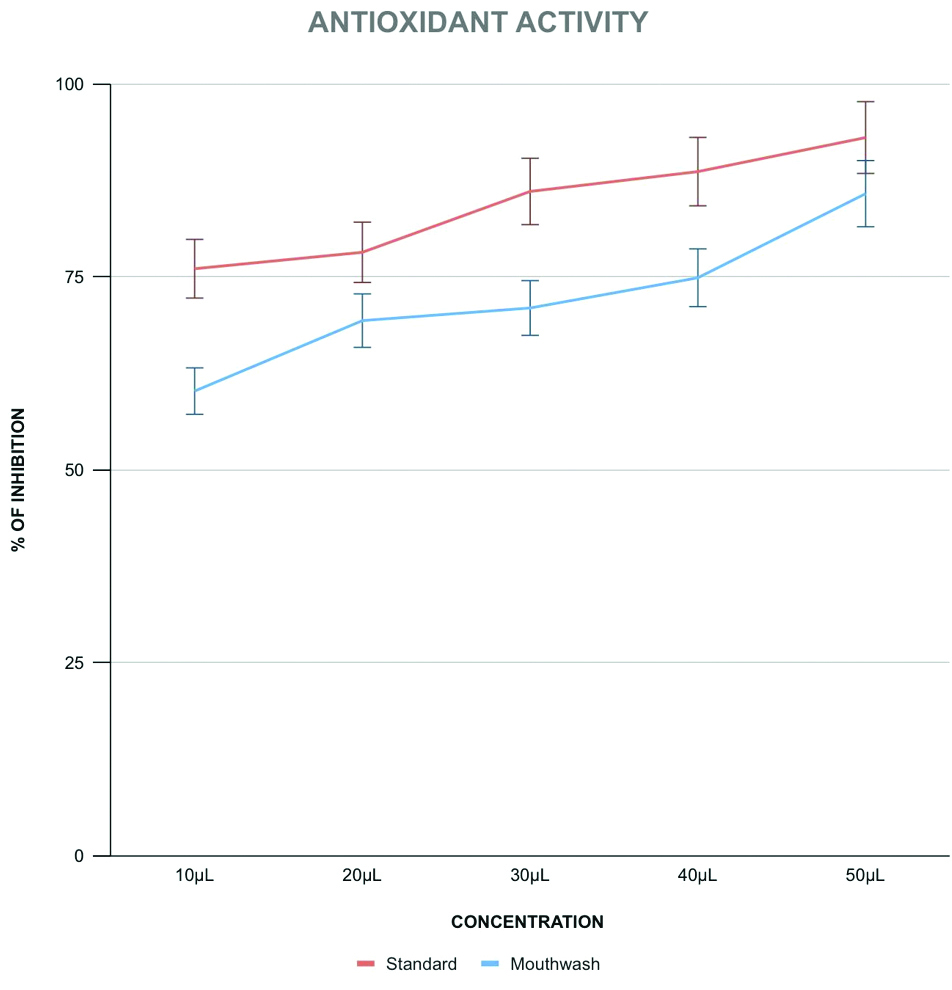
Antioxidant activity: The antioxidant activity of the prepared mouthwash was recorded as 60.18, 69.31, 70.946, 74.86, and 85.756 at 10 μL, 20 μL, 30 μL, 40 μL, and 50 μL, respectively. In contrast, the activity of the standard was 76.032, 78.164, 86.046, 88.616, and 93.03 at the same volumes. The study concluded that the antioxidant property of the prepared mouthwash was highest at 50 μL. However, the antioxidant activity was lower for the synthesised mouthwash when compared with that of the standard (p<0.001). The results of the DPPH assay are represented in [Table/Fig-4,5].
Table demonstrating comparative antioxidant activity of the prepared mouthwash and the control group.
| Concentration (μL) | Butylated hydroxytoluene standard% of inhibition(Mean) | Standard Deviation (SD) | Standard error (Mean) | P. americana-based mouthwash% of inhibition(Mean) | Standard Deviation (SD) | Standard error (Mean) | p-value |
|---|
| 10 | 76.032 | 0.47 | 0.21 | 60.18 | 0.56 | 0.25 | <0.001* |
| 20 | 78.164 | 0.76 | 0.34 | 69.31 | 0.95 | 0.42 | <0.001* |
| 30 | 86.046 | 0.73 | 0.32 | 70.946 | 0.71 | 0.32 | <0.001* |
| 40 | 88.616 | 0.62 | 0.28 | 74.86 | 1.21 | 0.54 | <0.001* |
| 50 | 93.03 | 1.03 | 0.46 | 85.756 | 0.90 | 0.40 | <0.001* |
*Statistically significant; test applied: Independent t-test, statistical significance set as p<0.05
Comparison of the anti-antioxidant activity of the standard mouthwash and the synthesised mouthwash using DPPH assay.
Discussion
The anti-inflammatory and antioxidant properties of the highly nutritious avocado fruit (Persea americana) and clove (Syzygium aromaticum) mouthwash formulation demonstrated a similar anti-inflammatory effect when compared to the standard, diclofenac sodium. However, when compared to the control, the mouthwash’s antioxidant properties were noticeably lower at every tested concentration.
The study conducted by Kristanti CD et al., compared the anti-inflammatory and analgesic properties of infusion and methanolic extracts from avocado seeds on carrageenan-induced paw oedema in mice. The results suggested that both infusion and methanolic extracts of avocado seeds showed a significant reduction in inflammation [21]. However, the present study, which was conducted using the edible part (pulp) of the avocado, resulted in superior anti-inflammatory properties (86.62% zone of inhibition at 50 μL) but demonstrated less activity compared to that of the seeds. The differing scavenging properties may be attributed to the varying methanol and lipid contents between the seeds and the fruit of P. americana. Similarly, Alkhalaf MI et al., conducted a study on the anti-inflammatory activities of both fruit and seed extracts of P. americana, in which the seed extract was reported to have better antioxidant and anti-inflammatory properties, contrasting with the findings of the present study [22]. The varying antioxidant results could be due to the differing amounts of phenolic compounds in the seed, peel, and pulp (64%, 23%, and 13%, respectively). Furthermore, factors that significantly affect the nutritional profiles of avocados include the fertilisers used, soil composition, climate, variety, and ripening stage of the fruit [23]. An earlier study on Wistar rats verified the underlying mechanisms facilitating the healing process, showing increased collagen synthesis linked to the high oleic acid content in the edible portion of avocados, which contributes to the fruit’s anti-inflammatory properties. Hence, the therapeutic benefits of avocado oil are attributed to its high content of fatty acids, particularly oleic acid (47.20%) [24]. Additionally, Avocado-soybean Unsaponifiable (ASU) has demonstrated effectiveness against periodontal disease by altering the expression of Transforming Growth Factor beta 1 (TGF-β1), TGF-β2, and Bone Morphogenetic Protein 2 (BMP-2) [25]. Therefore, avocados possess substantial anti-inflammatory qualities that may have potential applications in the management of oral inflammatory conditions.
In a study on Clove Essential Oil (CEO) by Han X et al., it was found that at a dosage of 0.011%, CEO exhibited better anti-inflammatory properties and strong antiproliferative effects on human dermal fibroblasts. Additionally, proinflammatory biomarkers such as Vascular Cell Adhesion Molecule-1 (VCAM-1), interferon-induced protein 10 (IP-10), interferon-inducible T-cell α Chemoattractant (I-TAC), and Monokine Induced by Gamma Interferon (MIG) were markedly inhibited [26]. Consequently, the anti-inflammatory properties of the bioactive molecule eugenol found in cloves may be responsible for the enhanced anti-inflammatory efficacy of the synthesised mouthwash in the current investigation. This explains why the mouthwash developed in the present study exhibited better anti-inflammatory properties.
In a study comparing the properties of eugenol and cloves, it was identified that both have similar antioxidant effects. The DPPH and ABTS radical scavenging values for clove and eugenol, respectively, were IC50=0.1595 mg/mL and 0.3257 mg/mL, and 0.1696-7 mg/mL. Eugenol, one of the chemical constituents of clove essential oil (CEO), exhibits antioxidant effects, which explains why CEO possesses antioxidant qualities [27]. Additionally, Esmaeili F et al., investigated the anti-inflammatory and antinociceptive effects of Nanogels (NG) prepared from cinnamon and CEO, as nanoemulsion-based gels enhance topical drug delivery and effectiveness. The results showed that cinnamon-NG suppressed paw oedema more than clove-NG [28]. The milder antioxidant property reported in this study could be attributed to the inferior antioxidant capacity of clove compared to cinnamon. Therefore, substituting clove with cinnamon might improve the antioxidant capacity of P. americana, which could be a future recommendation.
The DPPH has been widely used to assess the free radical scavenging potential of desired components. A study assessing the antioxidant activity of avocado peel, which evaluated phenolic contents, resulted in strongest antioxidant activity, following fractionation of the methanolic extract (fraction 8-4.221±0.137 mg/mL) [29]. Hence, fractionation of avocado pulp might influence its antioxidant properties, which are future recommendations. Furthermore, most of these investigations have shown a strong association between the antioxidant potential of avocado extracts and their phenolic components [30,31]. Additionally, these components have been demonstrated to reduce platelet aggregation and oxidation, as well as inflammation [32]. The antioxidant qualities of avocado by-product paste, with and without seeds, were assessed and contrasted, showing that the paste with seeds had less antioxidant activity than the paste without seeds. It was also noted that the antioxidant activity slightly diminished during storage [33]. This implies that the type of formulation and storage conditions also play a role in their activity and should therefore be considered.
Based on the results obtained from the present study, it is suggested that the formulated mouthwash exhibits good anti-inflammatory activity and could be used as an adjunct in treating minor inflammatory diseases. According to the previous studies discussed, this natural derivative-based formulated mouthwash is safer than other chemically manufactured mouthwashes.
Limitation(s)
The present study failed to assess the oil present in avocado and to compare it with other herbs high in oil, even though oils are known to have significant medicinal properties, particularly in treating inflammatory conditions. Additionally, other avocado components, such as the peel and seeds, were not included in the synthesis of the mouthwash. As a result, the study did not evaluate or compare the properties of these components. Investigating all parts of the avocado could potentially lead to the development of an effective mouthwash with therapeutic value.
Conclusion(s)
The mouthwash synthesised with avocado and clove extract exhibited better anti-inflammatory properties than standard mouthwash, working best at a concentration of 50 μL. Therefore, this formulation could be useful for treating minor inflammatory disorders such as aphthous ulcers. Given that avocado oil has a higher nutritional value than avocado seeds but lower activity levels, experimenting with various other combinations could potentially yield a less toxic yet effective mouthwash, thereby benefiting the medical field. Future in-vivo studies on human subjects could be conducted to validate the efficacy of the mouthwash.
*statistically significant; #not statistically significant; Test applied: Independent t-test, statistical significance set as p<0.05
*Statistically significant; test applied: Independent t-test, statistical significance set as p<0.05
[1]. Nile SH, Park SW, Optimized methods for in-vitro and in-vivo anti-inflammatory assays and its applications in herbal and synthetic drug analysisMini-Rev Med Chem 2013 13(1):95-100.Available from: https://pubmed.ncbi.nlm.nih.gov/22876959/ [Google Scholar]
[2]. Oz HS, Yeh SL, Amedei A, Gut inflammatory diseases, infection, and nutritionMediators Inflamm 2018 2018:7160859Available from: https://doi.org/10.1155/2018/7160859 [Google Scholar]
[3]. Nathan C, Nonresolving inflammation reduxImmunity 2022 55(4):592-605.10.1016/j.immuni.2022.03.016 [Google Scholar] [CrossRef]
[4]. Zhou Y, Hong Y, Huang H, Triptolide attenuates inflammatory response in membranous glomerulo-nephritis rat via downregulation of NF-κB signaling pathwayKidney Blood Press Res 2016 41(6):901-10.10.1159/000452591 [Google Scholar] [CrossRef]
[5]. Chen L, Deng H, Cui H, Fang J, Zuo Z, Deng J, Inflammatory responses and inflammation-associated diseases in organsOncotarget 2018 9(6):7204-18.10.18632/oncotarget.23208 [Google Scholar] [CrossRef]
[6]. Mittal M, Siddiqui MR, Tran K, Reddy SP, Malik AB, Reactive oxygen species in inflammation and tissue injuryAntioxid Redox Signal 2014 20(7):1126-67.10.1089/ars.2012.5149 [Google Scholar] [CrossRef]
[7]. Ghasemian M, Owlia S, Owlia MB, Review of anti-inflammatory herbal medicinesAdv Pharmacol Sci 2016 2016:913097910.1155/2016/9130979 [Google Scholar] [CrossRef]
[8]. Root MM, McGinn MC, Nieman DC, Henson DA, Heinz SA, Shanely RA, Combined fruit and vegetable intake is correlated with improved inflammatory and oxidant status from a cross-sectional study in a community settingNutrients 2012 4(1):29-41.10.3390/nu4010029 [Google Scholar] [CrossRef]
[9]. Ochoa-Zarzosa A, Báez-Magaña M, Guzmán-Rodríguez JJ, Flores-Alvarez LJ, Lara-Márquez M, Zavala-Guerrero B, Bioactive molecules from native mexican avocado fruit (Persea americana var. drymifolia): A reviewPlant Foods Hum Nutr 2021 76(2):133-42.10.1007/s11130-021-00887-7 [Google Scholar] [CrossRef]
[10]. Priyadharshini G, Pandiar D, Shanmugam R, Krishnan RP, An in-vitro evaluation of anti-inflammatory and antioxidant activities of Cocos nucifera and Triticum aestivum formulationCureus 2023 15(11):e4864910.7759/cureus.48649 [Google Scholar] [CrossRef]
[11]. Ding H, Chin YW, Kinghorn AD, D’Ambrosio SM, Chemopreventive characteristics of avocado fruitYSCBI 2007 17(5):386-94.10.1016/j.semcancer.2007.04.003 [Google Scholar] [CrossRef]
[12]. Chainani-Wu N, Safety and anti-inflammatory activity of curcumin: A component of tumeric (Curcuma longa)J Altern Complement Med 2003 9(1):161-68.10.1089/107555303321223035 [Google Scholar] [CrossRef]
[13]. Mardigan LP, dosSantos VJ, daSilva PT, Visentainer JV, Gomes STM, Matsushita M, Investigation of bioactive compounds from various avocado varieties (Persea americana Miller)Food Sci Technol 2018 39(Suppl.1):01-07.10.1590/fst.34817 [Google Scholar] [CrossRef]
[14]. Haro-González JN, Castillo-Herrera GA, Martínez-Velázquez M, Espinosa-Andrews H, Clove essential oil (Syzygium aromaticum L. Myrtaceae): Extraction, chemical composition, food applications, and essential bioactivity for human healthMolecules 2021 26(21):638710.3390/molecules26216387 [Google Scholar] [CrossRef]
[15]. Anandhi P, Tharani M, Rajeshkumar S, Lakshmi T, Antibacterial activity of Cinnamon and Clove oil against wound pathogensJ Popul Ther Clin Pharmacol 2022 28(2):e41-e46.10.47750/jptcp.2022.871 [Google Scholar] [CrossRef]
[16]. Lewis RJ, Sax’s Dangerous Properties of Industrial Materials 2012 Wiley [Google Scholar]
[17]. Selvaraj S, Chokkattu JJ, Neeharika S, Thangavelu L, Ramakrishnan M, Anti-inflammatory potential of a mouthwash formulated using clove and ginger mediated by zinc oxide nanoparticles: An in-vitro studyWorld J Dent 2023 14(5):394-401.10.5005/jp-journals-10015-2232 [Google Scholar] [CrossRef]
[18]. Mizushima Y, Kobayashi M, Interaction of anti-inflammatory drugs with serum proteins, especially with some biologically active proteinsJ Pharm Pharmacol 1968 20(3):169-73.10.1111/j.2042-7158.1968.tb09718.x [Google Scholar] [CrossRef]
[19]. Bharathidasan P, Sundar S, Shanmugam RK, Ramadoss R, Paneerselvam S, Ramani P, Antioxidant, anti-inflammatory and antidiabetic activity of oolong tea mediated strontium nanoparticlesJPTCP 2023 30(8):511-16.Available from: https://doi.org/10.47750/jptcp.2023.30.08.055 [Google Scholar]
[20]. Jan S, Khan MR, Rashid U, Bokhari J, Assessment of antioxidant potential, total phenolics and flavonoids of different solvent fractions of monotheca buxifolia fruitOsong Public Health Res Perspect 2013 4(5):246-54.10.1016/j.phrp.2013.09.003 [Google Scholar] [CrossRef]
[21]. Kristanti CD, Simanjuntak FPJ, Dewi NKP, Tianri SV, Hendra P, Anti-inflammatory and analgesic activities of avocado seed (Persea americana Mill.)J Pharm Sci 2017 14(2):104-11.10.24071/jpsc.142858 [Google Scholar] [CrossRef]
[22]. Alkhalaf MI, Alansari WS, Ibrahim EA, Elhalwagy MEA, Anti-oxidant, anti-inflammatory and anti-cancer activities of avocado (Persea Americana) fruit and seed extractJ King Saud Univ Sci 2018 31(4):1358-62.10.1016/j.jksus.2018.10.010 [Google Scholar] [CrossRef]
[23]. Duester KC, Avocados a look beyond basic nutrition for one of nature’s whole foodsNutr Today 2000 35(4):151-57.10.1097/00017285-200007000-00007 [Google Scholar] [CrossRef]
[24]. de Oliveira AP, Franco EdS, Rodrigues Barreto R, Cordeiro DP, de Melo RG, de Aquino CM, Effect of semisolid formulation of Persea Americana Mill (Avocado) oil on wound healing in ratsEvid Based Complement Alternat Med 2013 2013:47238210.1155/2013/472382 [Google Scholar] [CrossRef]
[25]. Andriamanalijaona R, Benateau H, Barre PE, Boumediene K, Labbe D, Compere JF, Effect of interleukin-1β on transforming growth factor-beta and bone morphogenetic protein-2 expression in human periodontal ligament and alveolar bone cells in culture: Modulation by avocado and soybean unsaponifiablesJ Periodontol 2006 77(7):1156-66.10.1902/jop.2006.050356 [Google Scholar] [CrossRef]
[26]. Han X, Parker TL, Anti-inflammatory activity of clove (Eugenia caryophyllata) essential oil in human dermal fibroblastsPharm Biol 2017 55(1):1619-22.10.1080/13880209.2017.1314513 [Google Scholar] [CrossRef]
[27]. Dawidowicz AL, Olszowy M, Does antioxidant properties of the main component of essential oil reflect its antioxidant properties? The comparison of antioxidant properties of essential oils and their main componentsNat Prod Res 2014 28(22):1952-63.10.1080/14786419.2014.918121 [Google Scholar] [CrossRef]
[28]. Esmaeili F, Zahmatkeshan M, Yousefpoor Y, Alipanah H, Safari E, Osanloo M, Anti-inflammatory and anti-nociceptive effects of Cinnamon and Clove essential oils nanogels: An in-vivo studyBMC Complement Med Ther 2022 22(1):14310.1186/s12906-022-03619-9 [Google Scholar] [CrossRef]
[29]. Antasionas I, Rohman A, Riyanto S, Antioxidant activities and phenolics contents of avocado (Persea americana Mill.) peel in-vitroRes J Medicinal Plant 2017 11(2):55-61.10.3923/rjmp.2017.55.61 [Google Scholar] [CrossRef]
[30]. Wang W, Bostic TR, Gu L, Antioxidant capacities, procyanidins and pigments in avocados of different strains and cultivarsFood Chem 2010 122(4):1193-98.10.1016/j.foodchem.2010.03.114 [Google Scholar] [CrossRef]
[31]. Segovia FJ, Corral-Pérez JJ, Almajano MP, Avocado seed: Modeling extraction of bioactive compoundsInd Crop Prod 2016 85:213-20.10.1016/j.indcrop.2016.03.005 [Google Scholar] [CrossRef]
[32]. Dreher ML, Davenport AJ, Hass avocado composition and potential health effectsCrit Rev Food Sci Nutr 2013 53(7):738-50.10.1080/10408398.2011.556759 [Google Scholar] [CrossRef]
[33]. Concepción-Brindis A, Jiménez-Ruiz EI, Rodríguez-Carpena JG, Sumaya-Martínez MT, Sánchez-Herrera LM, Peraza-Gómez V, Antioxidant capacity and oxidative stability of an avocado by-product paste with and without seedAgrociencia 2022 56(3):451-68.10.47163/agrociencia.v56i3.2801 [Google Scholar] [CrossRef]