Madarosis is characterised by either complete or partial loss of eyebrow or eyelash hair. Hair loss occurs due to interrupted blood supply to that region. In contemporary medicine, the management of madarosis includes hair transplant surgery or the use of steroids. There is no direct correlation to madarosis in Ayurveda; however, concepts like “Pakshmashata” described by Acharya Vagbhata exhibit symptoms that closely resemble this condition. In the present case report, a 30-year-old female patient presented to the Outpatient Department (OPD) of Kayachikitsa, complaining of sudden hair loss over the past month, accompanied by itching and a burning sensation in the affected area. A physical examination was conducted, and the patient was diagnosed with Pakshmashata. The treatment included Asthi Majja Pachak Kwath (a decoction for bone and bone marrow tissues), along with Manjistha (Rubia cordifolia) and Haridra (Curcuma longa), as well as a local paste (lepa). Jaloka Avcharan (leech therapy) was administered to the patient twice a month. For local application, Snehana (oil massage) with Eranda (Ricinus communis), taila was used three times a day. Significant improvement in hair growth in the affected area was observed during follow-ups on the 45th and 60th days.
Case Report
A 30-year-old female patient reported to the Outpatient Department of the Kayachikitsa with complaints of hair loss in her left eyebrow for the past month, accompanied by itching and a burning sensation in that area for the past 20 days. The patient noted that there was no abnormal hair loss prior to one month, and the onset was sudden. No other areas showed signs of alopecia. The patient underwent treatment with MSCORT lotion and fluconazole tablets, but after a few days, she observed no effect from the medications, and the hair loss worsened. After two weeks of treatment with no relief, she consulted a nearby dermatologist, who advised hair transplant surgery. She underwent various treatments, including ointments and medications, but no change was observed.
The patient had no history of diabetes mellitus or hypertension, and her hormonal profile was normal. There was no significant family history contributing to this condition. The patient was a vegetarian, had normal sleeping habits, and had no history of addiction. During the general examination, no abnormalities were found, and she was afebrile. Her blood pressure at the time of examination was 130/80 mm Hg, pulse was 76/min, height was recorded at 5.3 ft, and her weight was 71 kg. There was no pallor, cyanosis, icterus, or lymphadenopathy present. The patient’s Prakruti (body type) was classified as Kapha-Vataj (Kapha-Vataj body constitution). The systemic examination revealed normal vesicular breathing. In the cardiovascular system examination, S1 and S2 were heard, with no murmurs or added sounds recorded. Routine haematology results were normal.
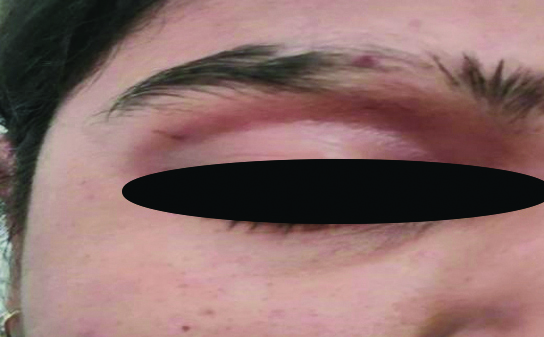
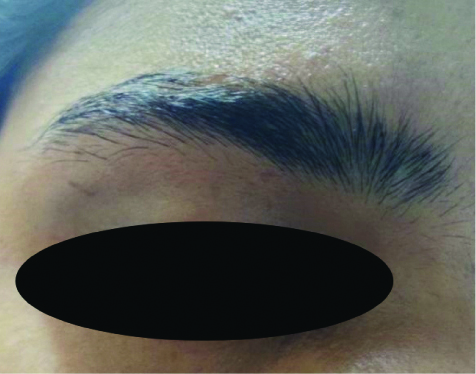
[Table/Fig-1] describes the details of the Ashta Vidha Pariksha, a diagnostic approach used in Ayurveda. A local examination of the area of concern showed a large eyebrow gap [Table/Fig-2,3]. The patient was diagnosed with Pakshmashata (Madarosis) based on clinical features and Ayurvedic textual references. The treatment is described in [Table/Fig-4].
Ashta Vidha Pariksha- The eightfold diagnostic approach.
| S. No. | Examination | Observation |
|---|
| 1 | Nadi: (pulse rate) | 76 b/min |
| 2 | Mutra: (urination) | 5-6 times |
| 3 | Mala: (faeces) | Once daily, complete evacuation |
| 4 | Shabda: (sound) | Spashta (clear) |
| 5 | Jiwha: (tounge) | Alipta (not coated) |
| 6 | Akriti: (body type) | Sthoola (healthy) |
| 7 | Druk (skin) | Avishesha (normal) |
| 8 | Sparsha: (touch) | Anushna Sheeta (afebrile) |
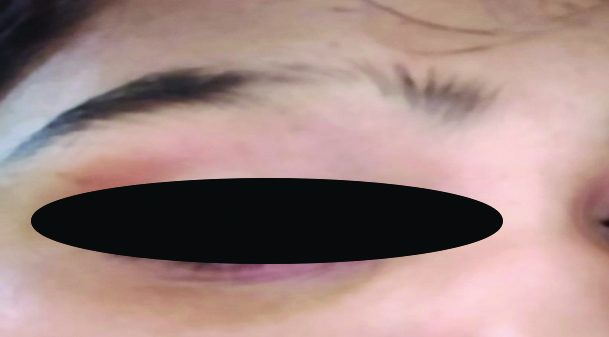
Condition at the initiation of treatment.
Treatment plan of the patient.
| S. No. | Medicine | Dose and time of administration | Anupana | Duration |
|---|
| 1 | Eranda taila- Sthanika snehana (local oil massage with Ricinus communis) | Thrice in a day (morning, afternoon and night) | - | 30 days |
| 2 | Manjistha churna lepa- Garshan and Rakt Prasadan karma (Rubia cordifolia, Curcuma longa paste for improvement in blood flow) | Twice in a day (morning and evening) | With alovera pulp | 30 days |
| 3 | Asthi majja pachak kwath (decocotion to enhance the quality of bone and bone marrow tissues) (amalki (Emblica officinalis), musta (Cyprus rotundus) and guduchi (Tinospora cordifolia) | 30 mL twice daily empty stomach | With ghrita (Cow ghee) | 30 days |
| 4 | Jaloka avcharan (leech therapy) | In morning | Nil | Twice in a month |
Method of preparation of the medicines: Guduchi (Tinospora cordifolia), Amalki (Emblica officinalis), and Musta (Cyperus rotundus) powder were taken in quantities of 2 grams each. This powder was added to 120 mL of water. The mixture was boiled and reduced to 30 mL.
First, the diseased area was meticulously cleaned and dried. Leech therapy involves using leeches (Hirudo medicinalis) to extract impure blood from the patient [Table/Fig-5], specifically from the affected area. The oral aperture of the leech was positioned close to the impacted area. Attachment generally occurs quickly; however, if the leech is reluctant, a small needle prick on the skin can produce a tiny droplet of blood, which should encourage attachment. After sucking the impure blood, the leech will automatically detach, or one can apply some turmeric to remove the leech [1].
Jaloka avcharan (leech therapy).
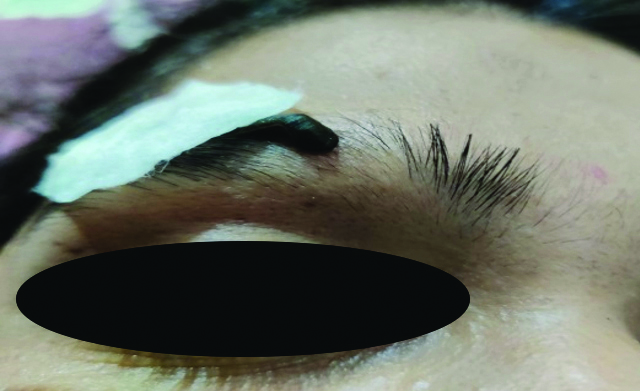
The outcome of this treatment is described in [Table/Fig-6] using the Brigham Eyebrow Tool for Alopecia (BETA) [2]. A follow-up was conducted on the 45th and 60th days [Table/Fig-7,8]. During this period, the patient did not experience any further symptoms. After the 30th day, the patient reported a gradual increase in hair growth. Notably, the patient experienced significant relief following the treatment.
Brigham Eyebrow Tool for Alopecia (BETA).
| Time of observation | Surface area | Density | Calculation | Eyebrow score |
|---|
| Before treatment | 2 | 0.5 | 2*0.5 | 1 |
| During treatment | 2 | 1 | 2*1 | 2 |
| After treatment (45th day) | 3 | 1.5 | 3*1.5 | 4.5 |
After treatment (45th day).
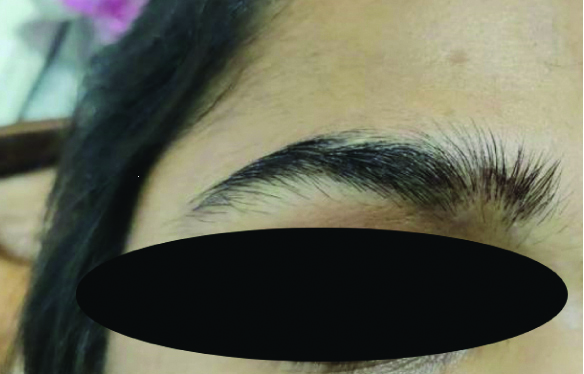
After treatment (60th day).
Discussion
Madarosis is a condition characterised by the loss of hair from the eyebrows due to interrupted blood supply in that area. It is also referred to as alopecia areata [3]. In contemporary medicine, the management of madarosis typically involves the use of steroids and hair transplant surgery [4,5]. While there is no direct correlation to madarosis in Ayurveda, concepts such as pakshmashata and khalitya (alopecia) display symptoms that closely resemble this condition.
The primary cause of madarosis is an increase in pitta dosha and dushti the impurity of rakta (blood). The treatment recommended by Acharya Vagbhata for pakshmakshata (madarosis) is considered beneficial. Rakta mokshan (leech therapy) can help eliminate dushit rakta (impure blood) from the affected area. Snehan (oil massage) and lepa (paste) can reduce vata (vitiated air), which may help prevent further hair loss.
Additionally, asthi majja pachak kwath (a decoction for bone and bone marrow tissues) can enhance asthi dhatu (bone), which will directly promote the growth of its mala (by-product) kesha the hair. Given the involvement of interrupted blood supply, the condition of rakta (blood) must be taken into account.
The treatment improved the clinical condition of the patient. The surface area, density, and total score of the eyebrows have shown improvement following the treatment [6]. The BETA score increased from 1 (poor) to 4.5 (good) [2]. With Ayurvedic treatments, the condition was effectively managed without causing any complications.
According to Acharya Vagbhatta, the treatments he mentioned include jaloka avcharan (leech therapy), nasya (nasal drops), shodhan (purification), and vikuttan prakriya (bloodletting). These treatments will help reduce pitta and increase blood flow [7].
Since your eyebrows draw attention to your face, everyone wants to have a confident, intelligent, and appealing appearance. To achieve this, eyebrow grooming serves as the foundation [8].
Jalauka avcharan (leech therapy) - Acharya Sushruta has indicated in his work that Jalauka avcharan (Leech therapy) is keshya (promotes hair growth). According to him, leech therapy helps lessen or subside localised pathology, thereby directly aiding in the growth of new hair [9].
Abhyangam (oil massage) is an effective method for nourishing your hair, including your eyebrows. To restore moisture in your hair, apply a thin layer of oil to your eyebrows every night. This practice will promote intense nourishment and regrowth of the hair roots. You can use oils such as castor oil, almond oil, amla oil, or olive oil for the massage. Since dandruff can also contribute to eyebrow hair loss, this procedure should be complemented with a siro abhyangam (head massage) to prevent a dry scalp and dandruff [10].
Sthanik lepa (paste) - Many medications, such as rakta shodhak (blood purifiers) (including neem, tulsi, mulethi, manjishtha, etc.), balya (which increases strength), jeevniya (which boosts immunity), and keshya (which promotes hair growth), can be used to address these issues.
Asthi majja pachak kwath (decoction for bone and bone marrow tissues) [11]- This kwath (decoction) functions effectively; the mala (by-products) associated with that dhatu (tissue) will also be beneficial, as kesha (hair) and nakha (nails) are the mala (by-products) of asthi dhatu (bone tissue). According to Ayurveda, hair is a by-product of the creation of bone tissue. Given that calcium and iron are essential for strong bones, they are also necessary for healthy hair. Additionally, foods and drinks that support liver function and cleanse the blood can aid in the treatment of disorders affecting the scalp and hair.
Conclusion(s)
The treatment of madarosis is quite challenging. Human eyebrows, especially those of women, hold particular significance as they reflect personality traits. This case report describes a patient with madarosis who was effectively treated. Additionally, various principles for the treatment of madarosis can be explored. It is advisable to conduct studies with larger patient samples to draw more concrete conclusions.
[1]. Engineer P, Makwana D, Dabhi A, Chudasama H, Comprehensive review of Jalaukavacharan-Leech therapy in purview of ayurvedaIJTSRD 2023 7(3):623-30. [Google Scholar]
[2]. Tkachenko E, Huang KP, Ko JM, Liu KJ, Scott DA, Senna MM, Brigham eyebrow tool for alopecia: A reliable assessment of eyebrow alopecia areataJ Investig Dermatol Symp Proc 2020 20(1):S41-S44. [Google Scholar]
[3]. Nguyen B, Hu JK, Tosti A, Eyebrow and eyelash alopecia: A clinical reviewAm J Clin Dermatol 2023 24(1):55-67. [Google Scholar]
[4]. Jabbour S, Nasr M, Kechichian E, Aderian SS, Nseir I, Levan P, “The evolution of eyebrow morphology: The westmore model revisited”Int J Dermatol 2018 57(8):928-32. [Google Scholar]
[5]. Liu LY, King BA, Response to tofacitinib therapy of eyebrows and eyelashes in alopecia areataJ Am Acad Dermatol 2019 80(6):1778-79. [Google Scholar]
[6]. Paus R, Cotsarelis G, The biology of hair folliclesN Engl J Med 1999 341(7):491-97. [Google Scholar]
[7]. Vagbhatta KR Shrikanthamurthy, Astanga hridayam, Uttarasthana chapter 9VaranasiChaukhamba Orientalia [Google Scholar]
[8]. Vagbhatta KR Shrikanthamurthy, Astanga hridayam, Uttarasthana chapter 8/8VaranasiChaukhamba Orientalia [Google Scholar]
[9]. Singhal GD, Sushruta Samhita, Second edition 2014 BangaloreChaukhamba Sanskrit Pratishthan, Part.1 Nidana Sthana. Ch.13/32-33:316 [Google Scholar]
[10]. Vagbhatta KR, Shrikanthamurthy, Astanga hridayam, Uttarasthana chapter 9/18VaranasiChaukhamba Orientalia [Google Scholar]
[11]. Agnivesh edited by Ravidatta Tripathi, Vidyadhar Shukla, Charak Samhita, Part 2 2013 DelhiChoukhambaSanskrit PublicationCh. No.3 [Google Scholar]